Event submissions
Published
This submission belongs to the session S2. AI Forecasting & Large Language Models of the event The 1st International Online Conference on Forecasting
Published date
16 Sep, 2026
Academic Editor
'%3e%3cpath%20d='M12.6657%2010.9104C12.4185%2010.325%2012.0599%209.79327%2011.6097%209.34482C11.1609%208.89508%2010.6293%208.5365%2010.0442%208.28888C10.0389%208.28626%2010.0337%208.28495%2010.0285%208.28233C10.8446%207.69279%2011.3752%206.73249%2011.3752%205.64904C11.3752%203.8542%209.92103%202.39999%208.1262%202.39999C6.33136%202.39999%204.87715%203.8542%204.87715%205.64904C4.87715%206.73249%205.40774%207.69279%206.22393%208.28364C6.21869%208.28626%206.21345%208.28757%206.20821%208.29019C5.62129%208.5378%205.09463%208.89284%204.64265%209.34613C4.1929%209.79493%203.83432%2010.3266%203.58671%2010.9117C3.34345%2011.4845%203.21226%2012.0987%203.20023%2012.7209C3.19988%2012.7349%203.20233%2012.7488%203.20744%2012.7619C3.21255%2012.7749%203.22022%2012.7867%203.22998%2012.7968C3.23975%2012.8068%203.25142%2012.8147%203.26431%2012.8202C3.2772%2012.8256%203.29105%2012.8284%203.30504%2012.8284H4.09109C4.14874%2012.8284%204.19459%2012.7825%204.1959%2012.7262C4.2221%2011.7148%204.62823%2010.7676%205.34617%2010.0497C6.08899%209.30683%207.0755%208.89808%208.1262%208.89808C9.17689%208.89808%2010.1634%209.30683%2010.9062%2010.0497C11.6242%2010.7676%2012.0303%2011.7148%2012.0565%2012.7262C12.0578%2012.7838%2012.1037%2012.8284%2012.1613%2012.8284H12.9474C12.9613%2012.8284%2012.9752%2012.8256%2012.9881%2012.8202C13.001%2012.8147%2013.0126%2012.8068%2013.0224%2012.7968C13.0322%2012.7867%2013.0398%2012.7749%2013.0449%2012.7619C13.0501%2012.7488%2013.0525%2012.7349%2013.0522%2012.7209C13.0391%2012.0947%2012.9094%2011.4855%2012.6657%2010.9104ZM8.1262%207.9024C7.52486%207.9024%206.9589%207.6679%206.53312%207.24211C6.10733%206.81633%205.87283%206.25037%205.87283%205.64904C5.87283%205.0477%206.10733%204.48174%206.53312%204.05596C6.9589%203.63018%207.52486%203.39567%208.1262%203.39567C8.72753%203.39567%209.29349%203.63018%209.71927%204.05596C10.1451%204.48174%2010.3796%205.0477%2010.3796%205.64904C10.3796%206.25037%2010.1451%206.81633%209.71927%207.24211C9.29349%207.6679%208.72753%207.9024%208.1262%207.9024Z'%20fill='%235D1EE1'/%3e%3c/g%3e%3c/svg%3e) Alessandro Niccolai
Alessandro NiccolaiCitation
Fahim Sufi, From Visibility to Anticipation: AI-Based Prioritisation of High-Severity Crime and Security Signals in Global News Streams, in Proceedings of The 1st International Online Conference on Forecasting, 21 September–22 September 2026, MDPI: Basel, Switzerland
Share
Email
Facebook
Twitter
LinkedIn
From Visibility to Anticipation: AI-Based Prioritisation of High-Severity Crime and Security Signals in Global News Streams

Fahim Sufi 1
1. Centre for Trade and Investment (CTI), University of Dhaka, Dhaka 1000, Bangladesh
Abstract
Introduction:
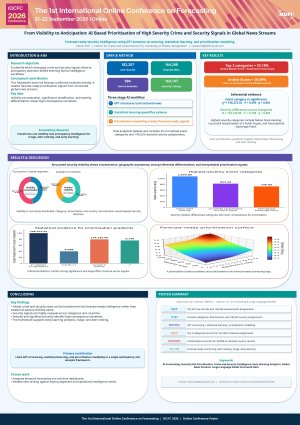
Forecasting societal security risk requires methods that can identify emerging information signals before they enter formal intelligence workflows. This study introduces an AI-based security signal prioritisation framework that transforms global crime and security news streams into structured evidence for forecasting-oriented risk assessment. Rather than forecasting incident occurrence directly, the approach quantifies visibility concentration, significance stratification, and severity differentiation to identify high-consequence security narratives.
Methods:
An original corpus of 182,207 crime- and security-related news records was collected from global media providers using web scraping, RSS feeds, and application programming interfaces. After preprocessing, the final dataset comprised 164,268 unique URL event assignments, 25 normalised event categories, 994 source domains, 140,533 resolved country assignments, and 164,147 valid severity-rating observations. The AI workflow used three stages: GPT-based semantic structuring of unstructured news records, statistical learning to identify concentration and severity patterns, and prioritisation modelling to generate forecast-ready security signals for alert ranking and early warning analytics.
Results:
The findings reveal a highly unequal security signal environment. Civilian Murder Event and Government Data Dump of Citizens and Employees account for 53.18% of cleaned assignments, while the United States represents 39.09% of resolved country labelled records. Event category and significance class are strongly associated, χ² = 156,273.32, V = 0.399, p < 0.001, and severity ratings vary substantially across categories, H = 124,135.95, ε² = 0.758, p < 0.001. High-severity categories include Nation State Hacking, Successful Assassination of a Public Figure, and International Espionage Event.
Conclusions:
This study advances AI forecasting by showing how large-language-model-structured news data can generate anticipatory risk-prioritisation signals for crime and security intelligence. The framework supports forecast-ready monitoring, triage, alert ranking, and AI-assisted situational awareness.
Keywords
AI Forecasting
Security Risk Prioritisation
Crime and Security Intelligence
Early Warning Analytics
Global News Streams
Large Language Model Structured Data
Poster
IOCFC2026_Crime_Security_Prioritisation_Poster.pdf
A Fourier-Guided Machine Learning Framework for District-Level Dew Point Comfort Forecasting Across 64 districts of Bangladesh (2025–2027)
From Forecast Accuracy to System Value: Joint Probabilistic Energy Forecasting with Decision‑Centric Evaluation