Event submissions
Published
This submission belongs to the session S1. Energy Forecasting and Analytics of the event The 1st International Online Conference on Forecasting
Published date
16 Sep, 2026
Academic Editor
'%3e%3cpath%20d='M12.6657%2010.9104C12.4185%2010.325%2012.0599%209.79327%2011.6097%209.34482C11.1609%208.89508%2010.6293%208.5365%2010.0442%208.28888C10.0389%208.28626%2010.0337%208.28495%2010.0285%208.28233C10.8446%207.69279%2011.3752%206.73249%2011.3752%205.64904C11.3752%203.8542%209.92103%202.39999%208.1262%202.39999C6.33136%202.39999%204.87715%203.8542%204.87715%205.64904C4.87715%206.73249%205.40774%207.69279%206.22393%208.28364C6.21869%208.28626%206.21345%208.28757%206.20821%208.29019C5.62129%208.5378%205.09463%208.89284%204.64265%209.34613C4.1929%209.79493%203.83432%2010.3266%203.58671%2010.9117C3.34345%2011.4845%203.21226%2012.0987%203.20023%2012.7209C3.19988%2012.7349%203.20233%2012.7488%203.20744%2012.7619C3.21255%2012.7749%203.22022%2012.7867%203.22998%2012.7968C3.23975%2012.8068%203.25142%2012.8147%203.26431%2012.8202C3.2772%2012.8256%203.29105%2012.8284%203.30504%2012.8284H4.09109C4.14874%2012.8284%204.19459%2012.7825%204.1959%2012.7262C4.2221%2011.7148%204.62823%2010.7676%205.34617%2010.0497C6.08899%209.30683%207.0755%208.89808%208.1262%208.89808C9.17689%208.89808%2010.1634%209.30683%2010.9062%2010.0497C11.6242%2010.7676%2012.0303%2011.7148%2012.0565%2012.7262C12.0578%2012.7838%2012.1037%2012.8284%2012.1613%2012.8284H12.9474C12.9613%2012.8284%2012.9752%2012.8256%2012.9881%2012.8202C13.001%2012.8147%2013.0126%2012.8068%2013.0224%2012.7968C13.0322%2012.7867%2013.0398%2012.7749%2013.0449%2012.7619C13.0501%2012.7488%2013.0525%2012.7349%2013.0522%2012.7209C13.0391%2012.0947%2012.9094%2011.4855%2012.6657%2010.9104ZM8.1262%207.9024C7.52486%207.9024%206.9589%207.6679%206.53312%207.24211C6.10733%206.81633%205.87283%206.25037%205.87283%205.64904C5.87283%205.0477%206.10733%204.48174%206.53312%204.05596C6.9589%203.63018%207.52486%203.39567%208.1262%203.39567C8.72753%203.39567%209.29349%203.63018%209.71927%204.05596C10.1451%204.48174%2010.3796%205.0477%2010.3796%205.64904C10.3796%206.25037%2010.1451%206.81633%209.71927%207.24211C9.29349%207.6679%208.72753%207.9024%208.1262%207.9024Z'%20fill='%235D1EE1'/%3e%3c/g%3e%3c/svg%3e) Michele Quercio
Michele QuercioCitation
Son Nguyen, From Forecast Accuracy to System Value: Joint Probabilistic Energy Forecasting with Decision‑Centric Evaluation, in Proceedings of The 1st International Online Conference on Forecasting, 21 September–22 September 2026, MDPI: Basel, Switzerland
Share
Email
Facebook
Twitter
LinkedIn
From Forecast Accuracy to System Value: Joint Probabilistic Energy Forecasting with Decision‑Centric Evaluation
'%3e%3cpath%20d='M12.6647%2010.9104C12.4176%2010.325%2012.0589%209.7933%2011.6088%209.34485C11.16%208.89511%2010.6283%208.53653%2010.0432%208.28891C10.038%208.28629%2010.0327%208.28498%2010.0275%208.28236C10.8437%207.69282%2011.3743%206.73252%2011.3743%205.64907C11.3743%203.85423%209.92005%202.40002%208.12522%202.40002C6.33038%202.40002%204.87618%203.85423%204.87618%205.64907C4.87618%206.73252%205.40677%207.69282%206.22296%208.28367C6.21772%208.28629%206.21248%208.2876%206.20724%208.29022C5.62031%208.53783%205.09365%208.89287%204.64167%209.34616C4.19192%209.79496%203.83334%2010.3266%203.58573%2010.9117C3.34247%2011.4846%203.21128%2012.0987%203.19925%2012.721C3.1989%2012.735%203.20135%2012.7489%203.20646%2012.7619C3.21157%2012.7749%203.21924%2012.7868%203.22901%2012.7968C3.23877%2012.8068%203.25045%2012.8148%203.26334%2012.8202C3.27623%2012.8256%203.29007%2012.8284%203.30406%2012.8284H4.09012C4.14776%2012.8284%204.19362%2012.7825%204.19493%2012.7262C4.22113%2011.7148%204.62726%2010.7676%205.34519%2010.0497C6.08802%209.30686%207.07452%208.89811%208.12522%208.89811C9.17592%208.89811%2010.1624%209.30686%2010.9052%2010.0497C11.6232%2010.7676%2012.0293%2011.7148%2012.0555%2012.7262C12.0568%2012.7839%2012.1027%2012.8284%2012.1603%2012.8284H12.9464C12.9604%2012.8284%2012.9742%2012.8256%2012.9871%2012.8202C13%2012.8148%2013.0117%2012.8068%2013.0214%2012.7968C13.0312%2012.7868%2013.0389%2012.7749%2013.044%2012.7619C13.0491%2012.7489%2013.0515%2012.735%2013.0512%2012.721C13.0381%2012.0947%2012.9084%2011.4856%2012.6647%2010.9104ZM8.12522%207.90243C7.52388%207.90243%206.95792%207.66793%206.53214%207.24215C6.10636%206.81636%205.87185%206.2504%205.87185%205.64907C5.87185%205.04773%206.10636%204.48177%206.53214%204.05599C6.95792%203.63021%207.52388%203.3957%208.12522%203.3957C8.72655%203.3957%209.29252%203.63021%209.7183%204.05599C10.1441%204.48177%2010.3786%205.04773%2010.3786%205.64907C10.3786%206.2504%2010.1441%206.81636%209.7183%207.24215C9.29252%207.66793%208.72655%207.90243%208.12522%207.90243Z'%20fill='%235D1EE1'/%3e%3c/g%3e%3c/svg%3e)
Son Nguyen 1
1. Executive Board, Sustainable Development Governance and Law Association – Vietnam National Branch, Ho Chi Minh City 700000, Vietnam
Abstract
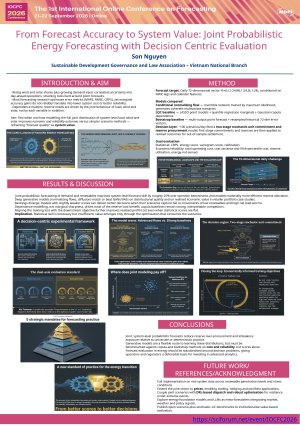
System operators and market participants increasingly recognize that incremental gains in forecast accuracy do not automatically translate into lower system costs or higher trading profits. This paper argues that the next frontier in energy forecasting lies in system‑level joint probabilistic models explicitly evaluated through their economic value in concrete decision problems. Building on recent advances in copula‑based dependence modeling, deep generative models, and multivariate sequence architectures, we focus on the joint day‑ahead forecasting of system‑level load, wind, and solar generation, and its impact on unit commitment and reserve procurement decisions. The central research question is: when and how does modeling the full joint distribution of key system variables materially improve operational or market outcomes relative to simpler baselines?
Methodologically, we propose a conditional normalizing‑flow model that generates coherent multivariate scenarios for 24‑hour trajectories of system load, wind, and solar, conditional on weather and calendar information, and benchmark it against (i) a LASSO–quantile‑regression plus Gaussian‑copula approach and (ii) point‑forecast plus bootstrap error‑vector scenarios. These scenarios feed a two‑stage stochastic unit commitment and reserve‑procurement problem, enabling a direct comparison of models. Rather than reporting hypothetical error metrics, the paper details a complete experimental design and theory of change: from data, through joint probabilistic models, to optimization and realized costs.
We anticipate three main contributions. First, we synthesize the emerging literature on decision‑centric, joint probabilistic forecasting into a coherent framework for system‑level applications. Second, we provide a replicable experimental design that makes economic evaluation a first‑class citizen in forecasting research. Third, we formulate strategic recommendations for researchers, system operators, and regulators on when to invest in sophisticated joint models, how to benchmark them, and how to align training objectives with operational priorities. In doing so, the paper seeks to shift the evaluation norm in energy forecasting from “better scores” to “better decisions.”
Keywords
joint probabilistic forecasting
energy systems
normalizing flows
stochastic unit commitment
economic value of forecasts
decision centric evaluation
Poster
From Forecast Accuracy to System Value - Joint Probabilistic Energy Forecasting with Decision‑Centric Evaluation.pdf
From Visibility to Anticipation: AI-Based Prioritisation of High-Severity Crime and Security Signals in Global News Streams
Energy, Economic, and Environmental Forecasting for Sustainable Rail Transport: Green Hydrogen Deployment on the Silk Road Corridor