Event submissions
Published
This submission belongs to the session S1. Catalytic Materials of the event The 4th International Electronic Conference on Catalysis Sciences
Published date
16 Sep, 2026
Academic Editor
'%3e%3cpath%20d='M12.6657%2010.9104C12.4185%2010.325%2012.0599%209.79327%2011.6097%209.34482C11.1609%208.89508%2010.6293%208.5365%2010.0442%208.28888C10.0389%208.28626%2010.0337%208.28495%2010.0285%208.28233C10.8446%207.69279%2011.3752%206.73249%2011.3752%205.64904C11.3752%203.8542%209.92103%202.39999%208.1262%202.39999C6.33136%202.39999%204.87715%203.8542%204.87715%205.64904C4.87715%206.73249%205.40774%207.69279%206.22393%208.28364C6.21869%208.28626%206.21345%208.28757%206.20821%208.29019C5.62129%208.5378%205.09463%208.89284%204.64265%209.34613C4.1929%209.79493%203.83432%2010.3266%203.58671%2010.9117C3.34345%2011.4845%203.21226%2012.0987%203.20023%2012.7209C3.19988%2012.7349%203.20233%2012.7488%203.20744%2012.7619C3.21255%2012.7749%203.22022%2012.7867%203.22998%2012.7968C3.23975%2012.8068%203.25142%2012.8147%203.26431%2012.8202C3.2772%2012.8256%203.29105%2012.8284%203.30504%2012.8284H4.09109C4.14874%2012.8284%204.19459%2012.7825%204.1959%2012.7262C4.2221%2011.7148%204.62823%2010.7676%205.34617%2010.0497C6.08899%209.30683%207.0755%208.89808%208.1262%208.89808C9.17689%208.89808%2010.1634%209.30683%2010.9062%2010.0497C11.6242%2010.7676%2012.0303%2011.7148%2012.0565%2012.7262C12.0578%2012.7838%2012.1037%2012.8284%2012.1613%2012.8284H12.9474C12.9613%2012.8284%2012.9752%2012.8256%2012.9881%2012.8202C13.001%2012.8147%2013.0126%2012.8068%2013.0224%2012.7968C13.0322%2012.7867%2013.0398%2012.7749%2013.0449%2012.7619C13.0501%2012.7488%2013.0525%2012.7349%2013.0522%2012.7209C13.0391%2012.0947%2012.9094%2011.4855%2012.6657%2010.9104ZM8.1262%207.9024C7.52486%207.9024%206.9589%207.6679%206.53312%207.24211C6.10733%206.81633%205.87283%206.25037%205.87283%205.64904C5.87283%205.0477%206.10733%204.48174%206.53312%204.05596C6.9589%203.63018%207.52486%203.39567%208.1262%203.39567C8.72753%203.39567%209.29349%203.63018%209.71927%204.05596C10.1451%204.48174%2010.3796%205.0477%2010.3796%205.64904C10.3796%206.25037%2010.1451%206.81633%209.71927%207.24211C9.29349%207.6679%208.72753%207.9024%208.1262%207.9024Z'%20fill='%235D1EE1'/%3e%3c/g%3e%3c/svg%3e) Narendra Kumar
Narendra KumarCitation
Izabela Marinela Vînătoru, Rodica Zăvoianu, Vasile I. Parvulescu, Bogdan E. Cojocaru, Octavian-D. Pavel, Impact of Synthesis Pathways / Hydrolysis Agents on the Physico-Chemical Properties of Zn₃Al-Layered Double Hydroxides used for chalcone synthesis, in Proceedings of The 4th International Electronic Conference on Catalysis Sciences, 22 September–24 September 2026, MDPI: Basel, Switzerland
Share
Email
Facebook
Twitter
LinkedIn
Impact of Synthesis Pathways / Hydrolysis Agents on the Physico-Chemical Properties of Zn₃Al-Layered Double Hydroxides used for chalcone synthesis
'%3e%3cpath%20d='M12.6647%2010.9104C12.4176%2010.325%2012.0589%209.7933%2011.6088%209.34485C11.16%208.89511%2010.6283%208.53653%2010.0432%208.28891C10.038%208.28629%2010.0327%208.28498%2010.0275%208.28236C10.8437%207.69282%2011.3743%206.73252%2011.3743%205.64907C11.3743%203.85423%209.92005%202.40002%208.12522%202.40002C6.33038%202.40002%204.87618%203.85423%204.87618%205.64907C4.87618%206.73252%205.40677%207.69282%206.22296%208.28367C6.21772%208.28629%206.21248%208.2876%206.20724%208.29022C5.62031%208.53783%205.09365%208.89287%204.64167%209.34616C4.19192%209.79496%203.83334%2010.3266%203.58573%2010.9117C3.34247%2011.4846%203.21128%2012.0987%203.19925%2012.721C3.1989%2012.735%203.20135%2012.7489%203.20646%2012.7619C3.21157%2012.7749%203.21924%2012.7868%203.22901%2012.7968C3.23877%2012.8068%203.25045%2012.8148%203.26334%2012.8202C3.27623%2012.8256%203.29007%2012.8284%203.30406%2012.8284H4.09012C4.14776%2012.8284%204.19362%2012.7825%204.19493%2012.7262C4.22113%2011.7148%204.62726%2010.7676%205.34519%2010.0497C6.08802%209.30686%207.07452%208.89811%208.12522%208.89811C9.17592%208.89811%2010.1624%209.30686%2010.9052%2010.0497C11.6232%2010.7676%2012.0293%2011.7148%2012.0555%2012.7262C12.0568%2012.7839%2012.1027%2012.8284%2012.1603%2012.8284H12.9464C12.9604%2012.8284%2012.9742%2012.8256%2012.9871%2012.8202C13%2012.8148%2013.0117%2012.8068%2013.0214%2012.7968C13.0312%2012.7868%2013.0389%2012.7749%2013.044%2012.7619C13.0491%2012.7489%2013.0515%2012.735%2013.0512%2012.721C13.0381%2012.0947%2012.9084%2011.4856%2012.6647%2010.9104ZM8.12522%207.90243C7.52388%207.90243%206.95792%207.66793%206.53214%207.24215C6.10636%206.81636%205.87185%206.2504%205.87185%205.64907C5.87185%205.04773%206.10636%204.48177%206.53214%204.05599C6.95792%203.63021%207.52388%203.3957%208.12522%203.3957C8.72655%203.3957%209.29252%203.63021%209.7183%204.05599C10.1441%204.48177%2010.3786%205.04773%2010.3786%205.64907C10.3786%206.2504%2010.1441%206.81636%209.7183%207.24215C9.29252%207.66793%208.72655%207.90243%208.12522%207.90243Z'%20fill='%235D1EE1'/%3e%3c/g%3e%3c/svg%3e)
Izabela Marinela Vînătoru 1

Rodica Zăvoianu 1

Vasile I. Parvulescu 1

Bogdan E. Cojocaru 1

Octavian-D. Pavel 2
1. Department of Inorganic & Organic Chemistry, Biochemistry and Catalysis, Faculty of Chemistry, University of Bucharest, 4-12 Regina Elisabeta Av., S3, 030018, Bucharest, Romania
2. Faculty of Chemistry, University of Bucharest, Bucharest, Romania
Abstract
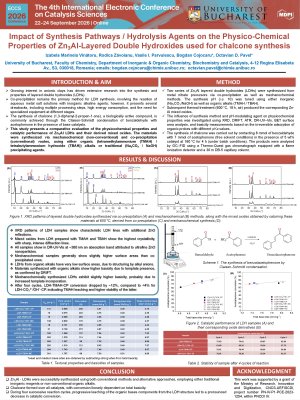
Synthesis of chalcone (1,3-diphenyl-2-propen-1-one), a biologically active compound, is typically achieved via Claisen-Schmidt condensation between benzaldehyde and acetophenone over base catalysts. While various catalytic systems have been explored, the performance of Zn₃Al-LDH materials synthesized with organic alkalis by mechano-chemical method remains an unexplored frontier in this reaction.
Two series of Zn₃Al-LDH materials were synthesized from metal nitrate precursors by co-precipitation and mechano-chemical methods. The synthesis pH was modulated using either inorganic or organic alkalis. Thermal treatment of the synthesized LDHs (600 °C, 18 h, air) yielded the corresponding Zn-Al mixed oxides. To evaluate the physicochemical effects of both pivotal parameters, we utilized various characterization techniques, including XRD, DRIFT, ATR, DR-UV-Vis, BET, and basicity measurements based on the irreversible adsorption of organic molecules with different pKa.
The formation of a ZnO phase within the layered LDH structure of the dry solid, driven by the tendency of Zn to crosslink during synthesis, was notably more pronounced for mechanochemically synthesized samples than for co-precipitated ones. The use of organic alkalis as hydrolysis agent yielded significantly lower surface areas of 20–30 m2∙g–1 and narrowed the pore sizes distribution to 50 nm, while inorganic alkalis lead to a broad pore size distribution. The basicity variation of the dried samples is similar to that of the mixed oxides, although the mixed oxides exhibit significantly higher values. In both cases, basicity depends on the base strength of the synthesis agent. Notably, the mechano-chemical method appears to yield higher basicity compared to co-precipitation. The catalysts prepared with organic alkalis significantly improved the yields towards chalcone, increasing it to over 80% compared to 65% when using catalysts prepared with inorganic alkalis.
Keywords
Layered Double Hydroxides
ZnAl
Fine chemicals
Poster
Poster Vînătoru.pdf
Catalytic Removal of Nitric Oxide and Hydrogenation to Ammonia