Event submissions
Published
This submission belongs to the session S1. Catalytic Materials of the event The 4th International Electronic Conference on Catalysis Sciences
Published date
16 Sep, 2026
Academic Editor
'%3e%3cpath%20d='M12.6657%2010.9104C12.4185%2010.325%2012.0599%209.79327%2011.6097%209.34482C11.1609%208.89508%2010.6293%208.5365%2010.0442%208.28888C10.0389%208.28626%2010.0337%208.28495%2010.0285%208.28233C10.8446%207.69279%2011.3752%206.73249%2011.3752%205.64904C11.3752%203.8542%209.92103%202.39999%208.1262%202.39999C6.33136%202.39999%204.87715%203.8542%204.87715%205.64904C4.87715%206.73249%205.40774%207.69279%206.22393%208.28364C6.21869%208.28626%206.21345%208.28757%206.20821%208.29019C5.62129%208.5378%205.09463%208.89284%204.64265%209.34613C4.1929%209.79493%203.83432%2010.3266%203.58671%2010.9117C3.34345%2011.4845%203.21226%2012.0987%203.20023%2012.7209C3.19988%2012.7349%203.20233%2012.7488%203.20744%2012.7619C3.21255%2012.7749%203.22022%2012.7867%203.22998%2012.7968C3.23975%2012.8068%203.25142%2012.8147%203.26431%2012.8202C3.2772%2012.8256%203.29105%2012.8284%203.30504%2012.8284H4.09109C4.14874%2012.8284%204.19459%2012.7825%204.1959%2012.7262C4.2221%2011.7148%204.62823%2010.7676%205.34617%2010.0497C6.08899%209.30683%207.0755%208.89808%208.1262%208.89808C9.17689%208.89808%2010.1634%209.30683%2010.9062%2010.0497C11.6242%2010.7676%2012.0303%2011.7148%2012.0565%2012.7262C12.0578%2012.7838%2012.1037%2012.8284%2012.1613%2012.8284H12.9474C12.9613%2012.8284%2012.9752%2012.8256%2012.9881%2012.8202C13.001%2012.8147%2013.0126%2012.8068%2013.0224%2012.7968C13.0322%2012.7867%2013.0398%2012.7749%2013.0449%2012.7619C13.0501%2012.7488%2013.0525%2012.7349%2013.0522%2012.7209C13.0391%2012.0947%2012.9094%2011.4855%2012.6657%2010.9104ZM8.1262%207.9024C7.52486%207.9024%206.9589%207.6679%206.53312%207.24211C6.10733%206.81633%205.87283%206.25037%205.87283%205.64904C5.87283%205.0477%206.10733%204.48174%206.53312%204.05596C6.9589%203.63018%207.52486%203.39567%208.1262%203.39567C8.72753%203.39567%209.29349%203.63018%209.71927%204.05596C10.1451%204.48174%2010.3796%205.0477%2010.3796%205.64904C10.3796%206.25037%2010.1451%206.81633%209.71927%207.24211C9.29349%207.6679%208.72753%207.9024%208.1262%207.9024Z'%20fill='%235D1EE1'/%3e%3c/g%3e%3c/svg%3e) Narendra Kumar
Narendra KumarCitation
Isabel Lado-Touriño, Arisbel Cerpa-Naranjo, Miriam Roldán-Matilla, Oxygen Activation Mechanisms on AuₓCuᵧ Surfaces: A DFT Perspective, in Proceedings of The 4th International Electronic Conference on Catalysis Sciences, 22 September–24 September 2026, MDPI: Basel, Switzerland
Share
Email
Facebook
Twitter
LinkedIn
Oxygen Activation Mechanisms on AuₓCuᵧ Surfaces: A DFT Perspective

Isabel Lado-Touriño 1

Arisbel Cerpa-Naranjo 1
'%3e%3cpath%20d='M12.6647%2010.9104C12.4176%2010.325%2012.0589%209.7933%2011.6088%209.34485C11.16%208.89511%2010.6283%208.53653%2010.0432%208.28891C10.038%208.28629%2010.0327%208.28498%2010.0275%208.28236C10.8437%207.69282%2011.3743%206.73252%2011.3743%205.64907C11.3743%203.85423%209.92005%202.40002%208.12522%202.40002C6.33038%202.40002%204.87618%203.85423%204.87618%205.64907C4.87618%206.73252%205.40677%207.69282%206.22296%208.28367C6.21772%208.28629%206.21248%208.2876%206.20724%208.29022C5.62031%208.53783%205.09365%208.89287%204.64167%209.34616C4.19192%209.79496%203.83334%2010.3266%203.58573%2010.9117C3.34247%2011.4846%203.21128%2012.0987%203.19925%2012.721C3.1989%2012.735%203.20135%2012.7489%203.20646%2012.7619C3.21157%2012.7749%203.21924%2012.7868%203.22901%2012.7968C3.23877%2012.8068%203.25045%2012.8148%203.26334%2012.8202C3.27623%2012.8256%203.29007%2012.8284%203.30406%2012.8284H4.09012C4.14776%2012.8284%204.19362%2012.7825%204.19493%2012.7262C4.22113%2011.7148%204.62726%2010.7676%205.34519%2010.0497C6.08802%209.30686%207.07452%208.89811%208.12522%208.89811C9.17592%208.89811%2010.1624%209.30686%2010.9052%2010.0497C11.6232%2010.7676%2012.0293%2011.7148%2012.0555%2012.7262C12.0568%2012.7839%2012.1027%2012.8284%2012.1603%2012.8284H12.9464C12.9604%2012.8284%2012.9742%2012.8256%2012.9871%2012.8202C13%2012.8148%2013.0117%2012.8068%2013.0214%2012.7968C13.0312%2012.7868%2013.0389%2012.7749%2013.044%2012.7619C13.0491%2012.7489%2013.0515%2012.735%2013.0512%2012.721C13.0381%2012.0947%2012.9084%2011.4856%2012.6647%2010.9104ZM8.12522%207.90243C7.52388%207.90243%206.95792%207.66793%206.53214%207.24215C6.10636%206.81636%205.87185%206.2504%205.87185%205.64907C5.87185%205.04773%206.10636%204.48177%206.53214%204.05599C6.95792%203.63021%207.52388%203.3957%208.12522%203.3957C8.72655%203.3957%209.29252%203.63021%209.7183%204.05599C10.1441%204.48177%2010.3786%205.04773%2010.3786%205.64907C10.3786%206.2504%2010.1441%206.81636%209.7183%207.24215C9.29252%207.66793%208.72655%207.90243%208.12522%207.90243Z'%20fill='%235D1EE1'/%3e%3c/g%3e%3c/svg%3e)
Miriam Roldán-Matilla 2
1. Department of Engineering, School of Architecture, Engineering, Science and Computing, European University of Madrid, Villaviciosa de Odón, 28670, Madrid, Spain
2. Professional Formation Centre. European University of Madrid, Villaviciosa de Odón, 28670, Madrid, Spain
Abstract
1. Introduction
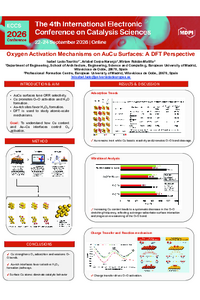
Bimetallic Au–Cu surfaces exhibit tunable catalytic properties that are highly sensitive to surface composition and atomic arrangement. Cu incorporation into Au modifies oxygen activation pathways and reactive oxygen species (ROS) generation, which are central to catalytic and antimicrobial functionalities. Atomistic understanding of these effects is essential for the rational design of Au–Cu nanomaterials. In this work, we investigate these effects at the atomic level using density functional theory (DFT) calculations to elucidate how surface composition and atomic arrangement in Au–Cu systems govern oxygen activation and ROS formation.
2. Methods
Density functional theory (DFT) calculations were performed to investigate oxygen reduction reaction (ORR) mechanisms on AuxCuy model surfaces with systematically varied Cu content. Periodic Au(111) slab models were constructed with surface and subsurface Cu incorporation to represent different AuxCuy compositions. Adsorption geometries and free energies of key ORR intermediates (O*, O*, OOH*, OH*, and H2O2*) were determined. Activation barriers for O–O and OOH bond dissociation were calculated, together with charge transfer, O–O bond lengths, vibrational frequencies, and d-band electronic structure analysis.
3. Results
The calculations reveal that Cu incorporation substantially strengthens oxygen adsorption and lowers O–O bond dissociation barriers relative to pristine Au surfaces. Au-rich AuxCuy models favor stabilization of molecular intermediates and H2O2 formation, while Cu-enriched surfaces promote deeper oxygen activation and facile O–O cleavage. Charge transfer analysis indicates enhanced metal-to-oxygen electron donation with increasing Cu content, accompanied by d-band centre shifts towards the Fermi level and progressive O–O bond weakening.
Conclusions
The DFT results demonstrate that surface composition in AuxCuy systems critically governs oxygen activation and ROS-related pathways. The atomistic insights provided here establish clear design principles for tailoring Au–Cu bimetallic surfaces with controlled reactivity through precise compositional engineering.
Keywords
Density functional theory
CuAg surfaces
reactive oxygen species
Poster
poster ILT.pdf
Obtaining low-molecular oxidized organic compounds by partial oxidation of propane on a modified zeolite catalyst
Electronic Structure Engineering of δ-MnO2 via Multi-Cation Co-Doping for Efficient Peroxymonosulfate Activation