Event submissions
Published
This submission belongs to the session S1. Catalytic Materials of the event The 4th International Electronic Conference on Catalysis Sciences
Published date
16 Sep, 2026
Academic Editor
'%3e%3cpath%20d='M12.6657%2010.9104C12.4185%2010.325%2012.0599%209.79327%2011.6097%209.34482C11.1609%208.89508%2010.6293%208.5365%2010.0442%208.28888C10.0389%208.28626%2010.0337%208.28495%2010.0285%208.28233C10.8446%207.69279%2011.3752%206.73249%2011.3752%205.64904C11.3752%203.8542%209.92103%202.39999%208.1262%202.39999C6.33136%202.39999%204.87715%203.8542%204.87715%205.64904C4.87715%206.73249%205.40774%207.69279%206.22393%208.28364C6.21869%208.28626%206.21345%208.28757%206.20821%208.29019C5.62129%208.5378%205.09463%208.89284%204.64265%209.34613C4.1929%209.79493%203.83432%2010.3266%203.58671%2010.9117C3.34345%2011.4845%203.21226%2012.0987%203.20023%2012.7209C3.19988%2012.7349%203.20233%2012.7488%203.20744%2012.7619C3.21255%2012.7749%203.22022%2012.7867%203.22998%2012.7968C3.23975%2012.8068%203.25142%2012.8147%203.26431%2012.8202C3.2772%2012.8256%203.29105%2012.8284%203.30504%2012.8284H4.09109C4.14874%2012.8284%204.19459%2012.7825%204.1959%2012.7262C4.2221%2011.7148%204.62823%2010.7676%205.34617%2010.0497C6.08899%209.30683%207.0755%208.89808%208.1262%208.89808C9.17689%208.89808%2010.1634%209.30683%2010.9062%2010.0497C11.6242%2010.7676%2012.0303%2011.7148%2012.0565%2012.7262C12.0578%2012.7838%2012.1037%2012.8284%2012.1613%2012.8284H12.9474C12.9613%2012.8284%2012.9752%2012.8256%2012.9881%2012.8202C13.001%2012.8147%2013.0126%2012.8068%2013.0224%2012.7968C13.0322%2012.7867%2013.0398%2012.7749%2013.0449%2012.7619C13.0501%2012.7488%2013.0525%2012.7349%2013.0522%2012.7209C13.0391%2012.0947%2012.9094%2011.4855%2012.6657%2010.9104ZM8.1262%207.9024C7.52486%207.9024%206.9589%207.6679%206.53312%207.24211C6.10733%206.81633%205.87283%206.25037%205.87283%205.64904C5.87283%205.0477%206.10733%204.48174%206.53312%204.05596C6.9589%203.63018%207.52486%203.39567%208.1262%203.39567C8.72753%203.39567%209.29349%203.63018%209.71927%204.05596C10.1451%204.48174%2010.3796%205.0477%2010.3796%205.64904C10.3796%206.25037%2010.1451%206.81633%209.71927%207.24211C9.29349%207.6679%208.72753%207.9024%208.1262%207.9024Z'%20fill='%235D1EE1'/%3e%3c/g%3e%3c/svg%3e) Narendra Kumar
Narendra KumarCitation
Abutu David, Peter Ujulu, Amani David Haruna, Yerima Amuntse Emmanuel, Metal Oxide Nanoparticle Catalysts for Improved Combustion of Ethanol–Gasoline Blends, in Proceedings of The 4th International Electronic Conference on Catalysis Sciences, 22 September–24 September 2026, MDPI: Basel, Switzerland
Share
Email
Facebook
Twitter
LinkedIn
Metal Oxide Nanoparticle Catalysts for Improved Combustion of Ethanol–Gasoline Blends
'%3e%3cpath%20d='M12.6647%2010.9104C12.4176%2010.325%2012.0589%209.7933%2011.6088%209.34485C11.16%208.89511%2010.6283%208.53653%2010.0432%208.28891C10.038%208.28629%2010.0327%208.28498%2010.0275%208.28236C10.8437%207.69282%2011.3743%206.73252%2011.3743%205.64907C11.3743%203.85423%209.92005%202.40002%208.12522%202.40002C6.33038%202.40002%204.87618%203.85423%204.87618%205.64907C4.87618%206.73252%205.40677%207.69282%206.22296%208.28367C6.21772%208.28629%206.21248%208.2876%206.20724%208.29022C5.62031%208.53783%205.09365%208.89287%204.64167%209.34616C4.19192%209.79496%203.83334%2010.3266%203.58573%2010.9117C3.34247%2011.4846%203.21128%2012.0987%203.19925%2012.721C3.1989%2012.735%203.20135%2012.7489%203.20646%2012.7619C3.21157%2012.7749%203.21924%2012.7868%203.22901%2012.7968C3.23877%2012.8068%203.25045%2012.8148%203.26334%2012.8202C3.27623%2012.8256%203.29007%2012.8284%203.30406%2012.8284H4.09012C4.14776%2012.8284%204.19362%2012.7825%204.19493%2012.7262C4.22113%2011.7148%204.62726%2010.7676%205.34519%2010.0497C6.08802%209.30686%207.07452%208.89811%208.12522%208.89811C9.17592%208.89811%2010.1624%209.30686%2010.9052%2010.0497C11.6232%2010.7676%2012.0293%2011.7148%2012.0555%2012.7262C12.0568%2012.7839%2012.1027%2012.8284%2012.1603%2012.8284H12.9464C12.9604%2012.8284%2012.9742%2012.8256%2012.9871%2012.8202C13%2012.8148%2013.0117%2012.8068%2013.0214%2012.7968C13.0312%2012.7868%2013.0389%2012.7749%2013.044%2012.7619C13.0491%2012.7489%2013.0515%2012.735%2013.0512%2012.721C13.0381%2012.0947%2012.9084%2011.4856%2012.6647%2010.9104ZM8.12522%207.90243C7.52388%207.90243%206.95792%207.66793%206.53214%207.24215C6.10636%206.81636%205.87185%206.2504%205.87185%205.64907C5.87185%205.04773%206.10636%204.48177%206.53214%204.05599C6.95792%203.63021%207.52388%203.3957%208.12522%203.3957C8.72655%203.3957%209.29252%203.63021%209.7183%204.05599C10.1441%204.48177%2010.3786%205.04773%2010.3786%205.64907C10.3786%206.2504%2010.1441%206.81636%209.7183%207.24215C9.29252%207.66793%208.72655%207.90243%208.12522%207.90243Z'%20fill='%235D1EE1'/%3e%3c/g%3e%3c/svg%3e)
Abutu David 1
Peter Ujulu 2
Amani David Haruna 1
Yerima Amuntse Emmanuel 3
1. Department of Chemical Engineering, Federal University Wukari, Wukari, Taraba State, Nigeria
2. Department of Central Laboratory, Federal University Wukari, Wukari, Taraba State, Nigeria
3. Department of Chemistry, Federal University Wukari, Wukari, Taraba State, Nigeria
Abstract
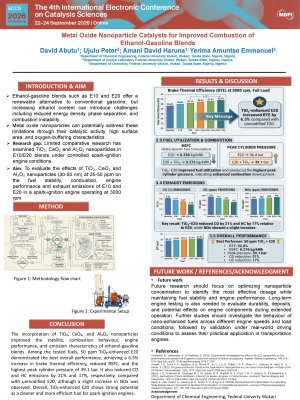
Nanoparticle-assisted ethanol-gasoline fuels have emerged as promising alternatives for cleaner combustion and improved engine efficiency due to their catalytic influence on oxidation reactions and flame propagation. This study investigates the catalytic effects of Titanium dioxide (TiO₂), Cerium dioxide (CeO₂), and Aluminum oxide (Al₂O₃) nanoparticles (30–50 nm) on the combustion behavior, fuel stability, and emission characteristics of E10 (10% ethanol + 90% gasoline) and E20 (20% ethanol + 80% gasoline) blends. The nanoparticles were dispersed at concentrations up to 50 ppm without surfactants, and fuel stability was evaluated through storage-based phase separation observation and oxidative stability analysis. The nanoparticle-doped blends exhibited improved homogeneity and reduced ethanol phase separation, indicating enhanced intermolecular stabilization within the fuel matrix. Engine combustion experiments were conducted using a single-cylinder spark-ignition engine operating at 3000 rpm. Among the tested catalysts, TiO₂-enhanced E20 demonstrated the best overall performance, producing a 6.3% increase in brake thermal efficiency together with reductions of 21% in carbon monoxide emissions and 17% in unburned hydrocarbon emissions relative to untreated E20 fuel. In-cylinder pressure and heat-release analyses revealed accelerated combustion rates, shorter ignition delay, and enhanced flame propagation in nanoparticle-assisted fuels. The improved combustion characteristics are attributed to the heterogeneous catalytic activity of the metal oxide nanoparticles, which promote surface-assisted radical oxidation reactions and facilitate more complete fuel oxidation. In particular, CeO₂ nanoparticles are believed to enhance oxidation kinetics through reversible Ce³⁺/Ce⁴⁺ redox cycling and oxygen vacancy-mediated oxygen transfer during combustion. These findings demonstrate the strong potential of metal oxide nanocatalysts for improving combustion efficiency, fuel stability, and environmental sustainability in ethanol–gasoline fuel systems.
Keywords
Ethanol-gasoline blends
Metal oxide nanoparticles
Engine combustion efficiency
Exhaust emission reduction
Alternative fuels
Poster
poster 2 Metal oxide nanoparticles.pdf
Improving enzymatic delignification of lignocellulosic biomass through enzyme engineering
TiO2 and ZnO nanomaterials: Fundamentals and applications in antibiotic degradation