Event submissions
Published
This submission belongs to the session S1. Catalytic Materials of the event The 4th International Electronic Conference on Catalysis Sciences
Published date
16 Sep, 2026
Academic Editor
'%3e%3cpath%20d='M12.6657%2010.9104C12.4185%2010.325%2012.0599%209.79327%2011.6097%209.34482C11.1609%208.89508%2010.6293%208.5365%2010.0442%208.28888C10.0389%208.28626%2010.0337%208.28495%2010.0285%208.28233C10.8446%207.69279%2011.3752%206.73249%2011.3752%205.64904C11.3752%203.8542%209.92103%202.39999%208.1262%202.39999C6.33136%202.39999%204.87715%203.8542%204.87715%205.64904C4.87715%206.73249%205.40774%207.69279%206.22393%208.28364C6.21869%208.28626%206.21345%208.28757%206.20821%208.29019C5.62129%208.5378%205.09463%208.89284%204.64265%209.34613C4.1929%209.79493%203.83432%2010.3266%203.58671%2010.9117C3.34345%2011.4845%203.21226%2012.0987%203.20023%2012.7209C3.19988%2012.7349%203.20233%2012.7488%203.20744%2012.7619C3.21255%2012.7749%203.22022%2012.7867%203.22998%2012.7968C3.23975%2012.8068%203.25142%2012.8147%203.26431%2012.8202C3.2772%2012.8256%203.29105%2012.8284%203.30504%2012.8284H4.09109C4.14874%2012.8284%204.19459%2012.7825%204.1959%2012.7262C4.2221%2011.7148%204.62823%2010.7676%205.34617%2010.0497C6.08899%209.30683%207.0755%208.89808%208.1262%208.89808C9.17689%208.89808%2010.1634%209.30683%2010.9062%2010.0497C11.6242%2010.7676%2012.0303%2011.7148%2012.0565%2012.7262C12.0578%2012.7838%2012.1037%2012.8284%2012.1613%2012.8284H12.9474C12.9613%2012.8284%2012.9752%2012.8256%2012.9881%2012.8202C13.001%2012.8147%2013.0126%2012.8068%2013.0224%2012.7968C13.0322%2012.7867%2013.0398%2012.7749%2013.0449%2012.7619C13.0501%2012.7488%2013.0525%2012.7349%2013.0522%2012.7209C13.0391%2012.0947%2012.9094%2011.4855%2012.6657%2010.9104ZM8.1262%207.9024C7.52486%207.9024%206.9589%207.6679%206.53312%207.24211C6.10733%206.81633%205.87283%206.25037%205.87283%205.64904C5.87283%205.0477%206.10733%204.48174%206.53312%204.05596C6.9589%203.63018%207.52486%203.39567%208.1262%203.39567C8.72753%203.39567%209.29349%203.63018%209.71927%204.05596C10.1451%204.48174%2010.3796%205.0477%2010.3796%205.64904C10.3796%206.25037%2010.1451%206.81633%209.71927%207.24211C9.29349%207.6679%208.72753%207.9024%208.1262%207.9024Z'%20fill='%235D1EE1'/%3e%3c/g%3e%3c/svg%3e) Narendra Kumar
Narendra KumarCitation
Boška Topalov, Sanja J. Armaković, Stevan Armaković, Maria Savanović, TiO₂ and ZnO nanomaterials: Fundamentals and applications in antibiotic degradation, in Proceedings of The 4th International Electronic Conference on Catalysis Sciences, 22 September–24 September 2026, MDPI: Basel, Switzerland
Share
Email
Facebook
Twitter
LinkedIn
TiO2 and ZnO nanomaterials: Fundamentals and applications in antibiotic degradation
'%3e%3cpath%20d='M12.6647%2010.9104C12.4176%2010.325%2012.0589%209.7933%2011.6088%209.34485C11.16%208.89511%2010.6283%208.53653%2010.0432%208.28891C10.038%208.28629%2010.0327%208.28498%2010.0275%208.28236C10.8437%207.69282%2011.3743%206.73252%2011.3743%205.64907C11.3743%203.85423%209.92005%202.40002%208.12522%202.40002C6.33038%202.40002%204.87618%203.85423%204.87618%205.64907C4.87618%206.73252%205.40677%207.69282%206.22296%208.28367C6.21772%208.28629%206.21248%208.2876%206.20724%208.29022C5.62031%208.53783%205.09365%208.89287%204.64167%209.34616C4.19192%209.79496%203.83334%2010.3266%203.58573%2010.9117C3.34247%2011.4846%203.21128%2012.0987%203.19925%2012.721C3.1989%2012.735%203.20135%2012.7489%203.20646%2012.7619C3.21157%2012.7749%203.21924%2012.7868%203.22901%2012.7968C3.23877%2012.8068%203.25045%2012.8148%203.26334%2012.8202C3.27623%2012.8256%203.29007%2012.8284%203.30406%2012.8284H4.09012C4.14776%2012.8284%204.19362%2012.7825%204.19493%2012.7262C4.22113%2011.7148%204.62726%2010.7676%205.34519%2010.0497C6.08802%209.30686%207.07452%208.89811%208.12522%208.89811C9.17592%208.89811%2010.1624%209.30686%2010.9052%2010.0497C11.6232%2010.7676%2012.0293%2011.7148%2012.0555%2012.7262C12.0568%2012.7839%2012.1027%2012.8284%2012.1603%2012.8284H12.9464C12.9604%2012.8284%2012.9742%2012.8256%2012.9871%2012.8202C13%2012.8148%2013.0117%2012.8068%2013.0214%2012.7968C13.0312%2012.7868%2013.0389%2012.7749%2013.044%2012.7619C13.0491%2012.7489%2013.0515%2012.735%2013.0512%2012.721C13.0381%2012.0947%2012.9084%2011.4856%2012.6647%2010.9104ZM8.12522%207.90243C7.52388%207.90243%206.95792%207.66793%206.53214%207.24215C6.10636%206.81636%205.87185%206.2504%205.87185%205.64907C5.87185%205.04773%206.10636%204.48177%206.53214%204.05599C6.95792%203.63021%207.52388%203.3957%208.12522%203.3957C8.72655%203.3957%209.29252%203.63021%209.7183%204.05599C10.1441%204.48177%2010.3786%205.04773%2010.3786%205.64907C10.3786%206.2504%2010.1441%206.81636%209.7183%207.24215C9.29252%207.66793%208.72655%207.90243%208.12522%207.90243Z'%20fill='%235D1EE1'/%3e%3c/g%3e%3c/svg%3e)
Boška Topalov 1,2

Sanja J. Armaković 2

Stevan Armaković 2

Maria Savanović 2
1. Hemofarm A.D., 26300 Vršac, Serbia
2. Department of Chemistry, Biochemistry and Environmental Protection, Faculty of Sciences, University of Novi Sad, 21000 Novi Sad, Serbia
Abstract
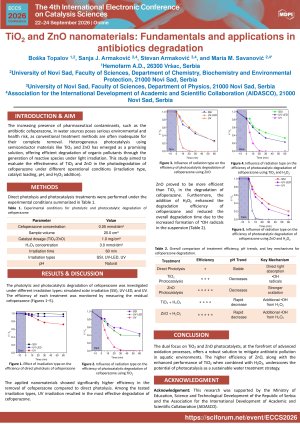
Introduction: The increasing environmental concern regarding water pollution has necessitated the development of effective remediation strategies, particularly for pharmaceutical contaminants such as cefoperazone. One promising approach involves heterogeneous photocatalysis, a process in which semiconductor materials such as TiO2 and ZnO are used to promote the degradation of organic pollutants under UV or visible light irradiation. TiO2 and ZnO exhibit significant photocatalytic activity due to the generation of reactive oxidative species under irradiation. Therefore, the purpose of this study was to examine the effectiveness of TiO₂ and ZnO in the photodegradation of cefoperazone under various operational conditions, in order to remove cefoperazone from aquatic systems and promote the development of sustainable water purification systems.
Methods: Direct photolysis and photocatalysis treatments, under different irradiation types, were performed using 20 cm3 of 0.05 mmol/dm3 of cefoperazone, which was irradiated for 60 min. All experiments were carried out at natural pH. Aliquots of 20 μL were injected and analyzed using Ultra Fast Liquid Chromatography with Photodiode Array Detection (UFLC–PDA, Shimadzu), equipped with an Eclipse XDB‒C18 column (150 mm × 4.6 mm i.d., particle size 5 μm) maintained at 30 °C.
Results: The photolytic and photocatalytic degradation of cefoperazone was investigated under different irradiation sources (simulated solar, UV-LED, and UV). The applied nanomaterials showed significantly higher efficiency in the removal of cefoperazone compared to direct photolysis. Among the tested irradiation types, UV irradiation resulted in the most effective degradation of cefoperazone. ZnO proved to be more efficient than TiO2 in the degradation of cefoperazone. Furthermore, the addition of H₂O₂ enhanced the degradation efficiency of cefoperazone and reduced the overall degradation time due to the increased formation of •OH radicals in the suspension.
Conclusions: Results demonstrate the potential of ZnO and TiO₂-based photocatalysts for efficient antibiotic removal from water under different irradiation conditions.
Keywords
photocatalysis
nanomaterials
pharmaceuticals
UV irradiation
Poster
Topalov et al. ECCS 2026_Final.pdf
Metal Oxide Nanoparticle Catalysts for Improved Combustion of Ethanol–Gasoline Blends
Development of Biomimetic Catalase and Peroxidase Sensors Based on Smart Materials for Sensitive Hydrogen Peroxide Detection