Event submissions
Published
This submission belongs to the session S4. Biocatalysis of the event The 4th International Electronic Conference on Catalysis Sciences
Published date
16 Sep, 2026
Academic Editor
'%3e%3cpath%20d='M12.6657%2010.9104C12.4185%2010.325%2012.0599%209.79327%2011.6097%209.34482C11.1609%208.89508%2010.6293%208.5365%2010.0442%208.28888C10.0389%208.28626%2010.0337%208.28495%2010.0285%208.28233C10.8446%207.69279%2011.3752%206.73249%2011.3752%205.64904C11.3752%203.8542%209.92103%202.39999%208.1262%202.39999C6.33136%202.39999%204.87715%203.8542%204.87715%205.64904C4.87715%206.73249%205.40774%207.69279%206.22393%208.28364C6.21869%208.28626%206.21345%208.28757%206.20821%208.29019C5.62129%208.5378%205.09463%208.89284%204.64265%209.34613C4.1929%209.79493%203.83432%2010.3266%203.58671%2010.9117C3.34345%2011.4845%203.21226%2012.0987%203.20023%2012.7209C3.19988%2012.7349%203.20233%2012.7488%203.20744%2012.7619C3.21255%2012.7749%203.22022%2012.7867%203.22998%2012.7968C3.23975%2012.8068%203.25142%2012.8147%203.26431%2012.8202C3.2772%2012.8256%203.29105%2012.8284%203.30504%2012.8284H4.09109C4.14874%2012.8284%204.19459%2012.7825%204.1959%2012.7262C4.2221%2011.7148%204.62823%2010.7676%205.34617%2010.0497C6.08899%209.30683%207.0755%208.89808%208.1262%208.89808C9.17689%208.89808%2010.1634%209.30683%2010.9062%2010.0497C11.6242%2010.7676%2012.0303%2011.7148%2012.0565%2012.7262C12.0578%2012.7838%2012.1037%2012.8284%2012.1613%2012.8284H12.9474C12.9613%2012.8284%2012.9752%2012.8256%2012.9881%2012.8202C13.001%2012.8147%2013.0126%2012.8068%2013.0224%2012.7968C13.0322%2012.7867%2013.0398%2012.7749%2013.0449%2012.7619C13.0501%2012.7488%2013.0525%2012.7349%2013.0522%2012.7209C13.0391%2012.0947%2012.9094%2011.4855%2012.6657%2010.9104ZM8.1262%207.9024C7.52486%207.9024%206.9589%207.6679%206.53312%207.24211C6.10733%206.81633%205.87283%206.25037%205.87283%205.64904C5.87283%205.0477%206.10733%204.48174%206.53312%204.05596C6.9589%203.63018%207.52486%203.39567%208.1262%203.39567C8.72753%203.39567%209.29349%203.63018%209.71927%204.05596C10.1451%204.48174%2010.3796%205.0477%2010.3796%205.64904C10.3796%206.25037%2010.1451%206.81633%209.71927%207.24211C9.29349%207.6679%208.72753%207.9024%208.1262%207.9024Z'%20fill='%235D1EE1'/%3e%3c/g%3e%3c/svg%3e) Gonzalo De Gonzalo
Gonzalo De GonzaloCitation
Nurana Malikova, Nahmad Ali-zadeh, Tofik Nagiev, Development of Biomimetic Catalase and Peroxidase Sensors Based on Smart Materials for Sensitive Hydrogen Peroxide Detection, in Proceedings of The 4th International Electronic Conference on Catalysis Sciences, 22 September–24 September 2026, MDPI: Basel, Switzerland
Share
Email
Facebook
Twitter
LinkedIn
Development of Biomimetic Catalase and Peroxidase Sensors Based on Smart Materials for Sensitive Hydrogen Peroxide Detection
'%3e%3cpath%20d='M12.6647%2010.9104C12.4176%2010.325%2012.0589%209.7933%2011.6088%209.34485C11.16%208.89511%2010.6283%208.53653%2010.0432%208.28891C10.038%208.28629%2010.0327%208.28498%2010.0275%208.28236C10.8437%207.69282%2011.3743%206.73252%2011.3743%205.64907C11.3743%203.85423%209.92005%202.40002%208.12522%202.40002C6.33038%202.40002%204.87618%203.85423%204.87618%205.64907C4.87618%206.73252%205.40677%207.69282%206.22296%208.28367C6.21772%208.28629%206.21248%208.2876%206.20724%208.29022C5.62031%208.53783%205.09365%208.89287%204.64167%209.34616C4.19192%209.79496%203.83334%2010.3266%203.58573%2010.9117C3.34247%2011.4846%203.21128%2012.0987%203.19925%2012.721C3.1989%2012.735%203.20135%2012.7489%203.20646%2012.7619C3.21157%2012.7749%203.21924%2012.7868%203.22901%2012.7968C3.23877%2012.8068%203.25045%2012.8148%203.26334%2012.8202C3.27623%2012.8256%203.29007%2012.8284%203.30406%2012.8284H4.09012C4.14776%2012.8284%204.19362%2012.7825%204.19493%2012.7262C4.22113%2011.7148%204.62726%2010.7676%205.34519%2010.0497C6.08802%209.30686%207.07452%208.89811%208.12522%208.89811C9.17592%208.89811%2010.1624%209.30686%2010.9052%2010.0497C11.6232%2010.7676%2012.0293%2011.7148%2012.0555%2012.7262C12.0568%2012.7839%2012.1027%2012.8284%2012.1603%2012.8284H12.9464C12.9604%2012.8284%2012.9742%2012.8256%2012.9871%2012.8202C13%2012.8148%2013.0117%2012.8068%2013.0214%2012.7968C13.0312%2012.7868%2013.0389%2012.7749%2013.044%2012.7619C13.0491%2012.7489%2013.0515%2012.735%2013.0512%2012.721C13.0381%2012.0947%2012.9084%2011.4856%2012.6647%2010.9104ZM8.12522%207.90243C7.52388%207.90243%206.95792%207.66793%206.53214%207.24215C6.10636%206.81636%205.87185%206.2504%205.87185%205.64907C5.87185%205.04773%206.10636%204.48177%206.53214%204.05599C6.95792%203.63021%207.52388%203.3957%208.12522%203.3957C8.72655%203.3957%209.29252%203.63021%209.7183%204.05599C10.1441%204.48177%2010.3786%205.04773%2010.3786%205.64907C10.3786%206.2504%2010.1441%206.81636%209.7183%207.24215C9.29252%207.66793%208.72655%207.90243%208.12522%207.90243Z'%20fill='%235D1EE1'/%3e%3c/g%3e%3c/svg%3e)
Nurana Malikova 1
Nahmad Ali-zadeh 1
Tofik Nagiev 2
1. Nagiev Institute of Catalysis and Inorganic Chemistry of Ministry of Science and Education, 113 H.Javid Av., 370143, Baku, Azerbaijan Republic.
2. Azerbaijan National Encyclopedia, Baku AZ1143 Azerbaijan
Abstract
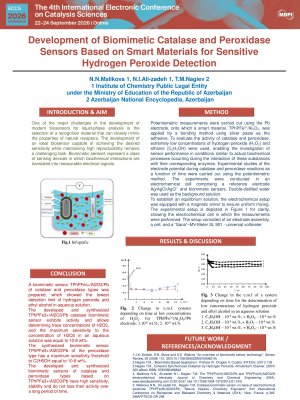
This study focuses on the development of a biomimetic sensor designed to assess the activity of catalase and peroxidase, utilizing a lead (Pb) electrode as a signal transducer. Potentiometric measurements were carried out using the Pb electrode, onto which a smart material, TPhPFe³⁺/Al₂O₃, was applied by a bonding method using silver paste as the adhesive. To evaluate the activity of catalase and peroxidase, extremely low concentrations of hydrogen peroxide (H₂O₂) and ethanol (C₂H₅OH) were used, enabling the investigation of sensor performance in conditions similar to actual biochemical processes occurring during the interaction of these substances with their corresponding enzymes. The results of the experiments demonstrated that the proposed biomimetic sensor based on TPhPFe³⁺/Al₂O₃/Pb exhibits high sensitivity and can rapidly detect the target concentrations of H₂O₂ and C₂H₅OH. The sensor responds to changes in concentration within a few seconds, confirming its suitability for applications requiring fast and accurate diagnostics. Moreover, the data revealed that the sensor is capable of detecting trace concentrations of hydrogen peroxide in aqueous solutions, with detection limits as low as 10⁻⁸wt.% for H₂O₂ and 10⁻⁶wt.% for C₂H₅OH. This sensor represents a significant advancement in the development of biomimetic devices for highly accurate biochemical analysis. The technology underlying this sensor could be useful for monitoring biocatalysts, quality control in chemical and pharmaceutical products, as well as further research in environmental monitoring and disease diagnostics. The high sensitivity and rapid response of the sensor open opportunities for its application in various scientific and industrial fields, where precise and rapid determination of trace biochemical substances is required.
Keywords
Biomimetic
Catalase
Peroxidase
Smart Material
Sensor.
Poster
P1 Malikova N.N.pdf
TiO2 and ZnO nanomaterials: Fundamentals and applications in antibiotic degradation
Electrocatalytic performance of Pd-decorated CoB/Cu and NiB/Cu coatings for HER and OER in overall water splitting