Event submissions
Published
This submission belongs to the session S1. Catalytic Materials of the event The 4th International Electronic Conference on Catalysis Sciences
Published date
16 Sep, 2026
Academic Editor
'%3e%3cpath%20d='M12.6657%2010.9104C12.4185%2010.325%2012.0599%209.79327%2011.6097%209.34482C11.1609%208.89508%2010.6293%208.5365%2010.0442%208.28888C10.0389%208.28626%2010.0337%208.28495%2010.0285%208.28233C10.8446%207.69279%2011.3752%206.73249%2011.3752%205.64904C11.3752%203.8542%209.92103%202.39999%208.1262%202.39999C6.33136%202.39999%204.87715%203.8542%204.87715%205.64904C4.87715%206.73249%205.40774%207.69279%206.22393%208.28364C6.21869%208.28626%206.21345%208.28757%206.20821%208.29019C5.62129%208.5378%205.09463%208.89284%204.64265%209.34613C4.1929%209.79493%203.83432%2010.3266%203.58671%2010.9117C3.34345%2011.4845%203.21226%2012.0987%203.20023%2012.7209C3.19988%2012.7349%203.20233%2012.7488%203.20744%2012.7619C3.21255%2012.7749%203.22022%2012.7867%203.22998%2012.7968C3.23975%2012.8068%203.25142%2012.8147%203.26431%2012.8202C3.2772%2012.8256%203.29105%2012.8284%203.30504%2012.8284H4.09109C4.14874%2012.8284%204.19459%2012.7825%204.1959%2012.7262C4.2221%2011.7148%204.62823%2010.7676%205.34617%2010.0497C6.08899%209.30683%207.0755%208.89808%208.1262%208.89808C9.17689%208.89808%2010.1634%209.30683%2010.9062%2010.0497C11.6242%2010.7676%2012.0303%2011.7148%2012.0565%2012.7262C12.0578%2012.7838%2012.1037%2012.8284%2012.1613%2012.8284H12.9474C12.9613%2012.8284%2012.9752%2012.8256%2012.9881%2012.8202C13.001%2012.8147%2013.0126%2012.8068%2013.0224%2012.7968C13.0322%2012.7867%2013.0398%2012.7749%2013.0449%2012.7619C13.0501%2012.7488%2013.0525%2012.7349%2013.0522%2012.7209C13.0391%2012.0947%2012.9094%2011.4855%2012.6657%2010.9104ZM8.1262%207.9024C7.52486%207.9024%206.9589%207.6679%206.53312%207.24211C6.10733%206.81633%205.87283%206.25037%205.87283%205.64904C5.87283%205.0477%206.10733%204.48174%206.53312%204.05596C6.9589%203.63018%207.52486%203.39567%208.1262%203.39567C8.72753%203.39567%209.29349%203.63018%209.71927%204.05596C10.1451%204.48174%2010.3796%205.0477%2010.3796%205.64904C10.3796%206.25037%2010.1451%206.81633%209.71927%207.24211C9.29349%207.6679%208.72753%207.9024%208.1262%207.9024Z'%20fill='%235D1EE1'/%3e%3c/g%3e%3c/svg%3e) Narendra Kumar
Narendra KumarCitation
Raminta Stagniūnaitė, Virginija Kepenienė, Zita Sukackienė, Loreta Tamašauskaitė Tamašiūnaitė, Electrocatalytic performance of Pd-decorated CoB/Cu and NiB/Cu coatings for HER and OER in overall water splitting, in Proceedings of The 4th International Electronic Conference on Catalysis Sciences, 22 September–24 September 2026, MDPI: Basel, Switzerland
Share
Email
Facebook
Twitter
LinkedIn
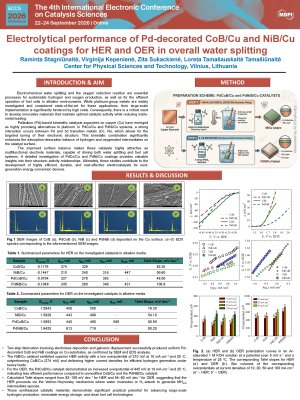
Electrocatalytic performance of Pd-decorated CoB/Cu and NiB/Cu coatings for HER and OER in overall water splitting
'%3e%3cpath%20d='M12.6647%2010.9104C12.4176%2010.325%2012.0589%209.7933%2011.6088%209.34485C11.16%208.89511%2010.6283%208.53653%2010.0432%208.28891C10.038%208.28629%2010.0327%208.28498%2010.0275%208.28236C10.8437%207.69282%2011.3743%206.73252%2011.3743%205.64907C11.3743%203.85423%209.92005%202.40002%208.12522%202.40002C6.33038%202.40002%204.87618%203.85423%204.87618%205.64907C4.87618%206.73252%205.40677%207.69282%206.22296%208.28367C6.21772%208.28629%206.21248%208.2876%206.20724%208.29022C5.62031%208.53783%205.09365%208.89287%204.64167%209.34616C4.19192%209.79496%203.83334%2010.3266%203.58573%2010.9117C3.34247%2011.4846%203.21128%2012.0987%203.19925%2012.721C3.1989%2012.735%203.20135%2012.7489%203.20646%2012.7619C3.21157%2012.7749%203.21924%2012.7868%203.22901%2012.7968C3.23877%2012.8068%203.25045%2012.8148%203.26334%2012.8202C3.27623%2012.8256%203.29007%2012.8284%203.30406%2012.8284H4.09012C4.14776%2012.8284%204.19362%2012.7825%204.19493%2012.7262C4.22113%2011.7148%204.62726%2010.7676%205.34519%2010.0497C6.08802%209.30686%207.07452%208.89811%208.12522%208.89811C9.17592%208.89811%2010.1624%209.30686%2010.9052%2010.0497C11.6232%2010.7676%2012.0293%2011.7148%2012.0555%2012.7262C12.0568%2012.7839%2012.1027%2012.8284%2012.1603%2012.8284H12.9464C12.9604%2012.8284%2012.9742%2012.8256%2012.9871%2012.8202C13%2012.8148%2013.0117%2012.8068%2013.0214%2012.7968C13.0312%2012.7868%2013.0389%2012.7749%2013.044%2012.7619C13.0491%2012.7489%2013.0515%2012.735%2013.0512%2012.721C13.0381%2012.0947%2012.9084%2011.4856%2012.6647%2010.9104ZM8.12522%207.90243C7.52388%207.90243%206.95792%207.66793%206.53214%207.24215C6.10636%206.81636%205.87185%206.2504%205.87185%205.64907C5.87185%205.04773%206.10636%204.48177%206.53214%204.05599C6.95792%203.63021%207.52388%203.3957%208.12522%203.3957C8.72655%203.3957%209.29252%203.63021%209.7183%204.05599C10.1441%204.48177%2010.3786%205.04773%2010.3786%205.64907C10.3786%206.2504%2010.1441%206.81636%209.7183%207.24215C9.29252%207.66793%208.72655%207.90243%208.12522%207.90243Z'%20fill='%235D1EE1'/%3e%3c/g%3e%3c/svg%3e)
Raminta Stagniūnaitė 1

Virginija Kepenienė 1

Zita Sukackienė 1

Loreta Tamašauskaitė Tamašiūnaitė 1
1. Department of Catalysis, Center for Physical Sciences and Technology, Vilnius, Saulėtekio ave. 3, LT-10257, Lithuania
Abstract
Sustainable hydrogen and oxygen generation, alongside the effective operation of alkaline fuel cells, heavily rely on electrochemical water splitting. As viable substitutes for platinum, copper-supported palladium-based bimetallic electrocatalysts have gained significant attention. Their appeal lies in their modifiable electronic properties, enhanced catalytic performance, and minimized requirements for precious metals. Specifically, systems such as PdCo/Cu and PdNi/Cu demonstrate strong synergistic interactions between palladium and 3d transition metals. This synergy optimizes the adsorption and desorption dynamics of hydrogen and oxygen intermediates on the active sites, making these materials highly versatile for overall water splitting and fuel cell applications. Consequently, investigating PdCo/Cu and PdNi/Cu architectures provides crucial knowledge regarding their structure-to-activity dynamics, facilitating the design of affordable, robust, and highly active electrocatalysts for advanced energy conversion technologies.
In this research, cobalt and nickel layers were synthesized on copper substrates via an electroless deposition process. The reaction was conducted at 40 °C using morpholine borane as the reducing agent to yield CoB/Cu and NiB/Cu frameworks. Subsequently, palladium nanoparticles were introduced using a 1 mmol PdCl₂ precursor solution. The morphological features and elemental composition of the resulting PdCoB/Cu and PdNiB/Cu composites were evaluated utilizing Field Emission Scanning Electron Microscopy (FESEM). Furthermore, linear sweep voltammetry (LSV) was employed to assess their electrocatalytic capabilities toward the hydrogen evolution (HER) and oxygen evolution (OER) reactions in an alkaline environment.
Electrochemical assessments revealed that the NiB/Cu configuration delivered better HER performance compared to its cobalt-based counterpart. At a standard working temperature of 25 °C, it required a minimal overpotential of 210mV to reach a current density of 10 mA cm⁻², whereas the CoB/Cu catalyst needed 274 mV to achieve the same benchmark. However, for the OER reaction, the CoB/C-based catalysts demonstrated higher electrocatalytic activity than the other investigated materials.
Keywords
water splitting
coatings
hydrogen evolution
oxygen evolution
catalysts
Poster
R. Stagniunaite.pdf
Development of Biomimetic Catalase and Peroxidase Sensors Based on Smart Materials for Sensitive Hydrogen Peroxide Detection
Heterologous expression, biochemical characterization and transglycosylation potential of a novel GH70 glucansucrase from Lactobacillus delbrueckii subsp. delbrueckii