Event submissions
Published
This submission belongs to the session S4. Biocatalysis of the event The 4th International Electronic Conference on Catalysis Sciences
Published date
16 Sep, 2026
Academic Editor
'%3e%3cpath%20d='M12.6657%2010.9104C12.4185%2010.325%2012.0599%209.79327%2011.6097%209.34482C11.1609%208.89508%2010.6293%208.5365%2010.0442%208.28888C10.0389%208.28626%2010.0337%208.28495%2010.0285%208.28233C10.8446%207.69279%2011.3752%206.73249%2011.3752%205.64904C11.3752%203.8542%209.92103%202.39999%208.1262%202.39999C6.33136%202.39999%204.87715%203.8542%204.87715%205.64904C4.87715%206.73249%205.40774%207.69279%206.22393%208.28364C6.21869%208.28626%206.21345%208.28757%206.20821%208.29019C5.62129%208.5378%205.09463%208.89284%204.64265%209.34613C4.1929%209.79493%203.83432%2010.3266%203.58671%2010.9117C3.34345%2011.4845%203.21226%2012.0987%203.20023%2012.7209C3.19988%2012.7349%203.20233%2012.7488%203.20744%2012.7619C3.21255%2012.7749%203.22022%2012.7867%203.22998%2012.7968C3.23975%2012.8068%203.25142%2012.8147%203.26431%2012.8202C3.2772%2012.8256%203.29105%2012.8284%203.30504%2012.8284H4.09109C4.14874%2012.8284%204.19459%2012.7825%204.1959%2012.7262C4.2221%2011.7148%204.62823%2010.7676%205.34617%2010.0497C6.08899%209.30683%207.0755%208.89808%208.1262%208.89808C9.17689%208.89808%2010.1634%209.30683%2010.9062%2010.0497C11.6242%2010.7676%2012.0303%2011.7148%2012.0565%2012.7262C12.0578%2012.7838%2012.1037%2012.8284%2012.1613%2012.8284H12.9474C12.9613%2012.8284%2012.9752%2012.8256%2012.9881%2012.8202C13.001%2012.8147%2013.0126%2012.8068%2013.0224%2012.7968C13.0322%2012.7867%2013.0398%2012.7749%2013.0449%2012.7619C13.0501%2012.7488%2013.0525%2012.7349%2013.0522%2012.7209C13.0391%2012.0947%2012.9094%2011.4855%2012.6657%2010.9104ZM8.1262%207.9024C7.52486%207.9024%206.9589%207.6679%206.53312%207.24211C6.10733%206.81633%205.87283%206.25037%205.87283%205.64904C5.87283%205.0477%206.10733%204.48174%206.53312%204.05596C6.9589%203.63018%207.52486%203.39567%208.1262%203.39567C8.72753%203.39567%209.29349%203.63018%209.71927%204.05596C10.1451%204.48174%2010.3796%205.0477%2010.3796%205.64904C10.3796%206.25037%2010.1451%206.81633%209.71927%207.24211C9.29349%207.6679%208.72753%207.9024%208.1262%207.9024Z'%20fill='%235D1EE1'/%3e%3c/g%3e%3c/svg%3e) Evangelos Topakas
Evangelos TopakasCitation
Panitanong Sritanat, Saengchai Akepratumchai, Lakha Salaipeth, Paripok Phitsuwan, Cloning and preliminary characterization of Clostridium alkalicellulosi endo-xylanase for xylo-oligosaccahride production, in Proceedings of The 4th International Electronic Conference on Catalysis Sciences, 22 September–24 September 2026, MDPI: Basel, Switzerland
Share
Email
Facebook
Twitter
LinkedIn
Cloning and preliminary characterization of Clostridium alkalicellulosi endo-xylanase for xylo-oligosaccahride production
'%3e%3cpath%20d='M12.6647%2010.9104C12.4176%2010.325%2012.0589%209.7933%2011.6088%209.34485C11.16%208.89511%2010.6283%208.53653%2010.0432%208.28891C10.038%208.28629%2010.0327%208.28498%2010.0275%208.28236C10.8437%207.69282%2011.3743%206.73252%2011.3743%205.64907C11.3743%203.85423%209.92005%202.40002%208.12522%202.40002C6.33038%202.40002%204.87618%203.85423%204.87618%205.64907C4.87618%206.73252%205.40677%207.69282%206.22296%208.28367C6.21772%208.28629%206.21248%208.2876%206.20724%208.29022C5.62031%208.53783%205.09365%208.89287%204.64167%209.34616C4.19192%209.79496%203.83334%2010.3266%203.58573%2010.9117C3.34247%2011.4846%203.21128%2012.0987%203.19925%2012.721C3.1989%2012.735%203.20135%2012.7489%203.20646%2012.7619C3.21157%2012.7749%203.21924%2012.7868%203.22901%2012.7968C3.23877%2012.8068%203.25045%2012.8148%203.26334%2012.8202C3.27623%2012.8256%203.29007%2012.8284%203.30406%2012.8284H4.09012C4.14776%2012.8284%204.19362%2012.7825%204.19493%2012.7262C4.22113%2011.7148%204.62726%2010.7676%205.34519%2010.0497C6.08802%209.30686%207.07452%208.89811%208.12522%208.89811C9.17592%208.89811%2010.1624%209.30686%2010.9052%2010.0497C11.6232%2010.7676%2012.0293%2011.7148%2012.0555%2012.7262C12.0568%2012.7839%2012.1027%2012.8284%2012.1603%2012.8284H12.9464C12.9604%2012.8284%2012.9742%2012.8256%2012.9871%2012.8202C13%2012.8148%2013.0117%2012.8068%2013.0214%2012.7968C13.0312%2012.7868%2013.0389%2012.7749%2013.044%2012.7619C13.0491%2012.7489%2013.0515%2012.735%2013.0512%2012.721C13.0381%2012.0947%2012.9084%2011.4856%2012.6647%2010.9104ZM8.12522%207.90243C7.52388%207.90243%206.95792%207.66793%206.53214%207.24215C6.10636%206.81636%205.87185%206.2504%205.87185%205.64907C5.87185%205.04773%206.10636%204.48177%206.53214%204.05599C6.95792%203.63021%207.52388%203.3957%208.12522%203.3957C8.72655%203.3957%209.29252%203.63021%209.7183%204.05599C10.1441%204.48177%2010.3786%205.04773%2010.3786%205.64907C10.3786%206.2504%2010.1441%206.81636%209.7183%207.24215C9.29252%207.66793%208.72655%207.90243%208.12522%207.90243Z'%20fill='%235D1EE1'/%3e%3c/g%3e%3c/svg%3e)
Panitanong Sritanat 1
Saengchai Akepratumchai 1
Lakha Salaipeth 1

Paripok Phitsuwan 1
1. LigniTech-Lignin Technology Research Group, School of Bioresources and Technology, King Mongkut’s University of Technology, Thonburi, Bangkuntien, Bangkok 10150, Thailand.
Abstract
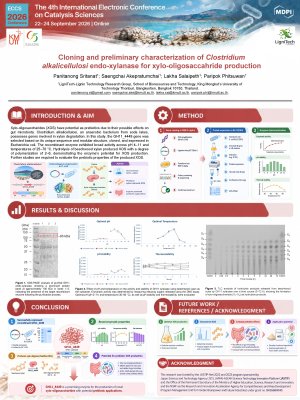
Xylo-oligosaccharides (XOs) have emerged as a new type of prebiotic due to their distinct effects on gut microbiota modulation compared to commercially available prebiotic oligosaccharides. This effect has been reported to correlate with the type and structure of XOs and their ability to be taken up by gut microbes. Therefore, there is room to explore the production of new types of xylan-derived XOS that may induce different prebiotic effects on gut microbiota. Clostridium alkalicellulosi is an anaerobic bacterium that grows in soda lakes. It plays a critical role in carbon recycling in the lake through effective degradation of plant and algal biomass. A previous study showed that the genome of C. alkalicellulosi contains several genes responsible for carbohydrate degradation, among which genes related to xylan degradation are predominant. In this study, the gene designated as GH11_4449 was selected based on its low similarity in amino acid sequence and unique modular organization of its polypeptide. Bioinformatic analysis revealed that this gene encodes a putative protein containing a glycoside hydrolase family 11 (GH11) domain along with additional modules in the polypeptide. The gene was cloned and expressed in Escherichia coli to characterize the biochemical properties and xylan-hydrolyzing ability of the enzyme for XOS production. We found that the GH11_4449 enzyme exhibited broad pH and temperature activity against beechwood xylan, ranging from pH 4.0 to 11.0 and 25 to 70 °C. The enzyme also showed good activity in the presence of high salt concentrations (20%). Hydrolysis of beechwood xylan by the GH11_4449 enzyme yielded oligosaccharides with a degree of polymerization of 2–6, as revealed by TLC analysis. This work demonstrates that GH11_4449 is a promising enzyme for XOS production in the presence of salt to prevent microbial contamination. Further studies will examine the prebiotic properties of the XOS produced by the GH11_4449 enzyme.
Keywords
Xylo-oligosaccharide
Prebiotics
Salt tolerance
xylanase
Poster
Poster_Panitanong Sritanat.pdf
Chemo-, photo- and enzyme-catalyzed dimerization of resveratrol under batch reaction conditions
RuCo3O4/C Catalyst with Reduced Noble Metal Content for Efficient Hydrogen Evolution Reaction in Alkaline Media