Event submissions
Published
This submission belongs to the session S1. Catalytic Materials of the event The 4th International Electronic Conference on Catalysis Sciences
Published date
16 Sep, 2026
Academic Editor
'%3e%3cpath%20d='M12.6657%2010.9104C12.4185%2010.325%2012.0599%209.79327%2011.6097%209.34482C11.1609%208.89508%2010.6293%208.5365%2010.0442%208.28888C10.0389%208.28626%2010.0337%208.28495%2010.0285%208.28233C10.8446%207.69279%2011.3752%206.73249%2011.3752%205.64904C11.3752%203.8542%209.92103%202.39999%208.1262%202.39999C6.33136%202.39999%204.87715%203.8542%204.87715%205.64904C4.87715%206.73249%205.40774%207.69279%206.22393%208.28364C6.21869%208.28626%206.21345%208.28757%206.20821%208.29019C5.62129%208.5378%205.09463%208.89284%204.64265%209.34613C4.1929%209.79493%203.83432%2010.3266%203.58671%2010.9117C3.34345%2011.4845%203.21226%2012.0987%203.20023%2012.7209C3.19988%2012.7349%203.20233%2012.7488%203.20744%2012.7619C3.21255%2012.7749%203.22022%2012.7867%203.22998%2012.7968C3.23975%2012.8068%203.25142%2012.8147%203.26431%2012.8202C3.2772%2012.8256%203.29105%2012.8284%203.30504%2012.8284H4.09109C4.14874%2012.8284%204.19459%2012.7825%204.1959%2012.7262C4.2221%2011.7148%204.62823%2010.7676%205.34617%2010.0497C6.08899%209.30683%207.0755%208.89808%208.1262%208.89808C9.17689%208.89808%2010.1634%209.30683%2010.9062%2010.0497C11.6242%2010.7676%2012.0303%2011.7148%2012.0565%2012.7262C12.0578%2012.7838%2012.1037%2012.8284%2012.1613%2012.8284H12.9474C12.9613%2012.8284%2012.9752%2012.8256%2012.9881%2012.8202C13.001%2012.8147%2013.0126%2012.8068%2013.0224%2012.7968C13.0322%2012.7867%2013.0398%2012.7749%2013.0449%2012.7619C13.0501%2012.7488%2013.0525%2012.7349%2013.0522%2012.7209C13.0391%2012.0947%2012.9094%2011.4855%2012.6657%2010.9104ZM8.1262%207.9024C7.52486%207.9024%206.9589%207.6679%206.53312%207.24211C6.10733%206.81633%205.87283%206.25037%205.87283%205.64904C5.87283%205.0477%206.10733%204.48174%206.53312%204.05596C6.9589%203.63018%207.52486%203.39567%208.1262%203.39567C8.72753%203.39567%209.29349%203.63018%209.71927%204.05596C10.1451%204.48174%2010.3796%205.0477%2010.3796%205.64904C10.3796%206.25037%2010.1451%206.81633%209.71927%207.24211C9.29349%207.6679%208.72753%207.9024%208.1262%207.9024Z'%20fill='%235D1EE1'/%3e%3c/g%3e%3c/svg%3e) Narendra Kumar
Narendra KumarCitation
Julija Usavičiūtė, Virginija Kepenienė, Raminta Stagniūnaitė, Jūratė Vaičiūnienė, Loreta Tamašauskaitė-Tamašiūnaitė, RuCo₃O₄/C Catalyst with Reduced Noble Metal Content for Efficient Hydrogen Evolution Reaction in Alkaline Media, in Proceedings of The 4th International Electronic Conference on Catalysis Sciences, 22 September–24 September 2026, MDPI: Basel, Switzerland
Share
Email
Facebook
Twitter
LinkedIn
RuCo3O4/C Catalyst with Reduced Noble Metal Content for Efficient Hydrogen Evolution Reaction in Alkaline Media
'%3e%3cpath%20d='M12.6647%2010.9104C12.4176%2010.325%2012.0589%209.7933%2011.6088%209.34485C11.16%208.89511%2010.6283%208.53653%2010.0432%208.28891C10.038%208.28629%2010.0327%208.28498%2010.0275%208.28236C10.8437%207.69282%2011.3743%206.73252%2011.3743%205.64907C11.3743%203.85423%209.92005%202.40002%208.12522%202.40002C6.33038%202.40002%204.87618%203.85423%204.87618%205.64907C4.87618%206.73252%205.40677%207.69282%206.22296%208.28367C6.21772%208.28629%206.21248%208.2876%206.20724%208.29022C5.62031%208.53783%205.09365%208.89287%204.64167%209.34616C4.19192%209.79496%203.83334%2010.3266%203.58573%2010.9117C3.34247%2011.4846%203.21128%2012.0987%203.19925%2012.721C3.1989%2012.735%203.20135%2012.7489%203.20646%2012.7619C3.21157%2012.7749%203.21924%2012.7868%203.22901%2012.7968C3.23877%2012.8068%203.25045%2012.8148%203.26334%2012.8202C3.27623%2012.8256%203.29007%2012.8284%203.30406%2012.8284H4.09012C4.14776%2012.8284%204.19362%2012.7825%204.19493%2012.7262C4.22113%2011.7148%204.62726%2010.7676%205.34519%2010.0497C6.08802%209.30686%207.07452%208.89811%208.12522%208.89811C9.17592%208.89811%2010.1624%209.30686%2010.9052%2010.0497C11.6232%2010.7676%2012.0293%2011.7148%2012.0555%2012.7262C12.0568%2012.7839%2012.1027%2012.8284%2012.1603%2012.8284H12.9464C12.9604%2012.8284%2012.9742%2012.8256%2012.9871%2012.8202C13%2012.8148%2013.0117%2012.8068%2013.0214%2012.7968C13.0312%2012.7868%2013.0389%2012.7749%2013.044%2012.7619C13.0491%2012.7489%2013.0515%2012.735%2013.0512%2012.721C13.0381%2012.0947%2012.9084%2011.4856%2012.6647%2010.9104ZM8.12522%207.90243C7.52388%207.90243%206.95792%207.66793%206.53214%207.24215C6.10636%206.81636%205.87185%206.2504%205.87185%205.64907C5.87185%205.04773%206.10636%204.48177%206.53214%204.05599C6.95792%203.63021%207.52388%203.3957%208.12522%203.3957C8.72655%203.3957%209.29252%203.63021%209.7183%204.05599C10.1441%204.48177%2010.3786%205.04773%2010.3786%205.64907C10.3786%206.2504%2010.1441%206.81636%209.7183%207.24215C9.29252%207.66793%208.72655%207.90243%208.12522%207.90243Z'%20fill='%235D1EE1'/%3e%3c/g%3e%3c/svg%3e)
Julija Usavičiūtė 1

Virginija Kepenienė 1
Raminta Stagniūnaitė 1
Jūratė Vaičiūnienė 1

Loreta Tamašauskaitė-Tamašiūnaitė 1
1. Department of Catalysis, Center for Physical Sciences and Technology, Vilnius, 10257, Lithuania
Abstract
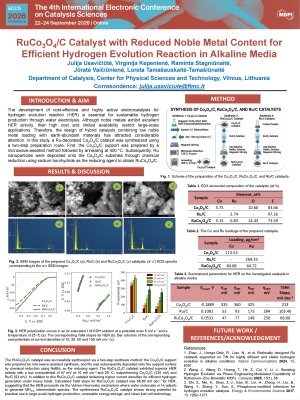
The development of cost-effective and highly active electrocatalysts for hydrogen evolution reaction (HER) is essential for sustainable hydrogen production through water electrolysis. Although noble metals exhibit excellent HER activity, their high cost and limited availability restrict large-scale applications. Therefore, the design of hybrid catalysts combining low noble metal loading with earth-abundant materials has attracted considerable attention. In this study, a Ru-decorated Co₃O₄/C catalyst was synthesized using a two-step preparation route. First, the Co₃O₄/C support was prepared by a microwave-assisted method followed by annealing at 400 °C. Subsequently, Ru nanoparticles were deposited onto the Co₃O₄/C substrate through chemical reduction using sodium borohydride as the reducing agent. The morphology and composition of the prepared catalysts were characterized by field emission scanning electron microscopy (FESEM), X-ray diffraction spectroscopy (XRD) and inductively coupled plasma optical emission spectroscopy (ICP-OES). The electrocatalytic performance toward HER in alkaline medium was evaluated using linear sweep voltammetry. The synthesized RuCo/C catalyst demonstrated significantly enhanced HER activity compared with the Co₃O₄/C support. The catalyst exhibited a low overpotential of 70 mV at a current density of 10 mA cm⁻² at 25 °C, indicating efficient catalytic performance despite the reduced noble metal loading. The improved activity was attributed to the synergistic interaction between Ru and Co species, as well as the conductive carbon support, which promoted hydrogen adsorption and accelerated charge transfer kinetics. The obtained results demonstrate that Ru-decorated Co₃O₄/C catalysts are promising low-noble-metal electrocatalysts for HER in alkaline media. The combination of Ru nanoparticles with Co₃O₄ based carbon supports provides an effective strategy for developing efficient and economically viable catalysts for sustainable hydrogen production.
Keywords
catlytic nanomaterials
ruthenium
Co₃O₄/C support
efficient hydrogen evolution
Poster
J.Usaviciute_Catalysts_Poster.pdf
Cloning and preliminary characterization of Clostridium alkalicellulosi endo-xylanase for xylo-oligosaccahride production
Enzymatic production of prebiotic oligosaccharide from rose residue derived from essential oil extraction process.