Event submissions
Published
This submission belongs to the session S1. Catalytic Materials of the event The 4th International Electronic Conference on Catalysis Sciences
Published date
16 Sep, 2026
Academic Editor
'%3e%3cpath%20d='M12.6657%2010.9104C12.4185%2010.325%2012.0599%209.79327%2011.6097%209.34482C11.1609%208.89508%2010.6293%208.5365%2010.0442%208.28888C10.0389%208.28626%2010.0337%208.28495%2010.0285%208.28233C10.8446%207.69279%2011.3752%206.73249%2011.3752%205.64904C11.3752%203.8542%209.92103%202.39999%208.1262%202.39999C6.33136%202.39999%204.87715%203.8542%204.87715%205.64904C4.87715%206.73249%205.40774%207.69279%206.22393%208.28364C6.21869%208.28626%206.21345%208.28757%206.20821%208.29019C5.62129%208.5378%205.09463%208.89284%204.64265%209.34613C4.1929%209.79493%203.83432%2010.3266%203.58671%2010.9117C3.34345%2011.4845%203.21226%2012.0987%203.20023%2012.7209C3.19988%2012.7349%203.20233%2012.7488%203.20744%2012.7619C3.21255%2012.7749%203.22022%2012.7867%203.22998%2012.7968C3.23975%2012.8068%203.25142%2012.8147%203.26431%2012.8202C3.2772%2012.8256%203.29105%2012.8284%203.30504%2012.8284H4.09109C4.14874%2012.8284%204.19459%2012.7825%204.1959%2012.7262C4.2221%2011.7148%204.62823%2010.7676%205.34617%2010.0497C6.08899%209.30683%207.0755%208.89808%208.1262%208.89808C9.17689%208.89808%2010.1634%209.30683%2010.9062%2010.0497C11.6242%2010.7676%2012.0303%2011.7148%2012.0565%2012.7262C12.0578%2012.7838%2012.1037%2012.8284%2012.1613%2012.8284H12.9474C12.9613%2012.8284%2012.9752%2012.8256%2012.9881%2012.8202C13.001%2012.8147%2013.0126%2012.8068%2013.0224%2012.7968C13.0322%2012.7867%2013.0398%2012.7749%2013.0449%2012.7619C13.0501%2012.7488%2013.0525%2012.7349%2013.0522%2012.7209C13.0391%2012.0947%2012.9094%2011.4855%2012.6657%2010.9104ZM8.1262%207.9024C7.52486%207.9024%206.9589%207.6679%206.53312%207.24211C6.10733%206.81633%205.87283%206.25037%205.87283%205.64904C5.87283%205.0477%206.10733%204.48174%206.53312%204.05596C6.9589%203.63018%207.52486%203.39567%208.1262%203.39567C8.72753%203.39567%209.29349%203.63018%209.71927%204.05596C10.1451%204.48174%2010.3796%205.0477%2010.3796%205.64904C10.3796%206.25037%2010.1451%206.81633%209.71927%207.24211C9.29349%207.6679%208.72753%207.9024%208.1262%207.9024Z'%20fill='%235D1EE1'/%3e%3c/g%3e%3c/svg%3e) Gonzalo De Gonzalo
Gonzalo De GonzaloCitation
Zita Sukackiene, Gitana Valeckytė, Loreta Tamašauskaitė-Tamašiūnaitė, Jolanta Stupakova, Development of nickel-based catalysts for sustainable hydrogen production, in Proceedings of The 4th International Electronic Conference on Catalysis Sciences, 22 September–24 September 2026, MDPI: Basel, Switzerland
Share
Email
Facebook
Twitter
LinkedIn
Development of nickel-based catalysts for sustainable hydrogen production

Zita Sukackiene 1
'%3e%3cpath%20d='M12.6647%2010.9104C12.4176%2010.325%2012.0589%209.7933%2011.6088%209.34485C11.16%208.89511%2010.6283%208.53653%2010.0432%208.28891C10.038%208.28629%2010.0327%208.28498%2010.0275%208.28236C10.8437%207.69282%2011.3743%206.73252%2011.3743%205.64907C11.3743%203.85423%209.92005%202.40002%208.12522%202.40002C6.33038%202.40002%204.87618%203.85423%204.87618%205.64907C4.87618%206.73252%205.40677%207.69282%206.22296%208.28367C6.21772%208.28629%206.21248%208.2876%206.20724%208.29022C5.62031%208.53783%205.09365%208.89287%204.64167%209.34616C4.19192%209.79496%203.83334%2010.3266%203.58573%2010.9117C3.34247%2011.4846%203.21128%2012.0987%203.19925%2012.721C3.1989%2012.735%203.20135%2012.7489%203.20646%2012.7619C3.21157%2012.7749%203.21924%2012.7868%203.22901%2012.7968C3.23877%2012.8068%203.25045%2012.8148%203.26334%2012.8202C3.27623%2012.8256%203.29007%2012.8284%203.30406%2012.8284H4.09012C4.14776%2012.8284%204.19362%2012.7825%204.19493%2012.7262C4.22113%2011.7148%204.62726%2010.7676%205.34519%2010.0497C6.08802%209.30686%207.07452%208.89811%208.12522%208.89811C9.17592%208.89811%2010.1624%209.30686%2010.9052%2010.0497C11.6232%2010.7676%2012.0293%2011.7148%2012.0555%2012.7262C12.0568%2012.7839%2012.1027%2012.8284%2012.1603%2012.8284H12.9464C12.9604%2012.8284%2012.9742%2012.8256%2012.9871%2012.8202C13%2012.8148%2013.0117%2012.8068%2013.0214%2012.7968C13.0312%2012.7868%2013.0389%2012.7749%2013.044%2012.7619C13.0491%2012.7489%2013.0515%2012.735%2013.0512%2012.721C13.0381%2012.0947%2012.9084%2011.4856%2012.6647%2010.9104ZM8.12522%207.90243C7.52388%207.90243%206.95792%207.66793%206.53214%207.24215C6.10636%206.81636%205.87185%206.2504%205.87185%205.64907C5.87185%205.04773%206.10636%204.48177%206.53214%204.05599C6.95792%203.63021%207.52388%203.3957%208.12522%203.3957C8.72655%203.3957%209.29252%203.63021%209.7183%204.05599C10.1441%204.48177%2010.3786%205.04773%2010.3786%205.64907C10.3786%206.2504%2010.1441%206.81636%209.7183%207.24215C9.29252%207.66793%208.72655%207.90243%208.12522%207.90243Z'%20fill='%235D1EE1'/%3e%3c/g%3e%3c/svg%3e)
Gitana Valeckytė 1

Loreta Tamašauskaitė-Tamašiūnaitė 1
Jolanta Stupakova 2
1. Department of Catalysis, Center for Physical Sciences and Technology, Vilnius LT-10257, Lithuania
2. Faculty of Fundamental Sciences Department of Physics, Vilnius Gediminas Technical University, Vilnius LT-10223, Lithuania
Abstract
The accelerating global demand for energy, in conjunction with the continuous depletion of fossil fuel reserves, has prompted the exploration of alternative energy sources that are characterized by their cleanliness, sustainability, and efficiency. Hydrogen is regarded as one of the most promising alternatives due to its high energy density and environmentally friendly nature, as its utilization produces only water as a by-product. Notwithstanding these advantages, the development of economically viable and highly efficient hydrogen production technologies remains a significant scientific challenge. Consequently, the catalytic hydrolysis of sodium borohydride has attracted increasing attention because of its ability to generate substantial amounts of hydrogen under relatively mild reaction conditions.
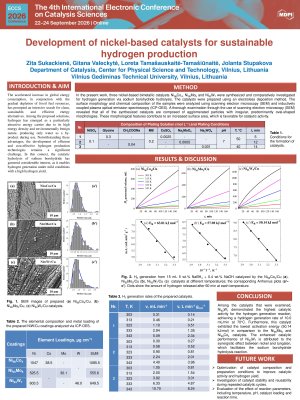
In this study, three nickel-based bimetallic catalysts, namely Ni96Co4, Ni95Mo5, and Ni93W7, were synthesized and evaluated for hydrogen production through the hydrolysis of sodium borohydride. The catalyst samples were fabricated by applying an electroless deposition technique. The surface structure and elemental composition of the samples were characterized using scanning electron microscopy (SEM) and inductively coupled plasma optical emission spectroscopy (ICP-OES). SEM observations revealed that all prepared catalysts were composed of agglomerated particles exhibiting irregular and predominantly oval-like shapes. These structural characteristics have been demonstrated to increase the available surface area, a property that is widely regarded as beneficial for enhancing catalytic performance.
Among the investigated samples, the Ni93W7 catalyst demonstrated the highest performance for hydrogen generation, achieving a hydrogen production rate of 10.0 mL/min at 70 °C. Furthermore, it exhibited the lowest activation energy value of 50.14 kJ/mol when compared with the Ni95Mo5 and Ni96Co4 catalysts. This enhanced catalytic behavior is hypothesized to be the result of a synergistic interaction between nickel and tungsten, which promotes and accelerates the hydrolysis of sodium borohydride.
Keywords
electroless deposition
catalysts
hydrogen generation
Poster
Zita Sukackiene ECCS.pdf
Colorimetric detection of hydrogen peroxide using metal-organic frameworks-based nanozymes
Enzymatic Valorization of Lignocellulosic Furans Using a Recombinant Ganoderma lucidum Glyoxal Oxidase