Event submissions
Published
This submission belongs to the session S4. Biocatalysis of the event The 4th International Electronic Conference on Catalysis Sciences
Published date
16 Sep, 2026
Academic Editor
'%3e%3cpath%20d='M12.6657%2010.9104C12.4185%2010.325%2012.0599%209.79327%2011.6097%209.34482C11.1609%208.89508%2010.6293%208.5365%2010.0442%208.28888C10.0389%208.28626%2010.0337%208.28495%2010.0285%208.28233C10.8446%207.69279%2011.3752%206.73249%2011.3752%205.64904C11.3752%203.8542%209.92103%202.39999%208.1262%202.39999C6.33136%202.39999%204.87715%203.8542%204.87715%205.64904C4.87715%206.73249%205.40774%207.69279%206.22393%208.28364C6.21869%208.28626%206.21345%208.28757%206.20821%208.29019C5.62129%208.5378%205.09463%208.89284%204.64265%209.34613C4.1929%209.79493%203.83432%2010.3266%203.58671%2010.9117C3.34345%2011.4845%203.21226%2012.0987%203.20023%2012.7209C3.19988%2012.7349%203.20233%2012.7488%203.20744%2012.7619C3.21255%2012.7749%203.22022%2012.7867%203.22998%2012.7968C3.23975%2012.8068%203.25142%2012.8147%203.26431%2012.8202C3.2772%2012.8256%203.29105%2012.8284%203.30504%2012.8284H4.09109C4.14874%2012.8284%204.19459%2012.7825%204.1959%2012.7262C4.2221%2011.7148%204.62823%2010.7676%205.34617%2010.0497C6.08899%209.30683%207.0755%208.89808%208.1262%208.89808C9.17689%208.89808%2010.1634%209.30683%2010.9062%2010.0497C11.6242%2010.7676%2012.0303%2011.7148%2012.0565%2012.7262C12.0578%2012.7838%2012.1037%2012.8284%2012.1613%2012.8284H12.9474C12.9613%2012.8284%2012.9752%2012.8256%2012.9881%2012.8202C13.001%2012.8147%2013.0126%2012.8068%2013.0224%2012.7968C13.0322%2012.7867%2013.0398%2012.7749%2013.0449%2012.7619C13.0501%2012.7488%2013.0525%2012.7349%2013.0522%2012.7209C13.0391%2012.0947%2012.9094%2011.4855%2012.6657%2010.9104ZM8.1262%207.9024C7.52486%207.9024%206.9589%207.6679%206.53312%207.24211C6.10733%206.81633%205.87283%206.25037%205.87283%205.64904C5.87283%205.0477%206.10733%204.48174%206.53312%204.05596C6.9589%203.63018%207.52486%203.39567%208.1262%203.39567C8.72753%203.39567%209.29349%203.63018%209.71927%204.05596C10.1451%204.48174%2010.3796%205.0477%2010.3796%205.64904C10.3796%206.25037%2010.1451%206.81633%209.71927%207.24211C9.29349%207.6679%208.72753%207.9024%208.1262%207.9024Z'%20fill='%235D1EE1'/%3e%3c/g%3e%3c/svg%3e) Gonzalo De Gonzalo
Gonzalo De GonzaloCitation
Maria Konstantina Karonidi, Κoar Chorozian, Asimina Marianou, Angelos Lappas, Evangelos Topakas, Anthi Karnaouri, Enzymatic Valorization of Lignocellulosic Furans Using a Recombinant Ganoderma lucidum Glyoxal Oxidase, in Proceedings of The 4th International Electronic Conference on Catalysis Sciences, 22 September–24 September 2026, MDPI: Basel, Switzerland
Share
Email
Facebook
Twitter
LinkedIn
Enzymatic Valorization of Lignocellulosic Furans Using a Recombinant Ganoderma lucidum Glyoxal Oxidase
'%3e%3cpath%20d='M12.6647%2010.9104C12.4176%2010.325%2012.0589%209.7933%2011.6088%209.34485C11.16%208.89511%2010.6283%208.53653%2010.0432%208.28891C10.038%208.28629%2010.0327%208.28498%2010.0275%208.28236C10.8437%207.69282%2011.3743%206.73252%2011.3743%205.64907C11.3743%203.85423%209.92005%202.40002%208.12522%202.40002C6.33038%202.40002%204.87618%203.85423%204.87618%205.64907C4.87618%206.73252%205.40677%207.69282%206.22296%208.28367C6.21772%208.28629%206.21248%208.2876%206.20724%208.29022C5.62031%208.53783%205.09365%208.89287%204.64167%209.34616C4.19192%209.79496%203.83334%2010.3266%203.58573%2010.9117C3.34247%2011.4846%203.21128%2012.0987%203.19925%2012.721C3.1989%2012.735%203.20135%2012.7489%203.20646%2012.7619C3.21157%2012.7749%203.21924%2012.7868%203.22901%2012.7968C3.23877%2012.8068%203.25045%2012.8148%203.26334%2012.8202C3.27623%2012.8256%203.29007%2012.8284%203.30406%2012.8284H4.09012C4.14776%2012.8284%204.19362%2012.7825%204.19493%2012.7262C4.22113%2011.7148%204.62726%2010.7676%205.34519%2010.0497C6.08802%209.30686%207.07452%208.89811%208.12522%208.89811C9.17592%208.89811%2010.1624%209.30686%2010.9052%2010.0497C11.6232%2010.7676%2012.0293%2011.7148%2012.0555%2012.7262C12.0568%2012.7839%2012.1027%2012.8284%2012.1603%2012.8284H12.9464C12.9604%2012.8284%2012.9742%2012.8256%2012.9871%2012.8202C13%2012.8148%2013.0117%2012.8068%2013.0214%2012.7968C13.0312%2012.7868%2013.0389%2012.7749%2013.044%2012.7619C13.0491%2012.7489%2013.0515%2012.735%2013.0512%2012.721C13.0381%2012.0947%2012.9084%2011.4856%2012.6647%2010.9104ZM8.12522%207.90243C7.52388%207.90243%206.95792%207.66793%206.53214%207.24215C6.10636%206.81636%205.87185%206.2504%205.87185%205.64907C5.87185%205.04773%206.10636%204.48177%206.53214%204.05599C6.95792%203.63021%207.52388%203.3957%208.12522%203.3957C8.72655%203.3957%209.29252%203.63021%209.7183%204.05599C10.1441%204.48177%2010.3786%205.04773%2010.3786%205.64907C10.3786%206.2504%2010.1441%206.81636%209.7183%207.24215C9.29252%207.66793%208.72655%207.90243%208.12522%207.90243Z'%20fill='%235D1EE1'/%3e%3c/g%3e%3c/svg%3e)
Maria Konstantina Karonidi 1
Κoar Chorozian 1,2
Asimina Marianou 3

Angelos Lappas 3
Evangelos Topakas 2

Anthi Karnaouri 1
1. Laboratory of General and Agricultural Microbiology, Department of Crop Science, Agricultural University of Athens, Athens, Greece
2. Industrial Biotechnology & Biocatalysis Group, Biotechnology Laboratory, School of Chemical Engineering, National Technical University of Athens, Athens, Greece
3. Chemical Process and Energy Resources Institute (CPERI), Centre for Research and Technology Hellas (CERTH), Thessaloniki, Greece
Abstract
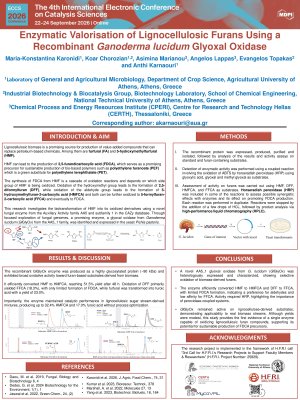
Furan platform chemicals such as 5-hydroxymethylfurfural (HMF) and furfural (FA), obtained via dehydration of lignocellulosic carbohydrates, are key intermediates to produce renewable monomers including 2,5-furandicarboxylic acid (FDCA), a promising substitute for fossil-based terephthalates in polymer synthesis. The enzymatic oxidation of HMF to FDCA proceeds through sequential formation of 5-hydroxymethyl-2-furancarboxylic acid (HMFCA) and/or 2,5-diformylfuran (DFF), converging at 5-formyl-2-furancarboxylic acid (FFCA) prior to FDCA formation, while FA can be selectively converted to furoic acid as a valuable platform molecule. Compared to chemocatalytic approaches, enzymatic systems provide advantages in selectivity, operational conditions, and sustainability due to the use of molecular oxygen as terminal oxidant. In this study, a fungal Auxiliary Activity family 5 (AA5_1) glyoxal oxidase from Ganoderma lucidum (GlGlyOx), identified by genome mining and heterologously expressed in Pichia pastoris, was investigated for the oxidation of HMF and FA, including substrates derived from lignocellulosic hydrolysates. Enzymatic activity was assessed via a horseradish peroxidase (HRP)-coupled ABTS assay, and reaction products were quantified by HPLC. Biomass-derived furan substrates were produced from wheat straw and beechwood via enzymatic hydrolysis followed by catalytic dehydration. Recombinant GlGlyOx appeared as a highly glycosylated protein (~90 kDa) and displayed activity toward multiple furan substrates. HMF was selectively oxidized to HMFCA (51.5% after 48 h), while DFF conversion to FFCA reached 18.3% with minor FDCA formation. FA was converted to furoic acid (23.0% after 48 h). Importantly, activity was retained on lignocellulose sugar stream-derived substrates, yielding up to 32.4% HMFCA and 17.0% furoic acid under non-optimized conditions. This work represents the first demonstration of a single AA5 glyoxal oxidase capable of catalyzing oxidation of biomass-derived furans, highlighting its potential for sustainable lignocellulose valorization and of FDCA precursors.
Keywords
biocatalysis
HMF
FDCA
FA
lignocellulose valorization
Poster
ECCS_2026_Poster_Karonidi.pdf
Development of nickel-based catalysts for sustainable hydrogen production
Polyurethane depolymerization by the white-rot basidiomycete Cyclocybe aegerita