Event submissions
Published
This submission belongs to the session S1. Catalytic Materials of the event The 4th International Electronic Conference on Catalysis Sciences
Published date
16 Sep, 2026
Academic Editor
'%3e%3cpath%20d='M12.6657%2010.9104C12.4185%2010.325%2012.0599%209.79327%2011.6097%209.34482C11.1609%208.89508%2010.6293%208.5365%2010.0442%208.28888C10.0389%208.28626%2010.0337%208.28495%2010.0285%208.28233C10.8446%207.69279%2011.3752%206.73249%2011.3752%205.64904C11.3752%203.8542%209.92103%202.39999%208.1262%202.39999C6.33136%202.39999%204.87715%203.8542%204.87715%205.64904C4.87715%206.73249%205.40774%207.69279%206.22393%208.28364C6.21869%208.28626%206.21345%208.28757%206.20821%208.29019C5.62129%208.5378%205.09463%208.89284%204.64265%209.34613C4.1929%209.79493%203.83432%2010.3266%203.58671%2010.9117C3.34345%2011.4845%203.21226%2012.0987%203.20023%2012.7209C3.19988%2012.7349%203.20233%2012.7488%203.20744%2012.7619C3.21255%2012.7749%203.22022%2012.7867%203.22998%2012.7968C3.23975%2012.8068%203.25142%2012.8147%203.26431%2012.8202C3.2772%2012.8256%203.29105%2012.8284%203.30504%2012.8284H4.09109C4.14874%2012.8284%204.19459%2012.7825%204.1959%2012.7262C4.2221%2011.7148%204.62823%2010.7676%205.34617%2010.0497C6.08899%209.30683%207.0755%208.89808%208.1262%208.89808C9.17689%208.89808%2010.1634%209.30683%2010.9062%2010.0497C11.6242%2010.7676%2012.0303%2011.7148%2012.0565%2012.7262C12.0578%2012.7838%2012.1037%2012.8284%2012.1613%2012.8284H12.9474C12.9613%2012.8284%2012.9752%2012.8256%2012.9881%2012.8202C13.001%2012.8147%2013.0126%2012.8068%2013.0224%2012.7968C13.0322%2012.7867%2013.0398%2012.7749%2013.0449%2012.7619C13.0501%2012.7488%2013.0525%2012.7349%2013.0522%2012.7209C13.0391%2012.0947%2012.9094%2011.4855%2012.6657%2010.9104ZM8.1262%207.9024C7.52486%207.9024%206.9589%207.6679%206.53312%207.24211C6.10733%206.81633%205.87283%206.25037%205.87283%205.64904C5.87283%205.0477%206.10733%204.48174%206.53312%204.05596C6.9589%203.63018%207.52486%203.39567%208.1262%203.39567C8.72753%203.39567%209.29349%203.63018%209.71927%204.05596C10.1451%204.48174%2010.3796%205.0477%2010.3796%205.64904C10.3796%206.25037%2010.1451%206.81633%209.71927%207.24211C9.29349%207.6679%208.72753%207.9024%208.1262%207.9024Z'%20fill='%235D1EE1'/%3e%3c/g%3e%3c/svg%3e) Narendra Kumar
Narendra KumarCitation
Marina Belén Palacios, Paola María Carraro, Ruben Mutal, Eliana Gabriela Vaschetto, Griselda Alejandra Eimer, Acidic mesoporous materials from renewable precursors as catalysts in the gas-phase dehydration of glycerol., in Proceedings of The 4th International Electronic Conference on Catalysis Sciences, 22 September–24 September 2026, MDPI: Basel, Switzerland
Share
Email
Facebook
Twitter
LinkedIn
Acidic mesoporous materials from renewable precursors as catalysts in the gas-phase dehydration of glycerol.
'%3e%3cpath%20d='M12.6647%2010.9104C12.4176%2010.325%2012.0589%209.7933%2011.6088%209.34485C11.16%208.89511%2010.6283%208.53653%2010.0432%208.28891C10.038%208.28629%2010.0327%208.28498%2010.0275%208.28236C10.8437%207.69282%2011.3743%206.73252%2011.3743%205.64907C11.3743%203.85423%209.92005%202.40002%208.12522%202.40002C6.33038%202.40002%204.87618%203.85423%204.87618%205.64907C4.87618%206.73252%205.40677%207.69282%206.22296%208.28367C6.21772%208.28629%206.21248%208.2876%206.20724%208.29022C5.62031%208.53783%205.09365%208.89287%204.64167%209.34616C4.19192%209.79496%203.83334%2010.3266%203.58573%2010.9117C3.34247%2011.4846%203.21128%2012.0987%203.19925%2012.721C3.1989%2012.735%203.20135%2012.7489%203.20646%2012.7619C3.21157%2012.7749%203.21924%2012.7868%203.22901%2012.7968C3.23877%2012.8068%203.25045%2012.8148%203.26334%2012.8202C3.27623%2012.8256%203.29007%2012.8284%203.30406%2012.8284H4.09012C4.14776%2012.8284%204.19362%2012.7825%204.19493%2012.7262C4.22113%2011.7148%204.62726%2010.7676%205.34519%2010.0497C6.08802%209.30686%207.07452%208.89811%208.12522%208.89811C9.17592%208.89811%2010.1624%209.30686%2010.9052%2010.0497C11.6232%2010.7676%2012.0293%2011.7148%2012.0555%2012.7262C12.0568%2012.7839%2012.1027%2012.8284%2012.1603%2012.8284H12.9464C12.9604%2012.8284%2012.9742%2012.8256%2012.9871%2012.8202C13%2012.8148%2013.0117%2012.8068%2013.0214%2012.7968C13.0312%2012.7868%2013.0389%2012.7749%2013.044%2012.7619C13.0491%2012.7489%2013.0515%2012.735%2013.0512%2012.721C13.0381%2012.0947%2012.9084%2011.4856%2012.6647%2010.9104ZM8.12522%207.90243C7.52388%207.90243%206.95792%207.66793%206.53214%207.24215C6.10636%206.81636%205.87185%206.2504%205.87185%205.64907C5.87185%205.04773%206.10636%204.48177%206.53214%204.05599C6.95792%203.63021%207.52388%203.3957%208.12522%203.3957C8.72655%203.3957%209.29252%203.63021%209.7183%204.05599C10.1441%204.48177%2010.3786%205.04773%2010.3786%205.64907C10.3786%206.2504%2010.1441%206.81636%209.7183%207.24215C9.29252%207.66793%208.72655%207.90243%208.12522%207.90243Z'%20fill='%235D1EE1'/%3e%3c/g%3e%3c/svg%3e)
Marina Belén Palacios 1,2
Paola María Carraro 1,2
Ruben Mutal 3
Eliana Gabriela Vaschetto 1,2
Griselda Alejandra Eimer 1,2
1. National Technological University, Córdoba Regional Faculty, Córdoba, Argentina
2. Center for Chemical Research and Technology (“Centro de Investigación y Tecnología Química CITeQ-UTN-CONICET"), National Technological University, FRC, Córdoba, University City, 5016, Argentina
3. Laboratory of Electron Microscopy and X-ray Analysis (LAMARX), National University of Córdoba, Faculty of Mathematics, Astronomy, Physics and Computing, Av. Medina Allende s/n, University City, Córdoba, Argentina
Abstract
The increasing environmental impact associated with the dependence on fossil resources is driving chemical technology toward the development of more sustainable chemical processes. In this context, the valorization of byproducts from the biofuel industry has gained relevance in order to enhance its efficiency and further promote its development. Particularly, the valorization of residual glycerol, a byproduct of the biodiesel industry, through its gas-phase dehydration enables the production of high value-added compounds, such as acrolein and acetol, which are used as intermediates in various industrial applications especially in the polymer, pharmaceutical, and food industries. Therefore, in this work, novel acidic mesoporous siliceous materials were developed to be evaluated in the glycerol dehydration reaction. The solids were synthesized using the Sol-Gel method under mild conditions, employing glyceryl monostearate as a molding agent and silica extracted from rice husk ash as an alternative silicon source, both renewable and environmentally friendly precursors. Aluminum was also incorporated directly during synthesis at different Si/Al molar ratios (10, 20, 30, and 60) to generate Brønsted and Lewis acid sites, essential for the reaction. Catalytic evaluation was carried out at 250°C in a fixed-bed reactor under N₂ flow (30 mL/min) using 200 mg of catalyst and a 10% w/w aqueous glycerol solution fed at a flow rate of 3.6 mL/h. The solid with the highest aluminum content and proportion of acid sites resulted in the highest glycerol conversion, 97%, with selectivities of 80% and 20% for acetol and acrolein, respectively. The predominance of Lewis acid sites favored acetol formation over acrolein. Thus, through the application of eco-friendly methodologies, the valorization of residual feedstocks and the use of renewable precursors, this work contributes to improving the efficiency and sustainability of chemical processes such as biodiesel production.
Keywords
Acidic nanomaterials
glycerol dehydration
renewable precursors
Poster
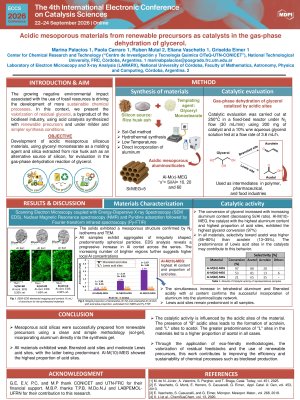
Marina Palacios Poster. 04.09.26.pdf
Polyurethane depolymerization by the white-rot basidiomycete Cyclocybe aegerita
Integrated Enzymatic Pretreatment and Ultrasound-Assisted Extraction for Enhanced Recovery of Ferulic Acid from Wheat Bran