Event submissions
Published
This submission belongs to the session S4. Biocatalysis of the event The 4th International Electronic Conference on Catalysis Sciences
Published date
16 Sep, 2026
Academic Editor
'%3e%3cpath%20d='M12.6657%2010.9104C12.4185%2010.325%2012.0599%209.79327%2011.6097%209.34482C11.1609%208.89508%2010.6293%208.5365%2010.0442%208.28888C10.0389%208.28626%2010.0337%208.28495%2010.0285%208.28233C10.8446%207.69279%2011.3752%206.73249%2011.3752%205.64904C11.3752%203.8542%209.92103%202.39999%208.1262%202.39999C6.33136%202.39999%204.87715%203.8542%204.87715%205.64904C4.87715%206.73249%205.40774%207.69279%206.22393%208.28364C6.21869%208.28626%206.21345%208.28757%206.20821%208.29019C5.62129%208.5378%205.09463%208.89284%204.64265%209.34613C4.1929%209.79493%203.83432%2010.3266%203.58671%2010.9117C3.34345%2011.4845%203.21226%2012.0987%203.20023%2012.7209C3.19988%2012.7349%203.20233%2012.7488%203.20744%2012.7619C3.21255%2012.7749%203.22022%2012.7867%203.22998%2012.7968C3.23975%2012.8068%203.25142%2012.8147%203.26431%2012.8202C3.2772%2012.8256%203.29105%2012.8284%203.30504%2012.8284H4.09109C4.14874%2012.8284%204.19459%2012.7825%204.1959%2012.7262C4.2221%2011.7148%204.62823%2010.7676%205.34617%2010.0497C6.08899%209.30683%207.0755%208.89808%208.1262%208.89808C9.17689%208.89808%2010.1634%209.30683%2010.9062%2010.0497C11.6242%2010.7676%2012.0303%2011.7148%2012.0565%2012.7262C12.0578%2012.7838%2012.1037%2012.8284%2012.1613%2012.8284H12.9474C12.9613%2012.8284%2012.9752%2012.8256%2012.9881%2012.8202C13.001%2012.8147%2013.0126%2012.8068%2013.0224%2012.7968C13.0322%2012.7867%2013.0398%2012.7749%2013.0449%2012.7619C13.0501%2012.7488%2013.0525%2012.7349%2013.0522%2012.7209C13.0391%2012.0947%2012.9094%2011.4855%2012.6657%2010.9104ZM8.1262%207.9024C7.52486%207.9024%206.9589%207.6679%206.53312%207.24211C6.10733%206.81633%205.87283%206.25037%205.87283%205.64904C5.87283%205.0477%206.10733%204.48174%206.53312%204.05596C6.9589%203.63018%207.52486%203.39567%208.1262%203.39567C8.72753%203.39567%209.29349%203.63018%209.71927%204.05596C10.1451%204.48174%2010.3796%205.0477%2010.3796%205.64904C10.3796%206.25037%2010.1451%206.81633%209.71927%207.24211C9.29349%207.6679%208.72753%207.9024%208.1262%207.9024Z'%20fill='%235D1EE1'/%3e%3c/g%3e%3c/svg%3e) Gonzalo De Gonzalo
Gonzalo De GonzaloCitation
Thidarat Boonlerd, Navadol Laosiripojana, Paripok Phitsuwan, Enzymatic Production of Amino Acids and Antioxidant Peptides from Soybean-Derived Protein Isolate, in Proceedings of The 4th International Electronic Conference on Catalysis Sciences, 22 September–24 September 2026, MDPI: Basel, Switzerland
Share
Email
Facebook
Twitter
LinkedIn
Enzymatic Production of Amino Acids and Antioxidant Peptides from Soybean-Derived Protein Isolate
'%3e%3cpath%20d='M12.6647%2010.9104C12.4176%2010.325%2012.0589%209.7933%2011.6088%209.34485C11.16%208.89511%2010.6283%208.53653%2010.0432%208.28891C10.038%208.28629%2010.0327%208.28498%2010.0275%208.28236C10.8437%207.69282%2011.3743%206.73252%2011.3743%205.64907C11.3743%203.85423%209.92005%202.40002%208.12522%202.40002C6.33038%202.40002%204.87618%203.85423%204.87618%205.64907C4.87618%206.73252%205.40677%207.69282%206.22296%208.28367C6.21772%208.28629%206.21248%208.2876%206.20724%208.29022C5.62031%208.53783%205.09365%208.89287%204.64167%209.34616C4.19192%209.79496%203.83334%2010.3266%203.58573%2010.9117C3.34247%2011.4846%203.21128%2012.0987%203.19925%2012.721C3.1989%2012.735%203.20135%2012.7489%203.20646%2012.7619C3.21157%2012.7749%203.21924%2012.7868%203.22901%2012.7968C3.23877%2012.8068%203.25045%2012.8148%203.26334%2012.8202C3.27623%2012.8256%203.29007%2012.8284%203.30406%2012.8284H4.09012C4.14776%2012.8284%204.19362%2012.7825%204.19493%2012.7262C4.22113%2011.7148%204.62726%2010.7676%205.34519%2010.0497C6.08802%209.30686%207.07452%208.89811%208.12522%208.89811C9.17592%208.89811%2010.1624%209.30686%2010.9052%2010.0497C11.6232%2010.7676%2012.0293%2011.7148%2012.0555%2012.7262C12.0568%2012.7839%2012.1027%2012.8284%2012.1603%2012.8284H12.9464C12.9604%2012.8284%2012.9742%2012.8256%2012.9871%2012.8202C13%2012.8148%2013.0117%2012.8068%2013.0214%2012.7968C13.0312%2012.7868%2013.0389%2012.7749%2013.044%2012.7619C13.0491%2012.7489%2013.0515%2012.735%2013.0512%2012.721C13.0381%2012.0947%2012.9084%2011.4856%2012.6647%2010.9104ZM8.12522%207.90243C7.52388%207.90243%206.95792%207.66793%206.53214%207.24215C6.10636%206.81636%205.87185%206.2504%205.87185%205.64907C5.87185%205.04773%206.10636%204.48177%206.53214%204.05599C6.95792%203.63021%207.52388%203.3957%208.12522%203.3957C8.72655%203.3957%209.29252%203.63021%209.7183%204.05599C10.1441%204.48177%2010.3786%205.04773%2010.3786%205.64907C10.3786%206.2504%2010.1441%206.81636%209.7183%207.24215C9.29252%207.66793%208.72655%207.90243%208.12522%207.90243Z'%20fill='%235D1EE1'/%3e%3c/g%3e%3c/svg%3e)
Thidarat Boonlerd 1,2
Navadol Laosiripojana 2

Paripok Phitsuwan 1
1. LigniTech-Lignin Technology Research Group, School of Bioresources and Technology, King Mongkut’s University of Technology Thonburi, Bangkhuntien, 10150, Bangkok
2. The Joint Graduate School of Energy and Environment, King Mongkut’s University of Technology Thonburi, 126 Prachauthit Rd, Bangmod, Tungkru, Bangkok, 10140, Thailand
Abstract
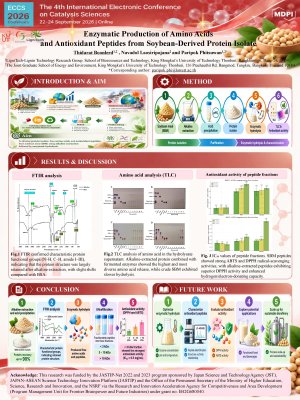
Soybean meal (SBM) is a major by-product of soybean processing and represents an abundant protein-rich resource for value-added applications. To enhance its utilization, SBM can be converted into protein isolates, free amino acids, and bioactive peptides with antioxidant activity. In this study, proteins were first isolated from SBM using 0.1 M NaOH, followed by acid precipitation with HCl and drying. This process achieved protein recovery of up to 90%. Fourier-transform infrared spectroscopy showed that the SBM protein isolate exhibited intensity profiles comparable to those of bovine serum albumin, suggesting that the secondary structural features were largely retained after extraction. The protein isolate was subsequently hydrolyzed using proteolytic enzymes to produce amino acids and peptides. Thin-layer chromatography analysis of the hydrolysate supernatant revealed the presence of several amino acids, including leucine, valine, glutamic acid, and glycine. The hydrolysate was further fractionated by ultrafiltration into three peptide fractions with molecular weight cut-offs of <3 kDa, 3–10 kDa, and >10 kDa. These fractions were evaluated for antioxidant activity using DPPH and ABTS radical scavenging assays. Among the fractions, the <3 kDa peptide fraction exhibited the strongest antioxidant activity, with the lowest IC₅₀ value of approximately 0.5 mg/mL. These findings demonstrate that alkaline extraction combined with enzymatic hydrolysis is a promising strategy for producing protein isolates, amino acids, and antioxidant peptides from SBM. This approach provides a practical valorization pathway for soybean-derived by-products and supports the development of integrated biorefinery processes in the soybean processing industry.
Keywords
Alkaline extraction
Antioxidant peptides
Biorefinery
Protein recovery
Soybean meal
Poster
ECCS-Thidarat Boonlerd Poster.pdf
Thermal and photochemical initiation of propane cracking on structurally heterogeneous rare earth molybdates
Magnetron-sputtered Cu gas diffusion electrodes for efficient CO2 electroreduction