Event submissions
Published
This submission belongs to the session S1. Catalytic Materials of the event The 4th International Electronic Conference on Catalysis Sciences
Published date
16 Sep, 2026
Academic Editor
'%3e%3cpath%20d='M12.6657%2010.9104C12.4185%2010.325%2012.0599%209.79327%2011.6097%209.34482C11.1609%208.89508%2010.6293%208.5365%2010.0442%208.28888C10.0389%208.28626%2010.0337%208.28495%2010.0285%208.28233C10.8446%207.69279%2011.3752%206.73249%2011.3752%205.64904C11.3752%203.8542%209.92103%202.39999%208.1262%202.39999C6.33136%202.39999%204.87715%203.8542%204.87715%205.64904C4.87715%206.73249%205.40774%207.69279%206.22393%208.28364C6.21869%208.28626%206.21345%208.28757%206.20821%208.29019C5.62129%208.5378%205.09463%208.89284%204.64265%209.34613C4.1929%209.79493%203.83432%2010.3266%203.58671%2010.9117C3.34345%2011.4845%203.21226%2012.0987%203.20023%2012.7209C3.19988%2012.7349%203.20233%2012.7488%203.20744%2012.7619C3.21255%2012.7749%203.22022%2012.7867%203.22998%2012.7968C3.23975%2012.8068%203.25142%2012.8147%203.26431%2012.8202C3.2772%2012.8256%203.29105%2012.8284%203.30504%2012.8284H4.09109C4.14874%2012.8284%204.19459%2012.7825%204.1959%2012.7262C4.2221%2011.7148%204.62823%2010.7676%205.34617%2010.0497C6.08899%209.30683%207.0755%208.89808%208.1262%208.89808C9.17689%208.89808%2010.1634%209.30683%2010.9062%2010.0497C11.6242%2010.7676%2012.0303%2011.7148%2012.0565%2012.7262C12.0578%2012.7838%2012.1037%2012.8284%2012.1613%2012.8284H12.9474C12.9613%2012.8284%2012.9752%2012.8256%2012.9881%2012.8202C13.001%2012.8147%2013.0126%2012.8068%2013.0224%2012.7968C13.0322%2012.7867%2013.0398%2012.7749%2013.0449%2012.7619C13.0501%2012.7488%2013.0525%2012.7349%2013.0522%2012.7209C13.0391%2012.0947%2012.9094%2011.4855%2012.6657%2010.9104ZM8.1262%207.9024C7.52486%207.9024%206.9589%207.6679%206.53312%207.24211C6.10733%206.81633%205.87283%206.25037%205.87283%205.64904C5.87283%205.0477%206.10733%204.48174%206.53312%204.05596C6.9589%203.63018%207.52486%203.39567%208.1262%203.39567C8.72753%203.39567%209.29349%203.63018%209.71927%204.05596C10.1451%204.48174%2010.3796%205.0477%2010.3796%205.64904C10.3796%206.25037%2010.1451%206.81633%209.71927%207.24211C9.29349%207.6679%208.72753%207.9024%208.1262%207.9024Z'%20fill='%235D1EE1'/%3e%3c/g%3e%3c/svg%3e) Narendra Kumar
Narendra KumarCitation
Alisa Lazarenko, Sofia Semenova, Aiyraa Mezhekey, Tatiana Sheshko, Tuning A/B- site cations in Gd-perovskite catalysts for selective CO₂ hydrogenation to C₂-C₃ olefins: the role of Fe-Co synergy and potassium promotion, in Proceedings of The 4th International Electronic Conference on Catalysis Sciences, 22 September–24 September 2026, MDPI: Basel, Switzerland
Share
Email
Facebook
Twitter
LinkedIn
Tuning A/B- site cations in Gd-perovskite catalysts for selective CO2 hydrogenation to C2-C3 olefins: the role of Fe-Co synergy and potassium promotion

Alisa Lazarenko 1
'%3e%3cpath%20d='M12.6647%2010.9104C12.4176%2010.325%2012.0589%209.7933%2011.6088%209.34485C11.16%208.89511%2010.6283%208.53653%2010.0432%208.28891C10.038%208.28629%2010.0327%208.28498%2010.0275%208.28236C10.8437%207.69282%2011.3743%206.73252%2011.3743%205.64907C11.3743%203.85423%209.92005%202.40002%208.12522%202.40002C6.33038%202.40002%204.87618%203.85423%204.87618%205.64907C4.87618%206.73252%205.40677%207.69282%206.22296%208.28367C6.21772%208.28629%206.21248%208.2876%206.20724%208.29022C5.62031%208.53783%205.09365%208.89287%204.64167%209.34616C4.19192%209.79496%203.83334%2010.3266%203.58573%2010.9117C3.34247%2011.4846%203.21128%2012.0987%203.19925%2012.721C3.1989%2012.735%203.20135%2012.7489%203.20646%2012.7619C3.21157%2012.7749%203.21924%2012.7868%203.22901%2012.7968C3.23877%2012.8068%203.25045%2012.8148%203.26334%2012.8202C3.27623%2012.8256%203.29007%2012.8284%203.30406%2012.8284H4.09012C4.14776%2012.8284%204.19362%2012.7825%204.19493%2012.7262C4.22113%2011.7148%204.62726%2010.7676%205.34519%2010.0497C6.08802%209.30686%207.07452%208.89811%208.12522%208.89811C9.17592%208.89811%2010.1624%209.30686%2010.9052%2010.0497C11.6232%2010.7676%2012.0293%2011.7148%2012.0555%2012.7262C12.0568%2012.7839%2012.1027%2012.8284%2012.1603%2012.8284H12.9464C12.9604%2012.8284%2012.9742%2012.8256%2012.9871%2012.8202C13%2012.8148%2013.0117%2012.8068%2013.0214%2012.7968C13.0312%2012.7868%2013.0389%2012.7749%2013.044%2012.7619C13.0491%2012.7489%2013.0515%2012.735%2013.0512%2012.721C13.0381%2012.0947%2012.9084%2011.4856%2012.6647%2010.9104ZM8.12522%207.90243C7.52388%207.90243%206.95792%207.66793%206.53214%207.24215C6.10636%206.81636%205.87185%206.2504%205.87185%205.64907C5.87185%205.04773%206.10636%204.48177%206.53214%204.05599C6.95792%203.63021%207.52388%203.3957%208.12522%203.3957C8.72655%203.3957%209.29252%203.63021%209.7183%204.05599C10.1441%204.48177%2010.3786%205.04773%2010.3786%205.64907C10.3786%206.2504%2010.1441%206.81636%209.7183%207.24215C9.29252%207.66793%208.72655%207.90243%208.12522%207.90243Z'%20fill='%235D1EE1'/%3e%3c/g%3e%3c/svg%3e)
Sofia Semenova 1
Aiyraa Mezhekey 1
Tatiana Sheshko 1
1. Department of Physical and Colloid Chemistry, Faculty of Physics, Mathematics and Natural Sciences, Peoples' Friendship University of Russia (RUDN University), Moscow, Russia
Abstract
Introduction
The progressive accumulation of atmospheric CO2 represents the primary driver of anthropogenic climate change, making chemical CO2 upcycling a strategic priority for a green and circular economy. Light olefins are among the most industrially significant petrochemical intermediates; however, their conventional production is responsible for 180-200 million tonnes of CO2 emissions annually. CO2-assisted Fischer-Tropsch synthesis - integrating the reverse water-gas shift reaction with CO hydrogenation - offers a viable alternative pathway. Perovskite-type oxides (ABO3) are particularly promising catalyst platforms, as heterovalent substitution at the A- and B-sites enables exceptional tunability of electronic structure, oxygen mobility, and redox properties.
Methods
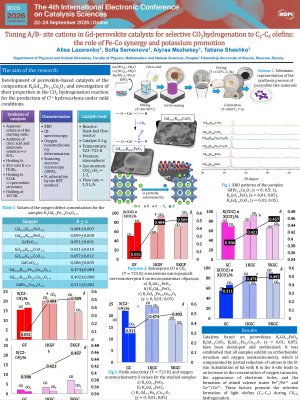
GdCoxFe1-хO3 (х=0; 0.2; 0.5; 0.8; 1) and potassium-doped analogues (KyGd1-yFeO3, KyGd1-yCoO3, KyGd1-yCo0.5Fe0.5O3) were synthesized via a citrate–nitrate sol-gel route and characterized by XRD, XPS, FTIR spectroscopy, TGA-DSC, and iodometric titration.
Results
All compositions adopt a single-phase orthorhombic perovskite structure. XPS analysis revealed coexisting mixed-valence states at the B-site (Fe2+/Fe3+, Co2+/Co3+). Potassium incorporation generates ordered oxygen vacancies that serve as CO2 activation sites, accompanied by reduction of the B-site cation oxidation states. TGA-DSC confirmed the thermal robustness of GdFeO₃, whereas cobalt-enriched phases showed partial decomposition under prolonged operation. Catalytic evaluation under CO/CO2 hydrogenation conditions (523-723 K) yielded 80-100% conversion, correlating with oxygen non-stoichiometry. The equimolar composition GdCo0.5Fe0.5O3 exhibited superior C2-C3 olefin selectivity, attributed to a balanced Fe2+/Co2+ ratio that governs chain propagation, olefin desorption, and suppression of secondary hydrogenation. Potassium acts as a bifunctional promoter, enhancing both vacancy ordering and olefin selectivity.
Conclusions
Catalytic performance is governed by the synergistic interplay between B-site Fe/Co composition and potassium-induced vacancy concentration - parameters that together determine active site density, redox state, and surface basicity. These findings support rational perovskite engineering as an effective strategy for sustainable CO2 upcycling to light olefins from bio-derived syngas.
Keywords
biosyngas
cobaltites
ferrites
energy
fisher-tropsh synthesis,potassium doping
light olefins
CO2 hydrogenation
Poster
MDPI_LAZARENKO.pdf
Pythia: A Surface-Based Deep Learning Framework for Predicting Carbohydrate-Binding Module Specificity
A Comparative In Silico Analysis of Bacterial Lipases: Thermostability, Solvent Tolerance, and Kinetic Profiles Across Geobacillus, Pseudomonas, and Bacillus