Event submissions
Published
This submission belongs to the session S4. Biocatalysis of the event The 4th International Electronic Conference on Catalysis Sciences
Published date
16 Sep, 2026
Academic Editor
'%3e%3cpath%20d='M12.6657%2010.9104C12.4185%2010.325%2012.0599%209.79327%2011.6097%209.34482C11.1609%208.89508%2010.6293%208.5365%2010.0442%208.28888C10.0389%208.28626%2010.0337%208.28495%2010.0285%208.28233C10.8446%207.69279%2011.3752%206.73249%2011.3752%205.64904C11.3752%203.8542%209.92103%202.39999%208.1262%202.39999C6.33136%202.39999%204.87715%203.8542%204.87715%205.64904C4.87715%206.73249%205.40774%207.69279%206.22393%208.28364C6.21869%208.28626%206.21345%208.28757%206.20821%208.29019C5.62129%208.5378%205.09463%208.89284%204.64265%209.34613C4.1929%209.79493%203.83432%2010.3266%203.58671%2010.9117C3.34345%2011.4845%203.21226%2012.0987%203.20023%2012.7209C3.19988%2012.7349%203.20233%2012.7488%203.20744%2012.7619C3.21255%2012.7749%203.22022%2012.7867%203.22998%2012.7968C3.23975%2012.8068%203.25142%2012.8147%203.26431%2012.8202C3.2772%2012.8256%203.29105%2012.8284%203.30504%2012.8284H4.09109C4.14874%2012.8284%204.19459%2012.7825%204.1959%2012.7262C4.2221%2011.7148%204.62823%2010.7676%205.34617%2010.0497C6.08899%209.30683%207.0755%208.89808%208.1262%208.89808C9.17689%208.89808%2010.1634%209.30683%2010.9062%2010.0497C11.6242%2010.7676%2012.0303%2011.7148%2012.0565%2012.7262C12.0578%2012.7838%2012.1037%2012.8284%2012.1613%2012.8284H12.9474C12.9613%2012.8284%2012.9752%2012.8256%2012.9881%2012.8202C13.001%2012.8147%2013.0126%2012.8068%2013.0224%2012.7968C13.0322%2012.7867%2013.0398%2012.7749%2013.0449%2012.7619C13.0501%2012.7488%2013.0525%2012.7349%2013.0522%2012.7209C13.0391%2012.0947%2012.9094%2011.4855%2012.6657%2010.9104ZM8.1262%207.9024C7.52486%207.9024%206.9589%207.6679%206.53312%207.24211C6.10733%206.81633%205.87283%206.25037%205.87283%205.64904C5.87283%205.0477%206.10733%204.48174%206.53312%204.05596C6.9589%203.63018%207.52486%203.39567%208.1262%203.39567C8.72753%203.39567%209.29349%203.63018%209.71927%204.05596C10.1451%204.48174%2010.3796%205.0477%2010.3796%205.64904C10.3796%206.25037%2010.1451%206.81633%209.71927%207.24211C9.29349%207.6679%208.72753%207.9024%208.1262%207.9024Z'%20fill='%235D1EE1'/%3e%3c/g%3e%3c/svg%3e) Evangelos Topakas
Evangelos TopakasCitation
Sina Saadati, Samaneh Rashtbari, A Comparative In Silico Analysis of Bacterial Lipases: Thermostability, Solvent Tolerance, and Kinetic Profiles Across Geobacillus, Pseudomonas, and Bacillus, in Proceedings of The 4th International Electronic Conference on Catalysis Sciences, 22 September–24 September 2026, MDPI: Basel, Switzerland
Share
Email
Facebook
Twitter
LinkedIn
A Comparative In Silico Analysis of Bacterial Lipases: Thermostability, Solvent Tolerance, and Kinetic Profiles Across Geobacillus, Pseudomonas, and Bacillus
'%3e%3cpath%20d='M12.6647%2010.9104C12.4176%2010.325%2012.0589%209.7933%2011.6088%209.34485C11.16%208.89511%2010.6283%208.53653%2010.0432%208.28891C10.038%208.28629%2010.0327%208.28498%2010.0275%208.28236C10.8437%207.69282%2011.3743%206.73252%2011.3743%205.64907C11.3743%203.85423%209.92005%202.40002%208.12522%202.40002C6.33038%202.40002%204.87618%203.85423%204.87618%205.64907C4.87618%206.73252%205.40677%207.69282%206.22296%208.28367C6.21772%208.28629%206.21248%208.2876%206.20724%208.29022C5.62031%208.53783%205.09365%208.89287%204.64167%209.34616C4.19192%209.79496%203.83334%2010.3266%203.58573%2010.9117C3.34247%2011.4846%203.21128%2012.0987%203.19925%2012.721C3.1989%2012.735%203.20135%2012.7489%203.20646%2012.7619C3.21157%2012.7749%203.21924%2012.7868%203.22901%2012.7968C3.23877%2012.8068%203.25045%2012.8148%203.26334%2012.8202C3.27623%2012.8256%203.29007%2012.8284%203.30406%2012.8284H4.09012C4.14776%2012.8284%204.19362%2012.7825%204.19493%2012.7262C4.22113%2011.7148%204.62726%2010.7676%205.34519%2010.0497C6.08802%209.30686%207.07452%208.89811%208.12522%208.89811C9.17592%208.89811%2010.1624%209.30686%2010.9052%2010.0497C11.6232%2010.7676%2012.0293%2011.7148%2012.0555%2012.7262C12.0568%2012.7839%2012.1027%2012.8284%2012.1603%2012.8284H12.9464C12.9604%2012.8284%2012.9742%2012.8256%2012.9871%2012.8202C13%2012.8148%2013.0117%2012.8068%2013.0214%2012.7968C13.0312%2012.7868%2013.0389%2012.7749%2013.044%2012.7619C13.0491%2012.7489%2013.0515%2012.735%2013.0512%2012.721C13.0381%2012.0947%2012.9084%2011.4856%2012.6647%2010.9104ZM8.12522%207.90243C7.52388%207.90243%206.95792%207.66793%206.53214%207.24215C6.10636%206.81636%205.87185%206.2504%205.87185%205.64907C5.87185%205.04773%206.10636%204.48177%206.53214%204.05599C6.95792%203.63021%207.52388%203.3957%208.12522%203.3957C8.72655%203.3957%209.29252%203.63021%209.7183%204.05599C10.1441%204.48177%2010.3786%205.04773%2010.3786%205.64907C10.3786%206.2504%2010.1441%206.81636%209.7183%207.24215C9.29252%207.66793%208.72655%207.90243%208.12522%207.90243Z'%20fill='%235D1EE1'/%3e%3c/g%3e%3c/svg%3e)
Sina Saadati 1
Samaneh Rashtbari 1
1. Department of Animal Biology, Faculty of Natural Sciences, University of Tabriz, Tabriz, Iran
Abstract
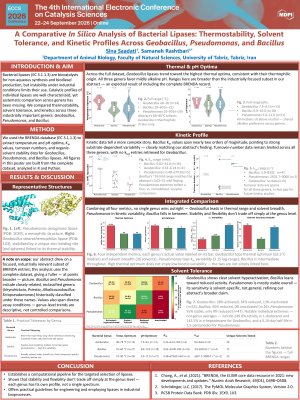
Background: Bacterial lipases (EC 3.1.1.3) are pivotal biocatalysts widely used in non-aqueous synthesis and biodiesel production. However, enzyme instability in demanding industrial conditions remains a major challenge. While the catalytic profiles of specific lipases have been well-characterized in vitro, a systematic comparative analysis of these parameters across different bacterial genera is currently lacking.
Methods: To address this gap, we conducted an in silico study using the BRENDA database to investigate structural-functional relationships across three major industrial genera: Geobacillus, Pseudomonas, and Bacillus. We systematically identified and analyzed quantitative parameters, including Michaelis constants (Km), temperature and pH optima, and solvent stability profiles.
Results: Our analysis revealed a significant inverse relationship between structural stability and catalytic flexibility. Thermophilic Geobacillus lipases (optimal temperature 68–80°C; pH 7.5–9.0) demonstrated remarkable tolerance to organic solvents, often exhibiting hyperactivation (e.g., reaching 149.6% and 142.5% relative activity in 1-dodecanol and n-heptadecane, respectively). In contrast, mesophilic Pseudomonas lipases (optimal temperature 45–60°C; pH 6.0–9.0) were highly sensitive to solvent-induced inactivation, indicated by rapid half-life decay (e.g., just 0.19 days in 1,5-pentanediol). Furthermore, kinetic profiling of Bacillus lipases highlighted substrate-dependent variability, with Km values shifting significantly from 0.62 mM to 22 mM. This indicates that the structural rigidity required for thermotolerance and solvent stability constrains substrate affinity in non-aqueous media.
Conclusion: This study establishes a computational pipeline for the targeted selection of lipases. By integrating macroscopic conditions (temperature/pH) with solvent stability and kinetic properties, our findings offer practical guidelines for engineering and employing lipases in industrial bioprocesses.
Keywords
Biocatalysis
lipase
BRENDA
kinetic parameters
organic solvent stability
thermostability.
Poster
ECCS2026.pdf
Tuning A/B- site cations in Gd-perovskite catalysts for selective CO2 hydrogenation to C2-C3 olefins: the role of Fe-Co synergy and potassium promotion
Alkane Hydroxylation by Anchored Unspecific Peroxygenase