Event submissions
Published
This submission belongs to the session S5. Biomass Catalysis of the event The 4th International Electronic Conference on Catalysis Sciences
Published date
16 Sep, 2026
Academic Editor
'%3e%3cpath%20d='M12.6657%2010.9104C12.4185%2010.325%2012.0599%209.79327%2011.6097%209.34482C11.1609%208.89508%2010.6293%208.5365%2010.0442%208.28888C10.0389%208.28626%2010.0337%208.28495%2010.0285%208.28233C10.8446%207.69279%2011.3752%206.73249%2011.3752%205.64904C11.3752%203.8542%209.92103%202.39999%208.1262%202.39999C6.33136%202.39999%204.87715%203.8542%204.87715%205.64904C4.87715%206.73249%205.40774%207.69279%206.22393%208.28364C6.21869%208.28626%206.21345%208.28757%206.20821%208.29019C5.62129%208.5378%205.09463%208.89284%204.64265%209.34613C4.1929%209.79493%203.83432%2010.3266%203.58671%2010.9117C3.34345%2011.4845%203.21226%2012.0987%203.20023%2012.7209C3.19988%2012.7349%203.20233%2012.7488%203.20744%2012.7619C3.21255%2012.7749%203.22022%2012.7867%203.22998%2012.7968C3.23975%2012.8068%203.25142%2012.8147%203.26431%2012.8202C3.2772%2012.8256%203.29105%2012.8284%203.30504%2012.8284H4.09109C4.14874%2012.8284%204.19459%2012.7825%204.1959%2012.7262C4.2221%2011.7148%204.62823%2010.7676%205.34617%2010.0497C6.08899%209.30683%207.0755%208.89808%208.1262%208.89808C9.17689%208.89808%2010.1634%209.30683%2010.9062%2010.0497C11.6242%2010.7676%2012.0303%2011.7148%2012.0565%2012.7262C12.0578%2012.7838%2012.1037%2012.8284%2012.1613%2012.8284H12.9474C12.9613%2012.8284%2012.9752%2012.8256%2012.9881%2012.8202C13.001%2012.8147%2013.0126%2012.8068%2013.0224%2012.7968C13.0322%2012.7867%2013.0398%2012.7749%2013.0449%2012.7619C13.0501%2012.7488%2013.0525%2012.7349%2013.0522%2012.7209C13.0391%2012.0947%2012.9094%2011.4855%2012.6657%2010.9104ZM8.1262%207.9024C7.52486%207.9024%206.9589%207.6679%206.53312%207.24211C6.10733%206.81633%205.87283%206.25037%205.87283%205.64904C5.87283%205.0477%206.10733%204.48174%206.53312%204.05596C6.9589%203.63018%207.52486%203.39567%208.1262%203.39567C8.72753%203.39567%209.29349%203.63018%209.71927%204.05596C10.1451%204.48174%2010.3796%205.0477%2010.3796%205.64904C10.3796%206.25037%2010.1451%206.81633%209.71927%207.24211C9.29349%207.6679%208.72753%207.9024%208.1262%207.9024Z'%20fill='%235D1EE1'/%3e%3c/g%3e%3c/svg%3e) Changwei Hu
Changwei HuCitation
Oana Adriana Petcuta, Maria Alexandra Balan, Simona Coman, CATALYTIC UPGRADING OF GLYCEROL TO ADVANCED FUEL ADDITIVES, in Proceedings of The 4th International Electronic Conference on Catalysis Sciences, 22 September–24 September 2026, MDPI: Basel, Switzerland
Share
Email
Facebook
Twitter
LinkedIn
CATALYTIC UPGRADING OF GLYCEROL TO ADVANCED FUEL ADDITIVES
'%3e%3cpath%20d='M12.6647%2010.9104C12.4176%2010.325%2012.0589%209.7933%2011.6088%209.34485C11.16%208.89511%2010.6283%208.53653%2010.0432%208.28891C10.038%208.28629%2010.0327%208.28498%2010.0275%208.28236C10.8437%207.69282%2011.3743%206.73252%2011.3743%205.64907C11.3743%203.85423%209.92005%202.40002%208.12522%202.40002C6.33038%202.40002%204.87618%203.85423%204.87618%205.64907C4.87618%206.73252%205.40677%207.69282%206.22296%208.28367C6.21772%208.28629%206.21248%208.2876%206.20724%208.29022C5.62031%208.53783%205.09365%208.89287%204.64167%209.34616C4.19192%209.79496%203.83334%2010.3266%203.58573%2010.9117C3.34247%2011.4846%203.21128%2012.0987%203.19925%2012.721C3.1989%2012.735%203.20135%2012.7489%203.20646%2012.7619C3.21157%2012.7749%203.21924%2012.7868%203.22901%2012.7968C3.23877%2012.8068%203.25045%2012.8148%203.26334%2012.8202C3.27623%2012.8256%203.29007%2012.8284%203.30406%2012.8284H4.09012C4.14776%2012.8284%204.19362%2012.7825%204.19493%2012.7262C4.22113%2011.7148%204.62726%2010.7676%205.34519%2010.0497C6.08802%209.30686%207.07452%208.89811%208.12522%208.89811C9.17592%208.89811%2010.1624%209.30686%2010.9052%2010.0497C11.6232%2010.7676%2012.0293%2011.7148%2012.0555%2012.7262C12.0568%2012.7839%2012.1027%2012.8284%2012.1603%2012.8284H12.9464C12.9604%2012.8284%2012.9742%2012.8256%2012.9871%2012.8202C13%2012.8148%2013.0117%2012.8068%2013.0214%2012.7968C13.0312%2012.7868%2013.0389%2012.7749%2013.044%2012.7619C13.0491%2012.7489%2013.0515%2012.735%2013.0512%2012.721C13.0381%2012.0947%2012.9084%2011.4856%2012.6647%2010.9104ZM8.12522%207.90243C7.52388%207.90243%206.95792%207.66793%206.53214%207.24215C6.10636%206.81636%205.87185%206.2504%205.87185%205.64907C5.87185%205.04773%206.10636%204.48177%206.53214%204.05599C6.95792%203.63021%207.52388%203.3957%208.12522%203.3957C8.72655%203.3957%209.29252%203.63021%209.7183%204.05599C10.1441%204.48177%2010.3786%205.04773%2010.3786%205.64907C10.3786%206.2504%2010.1441%206.81636%209.7183%207.24215C9.29252%207.66793%208.72655%207.90243%208.12522%207.90243Z'%20fill='%235D1EE1'/%3e%3c/g%3e%3c/svg%3e)
Oana Adriana Petcuta 1
Maria Alexandra Balan 1

Simona Coman 1
1. Inorganic Chemistry, Organic Chemistry, Biochemistry and Catalysis, Faculty of Chemistry, University of Bucharest, Bucharest, Romania
Abstract
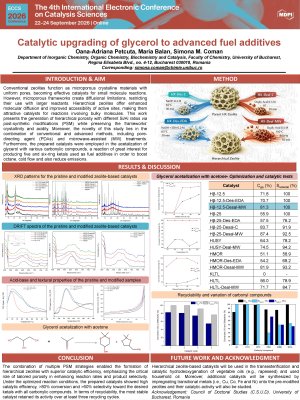
Hierarchical zeolites offer enhanced molecular diffusion and improved accessibility of active sites, making them attractive catalysts for reactions involving bulky molecules. This work presents the generation of hierarchical porosity with different Si/Al ratios via post-synthetic modifications (PSM) while preserving the frameworks’ crystallinity and acidity. Moreover, the novelty of this study lies in the combination of conventional and advanced methods, including pore-directing agent (PDAs) and microwave-assisted (MW) treatments.
A series of different zeolitic structures (beta-Hβ, mordenite-HMOR, L-KLTL, and ultra-stable Y-HUSY) were subjected to demetallation, namely desilication and dealumination, according to their Si/Al ratio. Each process was performed either conventionally (Des-C/Deal-C), or with ethylenediamine as the PDA for desilication (Des-EDA) and via microwave irradiation for dealumination (Deal-MW). Samples undergoing both desilication and dealumination were denoted as Desal-C and Desal-MW, respectively. As a result, XRD patterns highlighted that desilication with PDAs and MW-assisted dealumination showed improvement over conventional method while, maintaining structural integrity. Furthermore, the prepared catalysts were employed in the acetalization of glycerol with various carbonylic compounds, a reaction of great interest for producing five and six-ring ketals used as fuel additives in order to boost octane, cold flow and also reduce emissions.
Under the optimized reaction conditions, hierarchical zeolites showed high catalytic efficiency, >80% conversion and >60% selectivity toward the desired ketals. In terms of recyclability, the most stable catalyst retained its activity over at least three recycling cycles.
The combination of multiple PSM strategies enabled the formation of hierarchical zeolites with superior catalytic efficiency, emphasizing the critical role of tailored porosity in enhancing reaction rates and product selectivity. The influence of the textural, acid/base, density, distribution of active sites, and type of PSM properties on the efficiency of the catalysts in the aforesaid processes will be discussed.
Keywords
catalysis
zeolites
hierarchical
glycerol
additives
Poster
ECSS_2026_Poster_190163.pdf
Single-Step Ethanol Conversion into 1,3‑Butadiene over Bimetallic Silica‑Supported Catalysts: Optimization of the Reaction Pathway
Sulfur‑Driven Reconstruction of Ni Foams into NiOOH for Lignin Electro‑Depolymerization