Event submissions
Published
This submission belongs to the session S5. Biomass Catalysis of the event The 4th International Electronic Conference on Catalysis Sciences
Published date
16 Sep, 2026
Academic Editor
'%3e%3cpath%20d='M12.6657%2010.9104C12.4185%2010.325%2012.0599%209.79327%2011.6097%209.34482C11.1609%208.89508%2010.6293%208.5365%2010.0442%208.28888C10.0389%208.28626%2010.0337%208.28495%2010.0285%208.28233C10.8446%207.69279%2011.3752%206.73249%2011.3752%205.64904C11.3752%203.8542%209.92103%202.39999%208.1262%202.39999C6.33136%202.39999%204.87715%203.8542%204.87715%205.64904C4.87715%206.73249%205.40774%207.69279%206.22393%208.28364C6.21869%208.28626%206.21345%208.28757%206.20821%208.29019C5.62129%208.5378%205.09463%208.89284%204.64265%209.34613C4.1929%209.79493%203.83432%2010.3266%203.58671%2010.9117C3.34345%2011.4845%203.21226%2012.0987%203.20023%2012.7209C3.19988%2012.7349%203.20233%2012.7488%203.20744%2012.7619C3.21255%2012.7749%203.22022%2012.7867%203.22998%2012.7968C3.23975%2012.8068%203.25142%2012.8147%203.26431%2012.8202C3.2772%2012.8256%203.29105%2012.8284%203.30504%2012.8284H4.09109C4.14874%2012.8284%204.19459%2012.7825%204.1959%2012.7262C4.2221%2011.7148%204.62823%2010.7676%205.34617%2010.0497C6.08899%209.30683%207.0755%208.89808%208.1262%208.89808C9.17689%208.89808%2010.1634%209.30683%2010.9062%2010.0497C11.6242%2010.7676%2012.0303%2011.7148%2012.0565%2012.7262C12.0578%2012.7838%2012.1037%2012.8284%2012.1613%2012.8284H12.9474C12.9613%2012.8284%2012.9752%2012.8256%2012.9881%2012.8202C13.001%2012.8147%2013.0126%2012.8068%2013.0224%2012.7968C13.0322%2012.7867%2013.0398%2012.7749%2013.0449%2012.7619C13.0501%2012.7488%2013.0525%2012.7349%2013.0522%2012.7209C13.0391%2012.0947%2012.9094%2011.4855%2012.6657%2010.9104ZM8.1262%207.9024C7.52486%207.9024%206.9589%207.6679%206.53312%207.24211C6.10733%206.81633%205.87283%206.25037%205.87283%205.64904C5.87283%205.0477%206.10733%204.48174%206.53312%204.05596C6.9589%203.63018%207.52486%203.39567%208.1262%203.39567C8.72753%203.39567%209.29349%203.63018%209.71927%204.05596C10.1451%204.48174%2010.3796%205.0477%2010.3796%205.64904C10.3796%206.25037%2010.1451%206.81633%209.71927%207.24211C9.29349%207.6679%208.72753%207.9024%208.1262%207.9024Z'%20fill='%235D1EE1'/%3e%3c/g%3e%3c/svg%3e) Changwei Hu
Changwei HuCitation
Clara Hernández Luna, Rafael Estévez, Ana Granados, Vicente Montes, Felipa Maria Baustista, Analysis of solketal tert-butyl ether (STBE) production for potential industrial scaling. Use as an oxygenated additive in diesel fuel blends to reduce pollutant emissions., in Proceedings of The 4th International Electronic Conference on Catalysis Sciences, 22 September–24 September 2026, MDPI: Basel, Switzerland
Share
Email
Facebook
Twitter
LinkedIn
Analysis of solketal tert-butyl ether (STBE) production for potential industrial scaling. Use as an oxygenated additive in diesel fuel blends to reduce pollutant emissions.
'%3e%3cpath%20d='M12.6647%2010.9104C12.4176%2010.325%2012.0589%209.7933%2011.6088%209.34485C11.16%208.89511%2010.6283%208.53653%2010.0432%208.28891C10.038%208.28629%2010.0327%208.28498%2010.0275%208.28236C10.8437%207.69282%2011.3743%206.73252%2011.3743%205.64907C11.3743%203.85423%209.92005%202.40002%208.12522%202.40002C6.33038%202.40002%204.87618%203.85423%204.87618%205.64907C4.87618%206.73252%205.40677%207.69282%206.22296%208.28367C6.21772%208.28629%206.21248%208.2876%206.20724%208.29022C5.62031%208.53783%205.09365%208.89287%204.64167%209.34616C4.19192%209.79496%203.83334%2010.3266%203.58573%2010.9117C3.34247%2011.4846%203.21128%2012.0987%203.19925%2012.721C3.1989%2012.735%203.20135%2012.7489%203.20646%2012.7619C3.21157%2012.7749%203.21924%2012.7868%203.22901%2012.7968C3.23877%2012.8068%203.25045%2012.8148%203.26334%2012.8202C3.27623%2012.8256%203.29007%2012.8284%203.30406%2012.8284H4.09012C4.14776%2012.8284%204.19362%2012.7825%204.19493%2012.7262C4.22113%2011.7148%204.62726%2010.7676%205.34519%2010.0497C6.08802%209.30686%207.07452%208.89811%208.12522%208.89811C9.17592%208.89811%2010.1624%209.30686%2010.9052%2010.0497C11.6232%2010.7676%2012.0293%2011.7148%2012.0555%2012.7262C12.0568%2012.7839%2012.1027%2012.8284%2012.1603%2012.8284H12.9464C12.9604%2012.8284%2012.9742%2012.8256%2012.9871%2012.8202C13%2012.8148%2013.0117%2012.8068%2013.0214%2012.7968C13.0312%2012.7868%2013.0389%2012.7749%2013.044%2012.7619C13.0491%2012.7489%2013.0515%2012.735%2013.0512%2012.721C13.0381%2012.0947%2012.9084%2011.4856%2012.6647%2010.9104ZM8.12522%207.90243C7.52388%207.90243%206.95792%207.66793%206.53214%207.24215C6.10636%206.81636%205.87185%206.2504%205.87185%205.64907C5.87185%205.04773%206.10636%204.48177%206.53214%204.05599C6.95792%203.63021%207.52388%203.3957%208.12522%203.3957C8.72655%203.3957%209.29252%203.63021%209.7183%204.05599C10.1441%204.48177%2010.3786%205.04773%2010.3786%205.64907C10.3786%206.2504%2010.1441%206.81636%209.7183%207.24215C9.29252%207.66793%208.72655%207.90243%208.12522%207.90243Z'%20fill='%235D1EE1'/%3e%3c/g%3e%3c/svg%3e)
Clara Hernández Luna 1

Rafael Estévez 1
Ana Granados 1

Vicente Montes 1
Felipa Maria Baustista 1
1. Department of Organic Chemistry, Institute of Chemical Energy and Environment (IQUEMA), University of Córdoba, CeiA3 International Campus of Excellence in Agri-Food, Marie Curie Building, E-14014, Córdoba, Spain
Abstract
Solketal, also known as 2,2-dimethyl-4-hydroxymethyl-1,3-dioxolane, is the main product of the ketalization reaction between glycerol and acetone. This compound can be used as a fuel additive; however, it cannot be blended with diesel in proportions higher than 5% due to physicochemical limitations.
An alternative approach is its alkylation to produce solketal tert-butyl ether (STBE), a compound that is not commercially available and for which, limited information is found in the literature, but which can be used as an oxygenated fuel additive due to its higher physicochemical affinity with diesel.
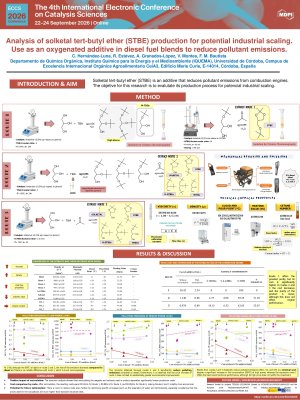
This work focuses on optimizing STBE synthesis. The conventional route (1) involves ketalization of 1-mono glycerol tert-butyl ether (1-m-GTBE) with acetone followed by isolation of STBE through Column Chromatography, a complex process with high solvent consumption. To reduce the number of steps, two alternative routes were studied: (2) synthesis from a mixture of MTBGs and h-GTBEs, avoiding chromatographic separation after glycerol etherification with tert-butanol; and (3) direct reaction between glycerol, tert-butanol, and acetone with unreacted glycerol removed by liquid-liquid extraction. All three processes were economically evaluated considering reagent, solvent, and energy consumption.
The fractions obtained from the three routes were blended with diesel at 5% v/v and their physicochemical properties were analyzed, confirming compliance with fuel standards (UNE-EN 590:2022). Their performance was evaluated in a diesel engine coupled to an AYERBE generator (5 kVA, 230 V).
Results showed that all three routes reduced pollutant emissions, in some cases substantially, compared to conventional diesel, without significantly affecting engine power output. The economic study indicated that routes 2 (0.88 €/mL) and 3 (0.89 €/mL) substantially lowered costs relative to route 1 (2.54 €/mL). Although product purity decreased, no significant differences were observed in engine performance.
Keywords
oxygenated fuel additives
solketal tert-butyl ether (STBE)
glycerol valorization
diesel blends
emission reduction
Poster
Clara Hernández Luna póster.pdf
Sulfur‑Driven Reconstruction of Ni Foams into NiOOH for Lignin Electro‑Depolymerization
Mo and V transition metal complexes as catalysts for biomass valorisation using organic-solvent sober processes