Event submissions
Published
This submission belongs to the session S5. Biomass Catalysis of the event The 4th International Electronic Conference on Catalysis Sciences
Published date
16 Sep, 2026
Academic Editor
'%3e%3cpath%20d='M12.6657%2010.9104C12.4185%2010.325%2012.0599%209.79327%2011.6097%209.34482C11.1609%208.89508%2010.6293%208.5365%2010.0442%208.28888C10.0389%208.28626%2010.0337%208.28495%2010.0285%208.28233C10.8446%207.69279%2011.3752%206.73249%2011.3752%205.64904C11.3752%203.8542%209.92103%202.39999%208.1262%202.39999C6.33136%202.39999%204.87715%203.8542%204.87715%205.64904C4.87715%206.73249%205.40774%207.69279%206.22393%208.28364C6.21869%208.28626%206.21345%208.28757%206.20821%208.29019C5.62129%208.5378%205.09463%208.89284%204.64265%209.34613C4.1929%209.79493%203.83432%2010.3266%203.58671%2010.9117C3.34345%2011.4845%203.21226%2012.0987%203.20023%2012.7209C3.19988%2012.7349%203.20233%2012.7488%203.20744%2012.7619C3.21255%2012.7749%203.22022%2012.7867%203.22998%2012.7968C3.23975%2012.8068%203.25142%2012.8147%203.26431%2012.8202C3.2772%2012.8256%203.29105%2012.8284%203.30504%2012.8284H4.09109C4.14874%2012.8284%204.19459%2012.7825%204.1959%2012.7262C4.2221%2011.7148%204.62823%2010.7676%205.34617%2010.0497C6.08899%209.30683%207.0755%208.89808%208.1262%208.89808C9.17689%208.89808%2010.1634%209.30683%2010.9062%2010.0497C11.6242%2010.7676%2012.0303%2011.7148%2012.0565%2012.7262C12.0578%2012.7838%2012.1037%2012.8284%2012.1613%2012.8284H12.9474C12.9613%2012.8284%2012.9752%2012.8256%2012.9881%2012.8202C13.001%2012.8147%2013.0126%2012.8068%2013.0224%2012.7968C13.0322%2012.7867%2013.0398%2012.7749%2013.0449%2012.7619C13.0501%2012.7488%2013.0525%2012.7349%2013.0522%2012.7209C13.0391%2012.0947%2012.9094%2011.4855%2012.6657%2010.9104ZM8.1262%207.9024C7.52486%207.9024%206.9589%207.6679%206.53312%207.24211C6.10733%206.81633%205.87283%206.25037%205.87283%205.64904C5.87283%205.0477%206.10733%204.48174%206.53312%204.05596C6.9589%203.63018%207.52486%203.39567%208.1262%203.39567C8.72753%203.39567%209.29349%203.63018%209.71927%204.05596C10.1451%204.48174%2010.3796%205.0477%2010.3796%205.64904C10.3796%206.25037%2010.1451%206.81633%209.71927%207.24211C9.29349%207.6679%208.72753%207.9024%208.1262%207.9024Z'%20fill='%235D1EE1'/%3e%3c/g%3e%3c/svg%3e) Changwei Hu
Changwei HuCitation
Mihai Bordeiasu, Joanna Goscianska, Simona Coman, Catalytic production of Furfuryl Alcohol on Bimetallic Nitrogen-doped Carbon Nanoframeworks, in Proceedings of The 4th International Electronic Conference on Catalysis Sciences, 22 September–24 September 2026, MDPI: Basel, Switzerland
Share
Email
Facebook
Twitter
LinkedIn
Catalytic production of Furfuryl Alcohol on Bimetallic Nitrogen-doped Carbon Nanoframeworks
'%3e%3cpath%20d='M12.6647%2010.9104C12.4176%2010.325%2012.0589%209.7933%2011.6088%209.34485C11.16%208.89511%2010.6283%208.53653%2010.0432%208.28891C10.038%208.28629%2010.0327%208.28498%2010.0275%208.28236C10.8437%207.69282%2011.3743%206.73252%2011.3743%205.64907C11.3743%203.85423%209.92005%202.40002%208.12522%202.40002C6.33038%202.40002%204.87618%203.85423%204.87618%205.64907C4.87618%206.73252%205.40677%207.69282%206.22296%208.28367C6.21772%208.28629%206.21248%208.2876%206.20724%208.29022C5.62031%208.53783%205.09365%208.89287%204.64167%209.34616C4.19192%209.79496%203.83334%2010.3266%203.58573%2010.9117C3.34247%2011.4846%203.21128%2012.0987%203.19925%2012.721C3.1989%2012.735%203.20135%2012.7489%203.20646%2012.7619C3.21157%2012.7749%203.21924%2012.7868%203.22901%2012.7968C3.23877%2012.8068%203.25045%2012.8148%203.26334%2012.8202C3.27623%2012.8256%203.29007%2012.8284%203.30406%2012.8284H4.09012C4.14776%2012.8284%204.19362%2012.7825%204.19493%2012.7262C4.22113%2011.7148%204.62726%2010.7676%205.34519%2010.0497C6.08802%209.30686%207.07452%208.89811%208.12522%208.89811C9.17592%208.89811%2010.1624%209.30686%2010.9052%2010.0497C11.6232%2010.7676%2012.0293%2011.7148%2012.0555%2012.7262C12.0568%2012.7839%2012.1027%2012.8284%2012.1603%2012.8284H12.9464C12.9604%2012.8284%2012.9742%2012.8256%2012.9871%2012.8202C13%2012.8148%2013.0117%2012.8068%2013.0214%2012.7968C13.0312%2012.7868%2013.0389%2012.7749%2013.044%2012.7619C13.0491%2012.7489%2013.0515%2012.735%2013.0512%2012.721C13.0381%2012.0947%2012.9084%2011.4856%2012.6647%2010.9104ZM8.12522%207.90243C7.52388%207.90243%206.95792%207.66793%206.53214%207.24215C6.10636%206.81636%205.87185%206.2504%205.87185%205.64907C5.87185%205.04773%206.10636%204.48177%206.53214%204.05599C6.95792%203.63021%207.52388%203.3957%208.12522%203.3957C8.72655%203.3957%209.29252%203.63021%209.7183%204.05599C10.1441%204.48177%2010.3786%205.04773%2010.3786%205.64907C10.3786%206.2504%2010.1441%206.81636%209.7183%207.24215C9.29252%207.66793%208.72655%207.90243%208.12522%207.90243Z'%20fill='%235D1EE1'/%3e%3c/g%3e%3c/svg%3e)
Mihai Bordeiasu 1

Joanna Goscianska 2

Simona Coman 1
1. Inorganic Chemistry, Organic Chemistry, Biochemistry and Catalysis, Faculty of Chemistry, University of Bucharest, Bucharest, Romania
2. Chemical Technology, Faculty of Chemistry, Adam Mickiewicz University, Poznań, Poland
Abstract
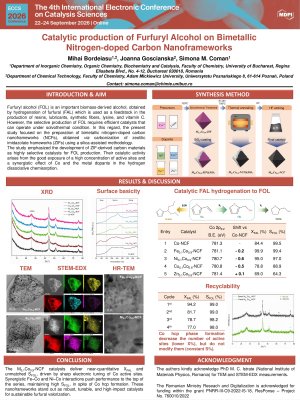
Furfuryl alcohol (FOL) is an important biomass-derived alcohol, obtained by hydrogenation of furfural (FAL) which is used as a feedstock in the production of resins, lubricants, synthetic fibers, lysine, and vitamin C. However, the selective production of FOL requires efficient catalysts that can operate under solvothermal condition. In this regard, the present study focused on the preparation of bimetallic nitrogen-doped carbon nanoframeworks (NCFs), obtained via carbonization of zeolitic imidazolate frameworks (ZIFs) using a silica-assisted methodology.
Several bimetallic M0.1Co0.9-ZIFs (M = Fe, Ni, Cu, Zn) were obtained under solvothermal conditions which was then subjected to carbonization at high temperatures under inert atmosphere, using a silica-protection shell, yielded to the corresponding M0.1Co0.9-NCF catalysts, after HF etching. The materials were fully characterized by XRD, FTIR, Raman, BET, NH3-/CO2-TPD, ICP-OES, XPS, TEM, and tested in the selective hydrogenation of FAL to FOL.
The synthesized M0.1Co0.9-NCF materials, characterized by a good dispersion of small metal nanoparticles embed in a nitrogen-rich graphitic carbon matrix, were found as highly efficient catalysts in the FOL production under mild reaction conditions (100℃, 15 bar H2, 3h) using ethanol as solvent. Fe- and Ni-doped catalysts afforded more than 95% FAL conversion and 97% FOL selectivity. Recyclability tests revealed a conversion drop over 3 subsequent cycles, but with constant selectivities as a result of small structural rearrangements.
The study emphasized the development of ZIF-derived carbon materials as highly selective catalysts for FOL production. Their catalytic activity arises from the good exposure of a high concentration of active sites and a synergistic effect of Co and the metal dopants in the hydrogen dissociative chemisorption.
Keywords
catalysis
N-carbons
bimetallic
hydrogenation
furfural
Poster
ECSS_2026_Poster_191657.pdf
Influence of Metal Identity in Amino Acid Functionalized ZIF-8 Nanozymes for Selective Methane Oxidation
Synthesis of Novel Core-Shell Ti/Zn-FeSi Sulfated Nanocatalysts for Biodiesel Production from Waste Cooking Oils