Event submissions
Published
This submission belongs to the session S5. Biomass Catalysis of the event The 4th International Electronic Conference on Catalysis Sciences
Published date
16 Sep, 2026
Academic Editor
'%3e%3cpath%20d='M12.6657%2010.9104C12.4185%2010.325%2012.0599%209.79327%2011.6097%209.34482C11.1609%208.89508%2010.6293%208.5365%2010.0442%208.28888C10.0389%208.28626%2010.0337%208.28495%2010.0285%208.28233C10.8446%207.69279%2011.3752%206.73249%2011.3752%205.64904C11.3752%203.8542%209.92103%202.39999%208.1262%202.39999C6.33136%202.39999%204.87715%203.8542%204.87715%205.64904C4.87715%206.73249%205.40774%207.69279%206.22393%208.28364C6.21869%208.28626%206.21345%208.28757%206.20821%208.29019C5.62129%208.5378%205.09463%208.89284%204.64265%209.34613C4.1929%209.79493%203.83432%2010.3266%203.58671%2010.9117C3.34345%2011.4845%203.21226%2012.0987%203.20023%2012.7209C3.19988%2012.7349%203.20233%2012.7488%203.20744%2012.7619C3.21255%2012.7749%203.22022%2012.7867%203.22998%2012.7968C3.23975%2012.8068%203.25142%2012.8147%203.26431%2012.8202C3.2772%2012.8256%203.29105%2012.8284%203.30504%2012.8284H4.09109C4.14874%2012.8284%204.19459%2012.7825%204.1959%2012.7262C4.2221%2011.7148%204.62823%2010.7676%205.34617%2010.0497C6.08899%209.30683%207.0755%208.89808%208.1262%208.89808C9.17689%208.89808%2010.1634%209.30683%2010.9062%2010.0497C11.6242%2010.7676%2012.0303%2011.7148%2012.0565%2012.7262C12.0578%2012.7838%2012.1037%2012.8284%2012.1613%2012.8284H12.9474C12.9613%2012.8284%2012.9752%2012.8256%2012.9881%2012.8202C13.001%2012.8147%2013.0126%2012.8068%2013.0224%2012.7968C13.0322%2012.7867%2013.0398%2012.7749%2013.0449%2012.7619C13.0501%2012.7488%2013.0525%2012.7349%2013.0522%2012.7209C13.0391%2012.0947%2012.9094%2011.4855%2012.6657%2010.9104ZM8.1262%207.9024C7.52486%207.9024%206.9589%207.6679%206.53312%207.24211C6.10733%206.81633%205.87283%206.25037%205.87283%205.64904C5.87283%205.0477%206.10733%204.48174%206.53312%204.05596C6.9589%203.63018%207.52486%203.39567%208.1262%203.39567C8.72753%203.39567%209.29349%203.63018%209.71927%204.05596C10.1451%204.48174%2010.3796%205.0477%2010.3796%205.64904C10.3796%206.25037%2010.1451%206.81633%209.71927%207.24211C9.29349%207.6679%208.72753%207.9024%208.1262%207.9024Z'%20fill='%235D1EE1'/%3e%3c/g%3e%3c/svg%3e) Changwei Hu
Changwei HuCitation
Francisco Pérez Hidalgo, Vicente Montes Jiménez, Felipa Mª Bautista Rubio, Rafael Carlos Estevez Toledano, Microemulsion systems for glycerol valorization into diesel additives, in Proceedings of The 4th International Electronic Conference on Catalysis Sciences, 22 September–24 September 2026, MDPI: Basel, Switzerland
Share
Email
Facebook
Twitter
LinkedIn
Microemulsion systems for glycerol valorization into diesel additives
'%3e%3cpath%20d='M12.6647%2010.9104C12.4176%2010.325%2012.0589%209.7933%2011.6088%209.34485C11.16%208.89511%2010.6283%208.53653%2010.0432%208.28891C10.038%208.28629%2010.0327%208.28498%2010.0275%208.28236C10.8437%207.69282%2011.3743%206.73252%2011.3743%205.64907C11.3743%203.85423%209.92005%202.40002%208.12522%202.40002C6.33038%202.40002%204.87618%203.85423%204.87618%205.64907C4.87618%206.73252%205.40677%207.69282%206.22296%208.28367C6.21772%208.28629%206.21248%208.2876%206.20724%208.29022C5.62031%208.53783%205.09365%208.89287%204.64167%209.34616C4.19192%209.79496%203.83334%2010.3266%203.58573%2010.9117C3.34247%2011.4846%203.21128%2012.0987%203.19925%2012.721C3.1989%2012.735%203.20135%2012.7489%203.20646%2012.7619C3.21157%2012.7749%203.21924%2012.7868%203.22901%2012.7968C3.23877%2012.8068%203.25045%2012.8148%203.26334%2012.8202C3.27623%2012.8256%203.29007%2012.8284%203.30406%2012.8284H4.09012C4.14776%2012.8284%204.19362%2012.7825%204.19493%2012.7262C4.22113%2011.7148%204.62726%2010.7676%205.34519%2010.0497C6.08802%209.30686%207.07452%208.89811%208.12522%208.89811C9.17592%208.89811%2010.1624%209.30686%2010.9052%2010.0497C11.6232%2010.7676%2012.0293%2011.7148%2012.0555%2012.7262C12.0568%2012.7839%2012.1027%2012.8284%2012.1603%2012.8284H12.9464C12.9604%2012.8284%2012.9742%2012.8256%2012.9871%2012.8202C13%2012.8148%2013.0117%2012.8068%2013.0214%2012.7968C13.0312%2012.7868%2013.0389%2012.7749%2013.044%2012.7619C13.0491%2012.7489%2013.0515%2012.735%2013.0512%2012.721C13.0381%2012.0947%2012.9084%2011.4856%2012.6647%2010.9104ZM8.12522%207.90243C7.52388%207.90243%206.95792%207.66793%206.53214%207.24215C6.10636%206.81636%205.87185%206.2504%205.87185%205.64907C5.87185%205.04773%206.10636%204.48177%206.53214%204.05599C6.95792%203.63021%207.52388%203.3957%208.12522%203.3957C8.72655%203.3957%209.29252%203.63021%209.7183%204.05599C10.1441%204.48177%2010.3786%205.04773%2010.3786%205.64907C10.3786%206.2504%2010.1441%206.81636%209.7183%207.24215C9.29252%207.66793%208.72655%207.90243%208.12522%207.90243Z'%20fill='%235D1EE1'/%3e%3c/g%3e%3c/svg%3e)
Francisco Pérez Hidalgo 1

Vicente Montes Jiménez 1
Felipa Mª Bautista Rubio 1

Rafael Carlos Estevez Toledano 1
1. Department of Organic Chemistry, Chemical Institute for Energy and the Environment (IQUEMA), University of Córdoba, International Campus of Excellence in Agri-Food CeiA3, Marie Curie Building, E-14014, Córdoba, Spain
Abstract
The depletion of fossil fuel resources and their environmental impact have driven the search for sustainable alternatives such as biomass. Biodiesel production, a key component of this green transition, generates glycerol as a major byproduct, accounting for approximately 10% of the total process mass. Converting this surplus glycerol into high-value chemicals is essential to ensure the economic viability of biorefineries. In particular, the etherification of glycerol with tert-butanol produces di- and tri-tert-butyl glycerol ethers (h-GTBEs), valuable fuel additives that enhance engine performance and reduce particulate emissions. However, this acid-catalyzed reaction is limited by chemical equilibrium, as the water generated during the process promotes the hydrolysis of the desired ethers.
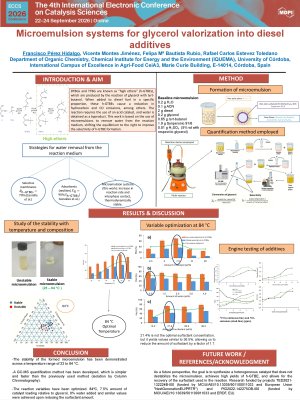
To overcome this limitation, this work develops a microemulsion system designed to protect h-GTBEs from water by partitioning them into an apolar domain. The reaction medium consists of a polar phase (glycerol, tert-butanol, acetonitrile, water, and H₂SO₄ as catalyst), an apolar phase (diesel), and a nonionic surfactant (Synperonic™ 91/6). System stability was evaluated over a temperature range of 25–85 °C, and the composition space was explored to construct a ternary phase diagram. In addition, a gas chromatography–mass spectrometry (GC–MS) method was validated for the quantification of the synthesized ethers.
The formulation remained fully stable up to 84 °C. An optimal catalyst concentration of 7.5 wt.% was identified, as higher concentrations disrupted the microemulsion structure. Experimental results also showed that increasing the water content reduced both glycerol conversion and ether selectivity. Finally, the amount of surfactant was successfully minimized to the range of 0.9–1.9 g, while concentrations below 0.9 g resulted in immediate phase separation.
Keywords
Glycerol
tert-Butanol
Etherification
Microemulsion
Oxygenated additive
Poster
Poster Francisco Pérez.pdf
Balancing Oxidation and Reforming Pathways for Energy-Efficient Methane Tri-Reforming over Ni/CeO2
Support-directed aromatisation of eucalyptus-derived 1,8-cineole over Fe-zeolite Y catalysts