Event submissions
Published
This submission belongs to the session S5. Biomass Catalysis of the event The 4th International Electronic Conference on Catalysis Sciences
Published date
16 Sep, 2026
Academic Editor
'%3e%3cpath%20d='M12.6657%2010.9104C12.4185%2010.325%2012.0599%209.79327%2011.6097%209.34482C11.1609%208.89508%2010.6293%208.5365%2010.0442%208.28888C10.0389%208.28626%2010.0337%208.28495%2010.0285%208.28233C10.8446%207.69279%2011.3752%206.73249%2011.3752%205.64904C11.3752%203.8542%209.92103%202.39999%208.1262%202.39999C6.33136%202.39999%204.87715%203.8542%204.87715%205.64904C4.87715%206.73249%205.40774%207.69279%206.22393%208.28364C6.21869%208.28626%206.21345%208.28757%206.20821%208.29019C5.62129%208.5378%205.09463%208.89284%204.64265%209.34613C4.1929%209.79493%203.83432%2010.3266%203.58671%2010.9117C3.34345%2011.4845%203.21226%2012.0987%203.20023%2012.7209C3.19988%2012.7349%203.20233%2012.7488%203.20744%2012.7619C3.21255%2012.7749%203.22022%2012.7867%203.22998%2012.7968C3.23975%2012.8068%203.25142%2012.8147%203.26431%2012.8202C3.2772%2012.8256%203.29105%2012.8284%203.30504%2012.8284H4.09109C4.14874%2012.8284%204.19459%2012.7825%204.1959%2012.7262C4.2221%2011.7148%204.62823%2010.7676%205.34617%2010.0497C6.08899%209.30683%207.0755%208.89808%208.1262%208.89808C9.17689%208.89808%2010.1634%209.30683%2010.9062%2010.0497C11.6242%2010.7676%2012.0303%2011.7148%2012.0565%2012.7262C12.0578%2012.7838%2012.1037%2012.8284%2012.1613%2012.8284H12.9474C12.9613%2012.8284%2012.9752%2012.8256%2012.9881%2012.8202C13.001%2012.8147%2013.0126%2012.8068%2013.0224%2012.7968C13.0322%2012.7867%2013.0398%2012.7749%2013.0449%2012.7619C13.0501%2012.7488%2013.0525%2012.7349%2013.0522%2012.7209C13.0391%2012.0947%2012.9094%2011.4855%2012.6657%2010.9104ZM8.1262%207.9024C7.52486%207.9024%206.9589%207.6679%206.53312%207.24211C6.10733%206.81633%205.87283%206.25037%205.87283%205.64904C5.87283%205.0477%206.10733%204.48174%206.53312%204.05596C6.9589%203.63018%207.52486%203.39567%208.1262%203.39567C8.72753%203.39567%209.29349%203.63018%209.71927%204.05596C10.1451%204.48174%2010.3796%205.0477%2010.3796%205.64904C10.3796%206.25037%2010.1451%206.81633%209.71927%207.24211C9.29349%207.6679%208.72753%207.9024%208.1262%207.9024Z'%20fill='%235D1EE1'/%3e%3c/g%3e%3c/svg%3e) Changwei Hu
Changwei HuCitation
Diyasha Sengupta, Shanthi Priya Samudrala, Support-directed aromatisation of eucalyptus-derived 1,8-cineole over Fe-zeolite Y catalysts , in Proceedings of The 4th International Electronic Conference on Catalysis Sciences, 22 September–24 September 2026, MDPI: Basel, Switzerland
Share
Email
Facebook
Twitter
LinkedIn
Support-directed aromatisation of eucalyptus-derived 1,8-cineole over Fe-zeolite Y catalysts
'%3e%3cpath%20d='M12.6647%2010.9104C12.4176%2010.325%2012.0589%209.7933%2011.6088%209.34485C11.16%208.89511%2010.6283%208.53653%2010.0432%208.28891C10.038%208.28629%2010.0327%208.28498%2010.0275%208.28236C10.8437%207.69282%2011.3743%206.73252%2011.3743%205.64907C11.3743%203.85423%209.92005%202.40002%208.12522%202.40002C6.33038%202.40002%204.87618%203.85423%204.87618%205.64907C4.87618%206.73252%205.40677%207.69282%206.22296%208.28367C6.21772%208.28629%206.21248%208.2876%206.20724%208.29022C5.62031%208.53783%205.09365%208.89287%204.64167%209.34616C4.19192%209.79496%203.83334%2010.3266%203.58573%2010.9117C3.34247%2011.4846%203.21128%2012.0987%203.19925%2012.721C3.1989%2012.735%203.20135%2012.7489%203.20646%2012.7619C3.21157%2012.7749%203.21924%2012.7868%203.22901%2012.7968C3.23877%2012.8068%203.25045%2012.8148%203.26334%2012.8202C3.27623%2012.8256%203.29007%2012.8284%203.30406%2012.8284H4.09012C4.14776%2012.8284%204.19362%2012.7825%204.19493%2012.7262C4.22113%2011.7148%204.62726%2010.7676%205.34519%2010.0497C6.08802%209.30686%207.07452%208.89811%208.12522%208.89811C9.17592%208.89811%2010.1624%209.30686%2010.9052%2010.0497C11.6232%2010.7676%2012.0293%2011.7148%2012.0555%2012.7262C12.0568%2012.7839%2012.1027%2012.8284%2012.1603%2012.8284H12.9464C12.9604%2012.8284%2012.9742%2012.8256%2012.9871%2012.8202C13%2012.8148%2013.0117%2012.8068%2013.0214%2012.7968C13.0312%2012.7868%2013.0389%2012.7749%2013.044%2012.7619C13.0491%2012.7489%2013.0515%2012.735%2013.0512%2012.721C13.0381%2012.0947%2012.9084%2011.4856%2012.6647%2010.9104ZM8.12522%207.90243C7.52388%207.90243%206.95792%207.66793%206.53214%207.24215C6.10636%206.81636%205.87185%206.2504%205.87185%205.64907C5.87185%205.04773%206.10636%204.48177%206.53214%204.05599C6.95792%203.63021%207.52388%203.3957%208.12522%203.3957C8.72655%203.3957%209.29252%203.63021%209.7183%204.05599C10.1441%204.48177%2010.3786%205.04773%2010.3786%205.64907C10.3786%206.2504%2010.1441%206.81636%209.7183%207.24215C9.29252%207.66793%208.72655%207.90243%208.12522%207.90243Z'%20fill='%235D1EE1'/%3e%3c/g%3e%3c/svg%3e)
Diyasha Sengupta 1

Shanthi Priya Samudrala 1
1. Department of Chemical and Biological Engineering, Monash University, Melbourne, Australia
Abstract
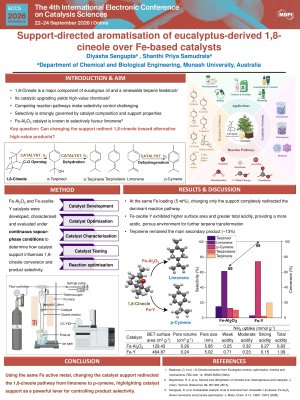
1,8-Cineole, the principal component of eucalyptus oil, is an abundant bio-renewable terpene and an attractive platform molecule for the sustainable production of value-added chemicals. Its catalytic conversion involves a complex network of ether activation, dehydration, and dehydrogenation reactions, producing terpineol, limonene, terpinene, terpinolene, and p-cymene. Controlling product selectivity among these competing reaction pathways remains a significant challenge and requires precise tuning of catalyst properties. In our previous work, Fe-Al2O3 catalysts selectively converted 1,8-cineole to limonene under continuous vapour-phase conditions, demonstrating the critical role of metal-support interactions in directing reaction pathways.
To elucidate the influence of catalyst support on reaction pathways and product selectivity, Fe was incorporated onto zeolite Y and evaluated for the upgrading of 1,8-cineole. Catalyst composition was optimised through variation of Fe loading, while reaction parameters including temperature, contact time and weight hourly space velocity (WHSV) were investigated to maximise catalytic performance. The catalysts were comprehensively characterised using X-ray diffraction (XRD), N2 physisorption (BET), NH3 temperature-programmed desorption (NH3-TPD), Fourier-transform infrared spectroscopy (FTIR) and X-ray photoelectron spectroscopy (XPS) to establish structure-activity relationships.
Preliminary catalytic evaluation revealed a marked support-induced shift in product selectivity relative to Fe-Al2O3. While Fe-Al2O3 favoured limonene formation, Fe-Y catalysts promoted enhanced dehydrogenation and aromatisation, resulting in p-cymene as the dominant product. Under mild reaction conditions, Fe-Y achieved greater than 95% 1,8-cineole conversion with 76% p-cymene selectivity, while terpinene was identified as the second most abundant product (13% selectivity). The enhanced aromatisation activity is attributed to the synergistic combination of Fe active sites with the strong acidity and confined pore architecture of the zeolite Y framework, which facilitates the sequential transformation of terpene intermediates into aromatic products. These findings demonstrate that catalyst support engineering can redirect terpene transformation networks and provide an effective strategy for the selective production of renewable aromatic hydrocarbons from eucalyptus-derived feedstocks.
Keywords
Heterogeneous catalysis
Fe-based catalysts
Biomass valorisation
Eucalyptus-derived terpenes
Sustainable chemical production
Poster
MDPI poster DS.pdf
Microemulsion systems for glycerol valorization into diesel additives
Thermomorphic behaviour intensifies the coproduction of glycerol carbonate and ethylene glycol