Event submissions
Published
This submission belongs to the session S5. Biomass Catalysis of the event The 4th International Electronic Conference on Catalysis Sciences
Published date
16 Sep, 2026
Academic Editor
'%3e%3cpath%20d='M12.6657%2010.9104C12.4185%2010.325%2012.0599%209.79327%2011.6097%209.34482C11.1609%208.89508%2010.6293%208.5365%2010.0442%208.28888C10.0389%208.28626%2010.0337%208.28495%2010.0285%208.28233C10.8446%207.69279%2011.3752%206.73249%2011.3752%205.64904C11.3752%203.8542%209.92103%202.39999%208.1262%202.39999C6.33136%202.39999%204.87715%203.8542%204.87715%205.64904C4.87715%206.73249%205.40774%207.69279%206.22393%208.28364C6.21869%208.28626%206.21345%208.28757%206.20821%208.29019C5.62129%208.5378%205.09463%208.89284%204.64265%209.34613C4.1929%209.79493%203.83432%2010.3266%203.58671%2010.9117C3.34345%2011.4845%203.21226%2012.0987%203.20023%2012.7209C3.19988%2012.7349%203.20233%2012.7488%203.20744%2012.7619C3.21255%2012.7749%203.22022%2012.7867%203.22998%2012.7968C3.23975%2012.8068%203.25142%2012.8147%203.26431%2012.8202C3.2772%2012.8256%203.29105%2012.8284%203.30504%2012.8284H4.09109C4.14874%2012.8284%204.19459%2012.7825%204.1959%2012.7262C4.2221%2011.7148%204.62823%2010.7676%205.34617%2010.0497C6.08899%209.30683%207.0755%208.89808%208.1262%208.89808C9.17689%208.89808%2010.1634%209.30683%2010.9062%2010.0497C11.6242%2010.7676%2012.0303%2011.7148%2012.0565%2012.7262C12.0578%2012.7838%2012.1037%2012.8284%2012.1613%2012.8284H12.9474C12.9613%2012.8284%2012.9752%2012.8256%2012.9881%2012.8202C13.001%2012.8147%2013.0126%2012.8068%2013.0224%2012.7968C13.0322%2012.7867%2013.0398%2012.7749%2013.0449%2012.7619C13.0501%2012.7488%2013.0525%2012.7349%2013.0522%2012.7209C13.0391%2012.0947%2012.9094%2011.4855%2012.6657%2010.9104ZM8.1262%207.9024C7.52486%207.9024%206.9589%207.6679%206.53312%207.24211C6.10733%206.81633%205.87283%206.25037%205.87283%205.64904C5.87283%205.0477%206.10733%204.48174%206.53312%204.05596C6.9589%203.63018%207.52486%203.39567%208.1262%203.39567C8.72753%203.39567%209.29349%203.63018%209.71927%204.05596C10.1451%204.48174%2010.3796%205.0477%2010.3796%205.64904C10.3796%206.25037%2010.1451%206.81633%209.71927%207.24211C9.29349%207.6679%208.72753%207.9024%208.1262%207.9024Z'%20fill='%235D1EE1'/%3e%3c/g%3e%3c/svg%3e) Changwei Hu
Changwei HuCitation
Tomas Pedregal-Garrido, David González-Miranda, Jesus Esteban, Juan M Bolivar, Miguel Ladero, Thermomorphic behaviour intensifies the coproduction of glycerol carbonate and ethylene glycol, in Proceedings of The 4th International Electronic Conference on Catalysis Sciences, 22 September–24 September 2026, MDPI: Basel, Switzerland
Share
Email
Facebook
Twitter
LinkedIn
Thermomorphic behaviour intensifies the coproduction of glycerol carbonate and ethylene glycol
'%3e%3cpath%20d='M12.6647%2010.9104C12.4176%2010.325%2012.0589%209.7933%2011.6088%209.34485C11.16%208.89511%2010.6283%208.53653%2010.0432%208.28891C10.038%208.28629%2010.0327%208.28498%2010.0275%208.28236C10.8437%207.69282%2011.3743%206.73252%2011.3743%205.64907C11.3743%203.85423%209.92005%202.40002%208.12522%202.40002C6.33038%202.40002%204.87618%203.85423%204.87618%205.64907C4.87618%206.73252%205.40677%207.69282%206.22296%208.28367C6.21772%208.28629%206.21248%208.2876%206.20724%208.29022C5.62031%208.53783%205.09365%208.89287%204.64167%209.34616C4.19192%209.79496%203.83334%2010.3266%203.58573%2010.9117C3.34247%2011.4846%203.21128%2012.0987%203.19925%2012.721C3.1989%2012.735%203.20135%2012.7489%203.20646%2012.7619C3.21157%2012.7749%203.21924%2012.7868%203.22901%2012.7968C3.23877%2012.8068%203.25045%2012.8148%203.26334%2012.8202C3.27623%2012.8256%203.29007%2012.8284%203.30406%2012.8284H4.09012C4.14776%2012.8284%204.19362%2012.7825%204.19493%2012.7262C4.22113%2011.7148%204.62726%2010.7676%205.34519%2010.0497C6.08802%209.30686%207.07452%208.89811%208.12522%208.89811C9.17592%208.89811%2010.1624%209.30686%2010.9052%2010.0497C11.6232%2010.7676%2012.0293%2011.7148%2012.0555%2012.7262C12.0568%2012.7839%2012.1027%2012.8284%2012.1603%2012.8284H12.9464C12.9604%2012.8284%2012.9742%2012.8256%2012.9871%2012.8202C13%2012.8148%2013.0117%2012.8068%2013.0214%2012.7968C13.0312%2012.7868%2013.0389%2012.7749%2013.044%2012.7619C13.0491%2012.7489%2013.0515%2012.735%2013.0512%2012.721C13.0381%2012.0947%2012.9084%2011.4856%2012.6647%2010.9104ZM8.12522%207.90243C7.52388%207.90243%206.95792%207.66793%206.53214%207.24215C6.10636%206.81636%205.87185%206.2504%205.87185%205.64907C5.87185%205.04773%206.10636%204.48177%206.53214%204.05599C6.95792%203.63021%207.52388%203.3957%208.12522%203.3957C8.72655%203.3957%209.29252%203.63021%209.7183%204.05599C10.1441%204.48177%2010.3786%205.04773%2010.3786%205.64907C10.3786%206.2504%2010.1441%206.81636%209.7183%207.24215C9.29252%207.66793%208.72655%207.90243%208.12522%207.90243Z'%20fill='%235D1EE1'/%3e%3c/g%3e%3c/svg%3e)
Tomas Pedregal-Garrido 1
David González-Miranda 1,2
Jesus Esteban 1

Juan M Bolivar 1

Miguel Ladero 1,3
1. FQPIMA group, Chemical and Materials Engineering Department, Faculty of Chemical Sciences, Complutense University of Madrid, Madrid, 28040, Spain
2. TBI, Université de Toulouse, CNRS, INRAE, INSA, Toulouse, France
3. Translational Research with iPS Cells Group, Instituto de Investigación Sanitaria Hospital 12 de Octubre, imas12, 28041 Madrid, Spain
Abstract
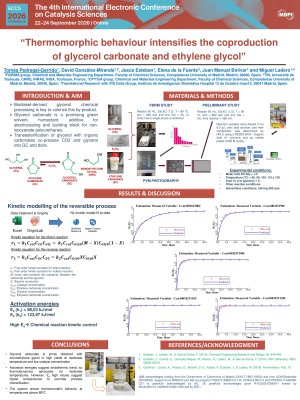
Glycerol carbonate is a chemical compound of high interest due to its unique properties that can be synthesized from glycerol, a byproduct of biodiesel, by transesterification with an organic carbonate. In this work, the transesterification of glycerol and ethylene carbonate has been conducted with the addition of low amounts of K2CO3 in a single-phase reaction system, at temperatures above 78 ºC – 80 ºC (glycerol - ethylene carbonate is a thermomorphic system with a biphasic-monophasic transition at that temperature range). Several runs have been carried out at diverse catalyst concentrations (20-500 ppm), EC to Gly molar ratios (1.5-2.5) and process temperature (80-120 ºC). Notably, as the system was solventless and glycerol conversion exceeded 96%, high concentrations of glycerol carbonate and monoethylene glycol (>3 mol/L) were reached with high selectivity (98%) in very short reaction times (40 minutes at 80 ºC) at low catalyst concentrations (100 ppm). Thus, turnover frequency is 4.37 h-1, which compares well to hydrocalcite-NaAlO2 catalyst (1.62 h-1). Subsequently, a first-order (with respect every involved compound) multivariate kinetic model containing equations for both direct reverse reactions was successfully fitted to all data at the same time, showing higher equilibrium conversions at the lowest temperature tested (endothermic system). Finally, key green chemistry metrics highlight a potential low environmental impact: Atom economy was 64%, E-factor reached 0.62 at 96% yield to GC and 2:1 Gly:EC molar ratio and process mass intensity (PMI) of 2.27 if only GC is considered as reference, or 1.25 if monoethylene glycol is also accepted as a product of interest.
Keywords
Transcarbonation
transesterification
thermomorphic systems
glycerol carbonate
monoethylene glycol
homogeneous catalysis
kinetics
solventless
green metrics
Poster
POSTER_ECCS_04_SEPTIEMBRE_2026.pdf
Support-directed aromatisation of eucalyptus-derived 1,8-cineole over Fe-zeolite Y catalysts
Pt-Ni-CeZrO2-CNT hybrid catalysts for stable low-temperature Dry reforming of methane (DRM)