Event submissions
Published
This submission belongs to the session S1. Catalytic Materials of the event The 4th International Electronic Conference on Catalysis Sciences
Published date
16 Sep, 2026
Academic Editor
'%3e%3cpath%20d='M12.6657%2010.9104C12.4185%2010.325%2012.0599%209.79327%2011.6097%209.34482C11.1609%208.89508%2010.6293%208.5365%2010.0442%208.28888C10.0389%208.28626%2010.0337%208.28495%2010.0285%208.28233C10.8446%207.69279%2011.3752%206.73249%2011.3752%205.64904C11.3752%203.8542%209.92103%202.39999%208.1262%202.39999C6.33136%202.39999%204.87715%203.8542%204.87715%205.64904C4.87715%206.73249%205.40774%207.69279%206.22393%208.28364C6.21869%208.28626%206.21345%208.28757%206.20821%208.29019C5.62129%208.5378%205.09463%208.89284%204.64265%209.34613C4.1929%209.79493%203.83432%2010.3266%203.58671%2010.9117C3.34345%2011.4845%203.21226%2012.0987%203.20023%2012.7209C3.19988%2012.7349%203.20233%2012.7488%203.20744%2012.7619C3.21255%2012.7749%203.22022%2012.7867%203.22998%2012.7968C3.23975%2012.8068%203.25142%2012.8147%203.26431%2012.8202C3.2772%2012.8256%203.29105%2012.8284%203.30504%2012.8284H4.09109C4.14874%2012.8284%204.19459%2012.7825%204.1959%2012.7262C4.2221%2011.7148%204.62823%2010.7676%205.34617%2010.0497C6.08899%209.30683%207.0755%208.89808%208.1262%208.89808C9.17689%208.89808%2010.1634%209.30683%2010.9062%2010.0497C11.6242%2010.7676%2012.0303%2011.7148%2012.0565%2012.7262C12.0578%2012.7838%2012.1037%2012.8284%2012.1613%2012.8284H12.9474C12.9613%2012.8284%2012.9752%2012.8256%2012.9881%2012.8202C13.001%2012.8147%2013.0126%2012.8068%2013.0224%2012.7968C13.0322%2012.7867%2013.0398%2012.7749%2013.0449%2012.7619C13.0501%2012.7488%2013.0525%2012.7349%2013.0522%2012.7209C13.0391%2012.0947%2012.9094%2011.4855%2012.6657%2010.9104ZM8.1262%207.9024C7.52486%207.9024%206.9589%207.6679%206.53312%207.24211C6.10733%206.81633%205.87283%206.25037%205.87283%205.64904C5.87283%205.0477%206.10733%204.48174%206.53312%204.05596C6.9589%203.63018%207.52486%203.39567%208.1262%203.39567C8.72753%203.39567%209.29349%203.63018%209.71927%204.05596C10.1451%204.48174%2010.3796%205.0477%2010.3796%205.64904C10.3796%206.25037%2010.1451%206.81633%209.71927%207.24211C9.29349%207.6679%208.72753%207.9024%208.1262%207.9024Z'%20fill='%235D1EE1'/%3e%3c/g%3e%3c/svg%3e) Narendra Kumar
Narendra KumarCitation
Mahima Kamra, Agata Łamacz, Pt-Ni-CeZrO₂-CNT hybrid catalysts for stable low-temperature Dry reforming of methane (DRM), in Proceedings of The 4th International Electronic Conference on Catalysis Sciences, 22 September–24 September 2026, MDPI: Basel, Switzerland
Share
Email
Facebook
Twitter
LinkedIn
Pt-Ni-CeZrO2-CNT hybrid catalysts for stable low-temperature Dry reforming of methane (DRM)
'%3e%3cpath%20d='M12.6647%2010.9104C12.4176%2010.325%2012.0589%209.7933%2011.6088%209.34485C11.16%208.89511%2010.6283%208.53653%2010.0432%208.28891C10.038%208.28629%2010.0327%208.28498%2010.0275%208.28236C10.8437%207.69282%2011.3743%206.73252%2011.3743%205.64907C11.3743%203.85423%209.92005%202.40002%208.12522%202.40002C6.33038%202.40002%204.87618%203.85423%204.87618%205.64907C4.87618%206.73252%205.40677%207.69282%206.22296%208.28367C6.21772%208.28629%206.21248%208.2876%206.20724%208.29022C5.62031%208.53783%205.09365%208.89287%204.64167%209.34616C4.19192%209.79496%203.83334%2010.3266%203.58573%2010.9117C3.34247%2011.4846%203.21128%2012.0987%203.19925%2012.721C3.1989%2012.735%203.20135%2012.7489%203.20646%2012.7619C3.21157%2012.7749%203.21924%2012.7868%203.22901%2012.7968C3.23877%2012.8068%203.25045%2012.8148%203.26334%2012.8202C3.27623%2012.8256%203.29007%2012.8284%203.30406%2012.8284H4.09012C4.14776%2012.8284%204.19362%2012.7825%204.19493%2012.7262C4.22113%2011.7148%204.62726%2010.7676%205.34519%2010.0497C6.08802%209.30686%207.07452%208.89811%208.12522%208.89811C9.17592%208.89811%2010.1624%209.30686%2010.9052%2010.0497C11.6232%2010.7676%2012.0293%2011.7148%2012.0555%2012.7262C12.0568%2012.7839%2012.1027%2012.8284%2012.1603%2012.8284H12.9464C12.9604%2012.8284%2012.9742%2012.8256%2012.9871%2012.8202C13%2012.8148%2013.0117%2012.8068%2013.0214%2012.7968C13.0312%2012.7868%2013.0389%2012.7749%2013.044%2012.7619C13.0491%2012.7489%2013.0515%2012.735%2013.0512%2012.721C13.0381%2012.0947%2012.9084%2011.4856%2012.6647%2010.9104ZM8.12522%207.90243C7.52388%207.90243%206.95792%207.66793%206.53214%207.24215C6.10636%206.81636%205.87185%206.2504%205.87185%205.64907C5.87185%205.04773%206.10636%204.48177%206.53214%204.05599C6.95792%203.63021%207.52388%203.3957%208.12522%203.3957C8.72655%203.3957%209.29252%203.63021%209.7183%204.05599C10.1441%204.48177%2010.3786%205.04773%2010.3786%205.64907C10.3786%206.2504%2010.1441%206.81636%209.7183%207.24215C9.29252%207.66793%208.72655%207.90243%208.12522%207.90243Z'%20fill='%235D1EE1'/%3e%3c/g%3e%3c/svg%3e)
Mahima Kamra 1

Agata Łamacz 1
1. Department of Engineering and Technology of Chemical Processes, Wroclaw University of Science and Technology, Gdańska 7/9, 50-344 Wrocław, Poland
Abstract
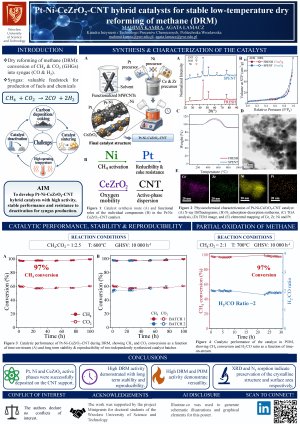
Introduction. Dry reforming of methane (DRM) is an advantageous approach for the simultaneous utilization of greenhouse gases CH4 and CO2, while producing syngas, which can then be further used for ammonia/hydrogen synthesis, Fischer-Tropsch processes, methanol production, amongst others. However, DRM is yet to be industrialized due to deactivation of catalysts at high temperatures via coking or sintering. In this study, Pt-Ni-CeZrO2-CNT catalysts were designed and prepared to improve catalytic performance, stability and resistance to deactivation in DRM.
Methods. The catalysts were synthesized using a coprecipitation-solvothermal route, and further characterized via X-ray diffraction (XRD), N2 sorption, thermogravimetric analysis (TGA), X-ray photoelectron spectroscopy (XPS) and transmission electron microscopy (TEM). The structural characterization confirmed successful deposition of active phases of metals Pt and Ni, and CeZrO2 promoter species on the functionalized CNT support, with well-dispersed nanoparticles.
Results. Catalytic performance in DRM was evaluated at the temperatures of 500-600°C under gas hour space velocity of 10,000 h-1. The catalysts achieved CH4 conversions of up to 97% and CO2 conversions of ~55% while maintaining stable activity under long term operation. Carbon balance calculations and H2/CO ratios of approximately ~0.7 indicated the contribution of reverse water gas shift reaction, explaining the lower CO2 conversions. Long term stability tests demonstrated catalytic performance for more than 100 h time on run, whereas a second batch maintained stable operation for over 75 h, confirming excellent reproducibility. Furthermore, the catalysts exhibited promising activity in partial oxidation of methane, reaching 97% CH4 conversion and producing syngas with a H2/CO ratio close to 2 at 700°C.
Conclusions. The developed catalysts exhibit excellent activity, stability and reproducibility in DRM under low temperature conditions. Their additional activity in partial oxidation of methane highlights the potential of these hybrid catalysts as versatile materials for durable syngas production through methane reforming.
Keywords
Carbon nanotubes
dry reforming of methane
Pt
Ni
CeZrO2
Poster
ECCS POSTER 2026 MK.pdf
Thermomorphic behaviour intensifies the coproduction of glycerol carbonate and ethylene glycol
Cold Plasma Catalysis for the Green Valorisation of Bee Products Biomass within a Circular Bioeconomy Framework