Event submissions
Published
This submission belongs to the session S3. Photocatalysis and Electrocatalysis of the event The 4th International Electronic Conference on Catalysis Sciences
Published date
16 Sep, 2026
Academic Editor
'%3e%3cpath%20d='M12.6657%2010.9104C12.4185%2010.325%2012.0599%209.79327%2011.6097%209.34482C11.1609%208.89508%2010.6293%208.5365%2010.0442%208.28888C10.0389%208.28626%2010.0337%208.28495%2010.0285%208.28233C10.8446%207.69279%2011.3752%206.73249%2011.3752%205.64904C11.3752%203.8542%209.92103%202.39999%208.1262%202.39999C6.33136%202.39999%204.87715%203.8542%204.87715%205.64904C4.87715%206.73249%205.40774%207.69279%206.22393%208.28364C6.21869%208.28626%206.21345%208.28757%206.20821%208.29019C5.62129%208.5378%205.09463%208.89284%204.64265%209.34613C4.1929%209.79493%203.83432%2010.3266%203.58671%2010.9117C3.34345%2011.4845%203.21226%2012.0987%203.20023%2012.7209C3.19988%2012.7349%203.20233%2012.7488%203.20744%2012.7619C3.21255%2012.7749%203.22022%2012.7867%203.22998%2012.7968C3.23975%2012.8068%203.25142%2012.8147%203.26431%2012.8202C3.2772%2012.8256%203.29105%2012.8284%203.30504%2012.8284H4.09109C4.14874%2012.8284%204.19459%2012.7825%204.1959%2012.7262C4.2221%2011.7148%204.62823%2010.7676%205.34617%2010.0497C6.08899%209.30683%207.0755%208.89808%208.1262%208.89808C9.17689%208.89808%2010.1634%209.30683%2010.9062%2010.0497C11.6242%2010.7676%2012.0303%2011.7148%2012.0565%2012.7262C12.0578%2012.7838%2012.1037%2012.8284%2012.1613%2012.8284H12.9474C12.9613%2012.8284%2012.9752%2012.8256%2012.9881%2012.8202C13.001%2012.8147%2013.0126%2012.8068%2013.0224%2012.7968C13.0322%2012.7867%2013.0398%2012.7749%2013.0449%2012.7619C13.0501%2012.7488%2013.0525%2012.7349%2013.0522%2012.7209C13.0391%2012.0947%2012.9094%2011.4855%2012.6657%2010.9104ZM8.1262%207.9024C7.52486%207.9024%206.9589%207.6679%206.53312%207.24211C6.10733%206.81633%205.87283%206.25037%205.87283%205.64904C5.87283%205.0477%206.10733%204.48174%206.53312%204.05596C6.9589%203.63018%207.52486%203.39567%208.1262%203.39567C8.72753%203.39567%209.29349%203.63018%209.71927%204.05596C10.1451%204.48174%2010.3796%205.0477%2010.3796%205.64904C10.3796%206.25037%2010.1451%206.81633%209.71927%207.24211C9.29349%207.6679%208.72753%207.9024%208.1262%207.9024Z'%20fill='%235D1EE1'/%3e%3c/g%3e%3c/svg%3e) Carmelo Vecchio
Carmelo VecchioCitation
Mostafa Zedan, Abdallah F. Zedan, Xu Li, Visible-light Active Metal Nanoparticles@Carbon Nitride for Photocatalytic Degradation of Organic Water Pollutants and Photoelectrochemical Properties, in Proceedings of The 4th International Electronic Conference on Catalysis Sciences, 22 September–24 September 2026, MDPI: Basel, Switzerland
Share
Email
Facebook
Twitter
LinkedIn
Visible-light Active Metal Nanoparticles@Carbon Nitride for Photocatalytic Degradation of Organic Water Pollutants and Photoelectrochemical Properties

Mostafa Zedan 1
'%3e%3cpath%20d='M12.6647%2010.9104C12.4176%2010.325%2012.0589%209.7933%2011.6088%209.34485C11.16%208.89511%2010.6283%208.53653%2010.0432%208.28891C10.038%208.28629%2010.0327%208.28498%2010.0275%208.28236C10.8437%207.69282%2011.3743%206.73252%2011.3743%205.64907C11.3743%203.85423%209.92005%202.40002%208.12522%202.40002C6.33038%202.40002%204.87618%203.85423%204.87618%205.64907C4.87618%206.73252%205.40677%207.69282%206.22296%208.28367C6.21772%208.28629%206.21248%208.2876%206.20724%208.29022C5.62031%208.53783%205.09365%208.89287%204.64167%209.34616C4.19192%209.79496%203.83334%2010.3266%203.58573%2010.9117C3.34247%2011.4846%203.21128%2012.0987%203.19925%2012.721C3.1989%2012.735%203.20135%2012.7489%203.20646%2012.7619C3.21157%2012.7749%203.21924%2012.7868%203.22901%2012.7968C3.23877%2012.8068%203.25045%2012.8148%203.26334%2012.8202C3.27623%2012.8256%203.29007%2012.8284%203.30406%2012.8284H4.09012C4.14776%2012.8284%204.19362%2012.7825%204.19493%2012.7262C4.22113%2011.7148%204.62726%2010.7676%205.34519%2010.0497C6.08802%209.30686%207.07452%208.89811%208.12522%208.89811C9.17592%208.89811%2010.1624%209.30686%2010.9052%2010.0497C11.6232%2010.7676%2012.0293%2011.7148%2012.0555%2012.7262C12.0568%2012.7839%2012.1027%2012.8284%2012.1603%2012.8284H12.9464C12.9604%2012.8284%2012.9742%2012.8256%2012.9871%2012.8202C13%2012.8148%2013.0117%2012.8068%2013.0214%2012.7968C13.0312%2012.7868%2013.0389%2012.7749%2013.044%2012.7619C13.0491%2012.7489%2013.0515%2012.735%2013.0512%2012.721C13.0381%2012.0947%2012.9084%2011.4856%2012.6647%2010.9104ZM8.12522%207.90243C7.52388%207.90243%206.95792%207.66793%206.53214%207.24215C6.10636%206.81636%205.87185%206.2504%205.87185%205.64907C5.87185%205.04773%206.10636%204.48177%206.53214%204.05599C6.95792%203.63021%207.52388%203.3957%208.12522%203.3957C8.72655%203.3957%209.29252%203.63021%209.7183%204.05599C10.1441%204.48177%2010.3786%205.04773%2010.3786%205.64907C10.3786%206.2504%2010.1441%206.81636%209.7183%207.24215C9.29252%207.66793%208.72655%207.90243%208.12522%207.90243Z'%20fill='%235D1EE1'/%3e%3c/g%3e%3c/svg%3e)
Abdallah F. Zedan 1
Xu Li 2,3
1. National Institute of Laser Enhanced Sciences, Cairo University, Giza 12613, Egypt
2. Institute of Materials Research and Engineering, Agency for Science, Technology, and Research (A*STAR), Singapore 138634, Singapore.
3. Institute of Sustainability for Chemicals, Energy and Environment, Agency for Science, Technology and Research (A*STAR), Singapore 138634, Singapore.
Abstract
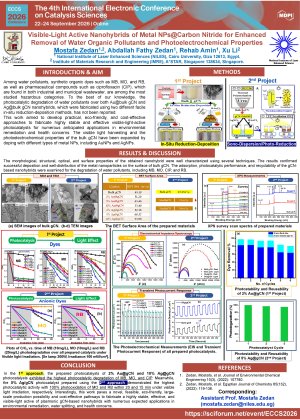
Water is a valuable resource that must be managed efficiently to support sustainable growth and development. Graphitic carbon nitride (g-C3N4 or gCN) has attracted considerable attention owing to its unique properties and metal-free nature. In this work, the visible light harvesting and photoelectrochemical properties of bulk gCN were expanded by hybridization with noble metals, including gold (Au) and silver (Ag) nanoparticles (NPs). A series of x% Au@gCN and x% Ag@gCN photocatalysts were developed using different feasible approaches: (a) an in-situ reduction deposition with the assistance of reducing agents and (b) a sequential approach combining sonodispersion followed by in-situ photoreduction and deposition, respectively. The morphological, structural, optical, and surface properties of the obtained nanohybrid photocatalysts were well-characterized using several techniques, including HR-TEM, FE-SEM, XRD, FTIR, XPS, BET surface area, PL, UV-vis DRS, and zeta potential. The characterization results confirmed the successful deposition and uniform distribution of the metal nanoparticles over the bulk gCN surface. The adsorption and photocatalytic performances of the plasmonic gCN-based nanohybrids were examined using organic water pollutants, including methylene blue (MB), methyl orange (MO), ciprofloxacin (CIP), and rose bengal (RB), in darkness and under light irradiation. In the 1st approach, the prepared photocatalysts of 2% Au@gCN and 10% Ag@gCN photocatalysts exhibited the highest photocatalytic degradation of MB, MO, and CIP under visible light irradiation. Meanwhile, the 5% Ag/gCN hybrid photocatalyst prepared using the 2nd approach demonstrated the highest photocatalytic activity with 100% photooxidation of MO and RB within 20 and 15 min under visible light irradiation, respectively. Interestingly, this work paves a feasible, eco-friendly, large-scale production possibility and cost-effective pathways to fabricate a highly stable, effective, and visible-light active plasmonic gCN-based nanohybrids. Additionally, the successful outcomes of this work can be beneficial and extended for numerous expected applications in environmental remediation, water splitting, and health concerns.
Keywords
Photocatalysis
Gold
Silver
g-C3N4
Environmental Remediation
Photoelectrochemistry
Poster
ECCS_Poster_Mostafa Zedan.pdf
Electronic and Band Gap Engineering of Sn-Germanate Oxides for Environmental Photocatalysis
Upscaling Metal-Halide Perovskite Driven Photoelectrochemical H2 Production System with > 10% Efficiency