Event submissions
Published
This submission belongs to the session S3. Photocatalysis and Electrocatalysis of the event The 4th International Electronic Conference on Catalysis Sciences
Published date
16 Sep, 2026
Academic Editor
'%3e%3cpath%20d='M12.6657%2010.9104C12.4185%2010.325%2012.0599%209.79327%2011.6097%209.34482C11.1609%208.89508%2010.6293%208.5365%2010.0442%208.28888C10.0389%208.28626%2010.0337%208.28495%2010.0285%208.28233C10.8446%207.69279%2011.3752%206.73249%2011.3752%205.64904C11.3752%203.8542%209.92103%202.39999%208.1262%202.39999C6.33136%202.39999%204.87715%203.8542%204.87715%205.64904C4.87715%206.73249%205.40774%207.69279%206.22393%208.28364C6.21869%208.28626%206.21345%208.28757%206.20821%208.29019C5.62129%208.5378%205.09463%208.89284%204.64265%209.34613C4.1929%209.79493%203.83432%2010.3266%203.58671%2010.9117C3.34345%2011.4845%203.21226%2012.0987%203.20023%2012.7209C3.19988%2012.7349%203.20233%2012.7488%203.20744%2012.7619C3.21255%2012.7749%203.22022%2012.7867%203.22998%2012.7968C3.23975%2012.8068%203.25142%2012.8147%203.26431%2012.8202C3.2772%2012.8256%203.29105%2012.8284%203.30504%2012.8284H4.09109C4.14874%2012.8284%204.19459%2012.7825%204.1959%2012.7262C4.2221%2011.7148%204.62823%2010.7676%205.34617%2010.0497C6.08899%209.30683%207.0755%208.89808%208.1262%208.89808C9.17689%208.89808%2010.1634%209.30683%2010.9062%2010.0497C11.6242%2010.7676%2012.0303%2011.7148%2012.0565%2012.7262C12.0578%2012.7838%2012.1037%2012.8284%2012.1613%2012.8284H12.9474C12.9613%2012.8284%2012.9752%2012.8256%2012.9881%2012.8202C13.001%2012.8147%2013.0126%2012.8068%2013.0224%2012.7968C13.0322%2012.7867%2013.0398%2012.7749%2013.0449%2012.7619C13.0501%2012.7488%2013.0525%2012.7349%2013.0522%2012.7209C13.0391%2012.0947%2012.9094%2011.4855%2012.6657%2010.9104ZM8.1262%207.9024C7.52486%207.9024%206.9589%207.6679%206.53312%207.24211C6.10733%206.81633%205.87283%206.25037%205.87283%205.64904C5.87283%205.0477%206.10733%204.48174%206.53312%204.05596C6.9589%203.63018%207.52486%203.39567%208.1262%203.39567C8.72753%203.39567%209.29349%203.63018%209.71927%204.05596C10.1451%204.48174%2010.3796%205.0477%2010.3796%205.64904C10.3796%206.25037%2010.1451%206.81633%209.71927%207.24211C9.29349%207.6679%208.72753%207.9024%208.1262%207.9024Z'%20fill='%235D1EE1'/%3e%3c/g%3e%3c/svg%3e) Carmelo Vecchio
Carmelo VecchioCitation
Nina Finčur, Dušica Jovanović, Maja Šćepanović, Mirjana Grujić Brojčin, Stevan Stojadinović, Daniela Šojić Merkulov, Sabolč Bognar, SUNLIGHT-DRIVEN PHOTOCATALYTIC DEGRADATION OF SULPIRIDE BY ZnO- AND CeO₂-DOPED MgAl COATINGS, in Proceedings of The 4th International Electronic Conference on Catalysis Sciences, 22 September–24 September 2026, MDPI: Basel, Switzerland
Share
Email
Facebook
Twitter
LinkedIn
SUNLIGHT-DRIVEN PHOTOCATALYTIC DEGRADATION OF SULPIRIDE BY ZnO- AND CeO2-DOPED MgAl COATINGS

Nina Finčur 1
'%3e%3cpath%20d='M12.6647%2010.9104C12.4176%2010.325%2012.0589%209.7933%2011.6088%209.34485C11.16%208.89511%2010.6283%208.53653%2010.0432%208.28891C10.038%208.28629%2010.0327%208.28498%2010.0275%208.28236C10.8437%207.69282%2011.3743%206.73252%2011.3743%205.64907C11.3743%203.85423%209.92005%202.40002%208.12522%202.40002C6.33038%202.40002%204.87618%203.85423%204.87618%205.64907C4.87618%206.73252%205.40677%207.69282%206.22296%208.28367C6.21772%208.28629%206.21248%208.2876%206.20724%208.29022C5.62031%208.53783%205.09365%208.89287%204.64167%209.34616C4.19192%209.79496%203.83334%2010.3266%203.58573%2010.9117C3.34247%2011.4846%203.21128%2012.0987%203.19925%2012.721C3.1989%2012.735%203.20135%2012.7489%203.20646%2012.7619C3.21157%2012.7749%203.21924%2012.7868%203.22901%2012.7968C3.23877%2012.8068%203.25045%2012.8148%203.26334%2012.8202C3.27623%2012.8256%203.29007%2012.8284%203.30406%2012.8284H4.09012C4.14776%2012.8284%204.19362%2012.7825%204.19493%2012.7262C4.22113%2011.7148%204.62726%2010.7676%205.34519%2010.0497C6.08802%209.30686%207.07452%208.89811%208.12522%208.89811C9.17592%208.89811%2010.1624%209.30686%2010.9052%2010.0497C11.6232%2010.7676%2012.0293%2011.7148%2012.0555%2012.7262C12.0568%2012.7839%2012.1027%2012.8284%2012.1603%2012.8284H12.9464C12.9604%2012.8284%2012.9742%2012.8256%2012.9871%2012.8202C13%2012.8148%2013.0117%2012.8068%2013.0214%2012.7968C13.0312%2012.7868%2013.0389%2012.7749%2013.044%2012.7619C13.0491%2012.7489%2013.0515%2012.735%2013.0512%2012.721C13.0381%2012.0947%2012.9084%2011.4856%2012.6647%2010.9104ZM8.12522%207.90243C7.52388%207.90243%206.95792%207.66793%206.53214%207.24215C6.10636%206.81636%205.87185%206.2504%205.87185%205.64907C5.87185%205.04773%206.10636%204.48177%206.53214%204.05599C6.95792%203.63021%207.52388%203.3957%208.12522%203.3957C8.72655%203.3957%209.29252%203.63021%209.7183%204.05599C10.1441%204.48177%2010.3786%205.04773%2010.3786%205.64907C10.3786%206.2504%2010.1441%206.81636%209.7183%207.24215C9.29252%207.66793%208.72655%207.90243%208.12522%207.90243Z'%20fill='%235D1EE1'/%3e%3c/g%3e%3c/svg%3e)
Dušica Jovanović 1

Maja Šćepanović 2
Mirjana Grujić Brojčin 2
Stevan Stojadinović 3

Daniela Šojić Merkulov 1
Sabolč Bognar 1
1. Department of Chemistry, Biochemistry and Environmental Protection, University of Novi Sad Faculty of Sciences, 21000 Novi Sad, Serbia
2. Center for Solid State Physics and New Materials, Institute of Physics, University of Belgrade, Pregrevica 118, 11080 Belgrade, Serbia
3. Faculty of Physics, University of Belgrade, Studentski Trg 12‑16, 11000 Belgrade, Serbia
Abstract
Schizophrenia is a chronic psychiatric disorder affecting ~23 million people worldwide and requires long-term pharmacotherapy. Among antipsychotics, sulpiride (SUL), a benzamide derivative acting on dopamine and serotonin receptors, is used for the treatment of schizophrenia, as well as depression, vertigo, and peptic ulcers. Since SUL is excreted unchanged via the renal route, it has emerged as an environmental contaminant frequently detected in wastewater, surface and groundwater, soil, and sediments. Therefore, various methods for its removal have been investigated.
Among advanced oxidation processes, heterogeneous photocatalysis represents a sustainable and environmentally friendly approach for the degradation of organic pollutants in aquatic systems. Its mechanism relies on the use of light and a photocatalyst to generate reactive species capable of degrading pollutants.
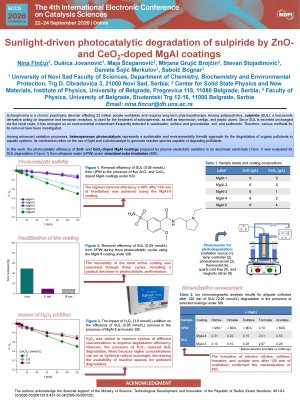
In this work, the photocatalytic efficiency of ZnO- and CeO2-doped MgAl coatings prepared by plasma electrolytic oxidation in an aluminate electrolyte was evaluated for SUL degradation under simulated solar irradiation. The highest removal efficiency (~50% after 120 min of irradiation) was achieved using the MgAl-5 coating (6 g/L ZnO and 4 g/L CeO2). The reusability of the most active coating was examined through three cycles, revealing a gradual decrease in photocatalytic performance. In addition, hydrogen peroxide was added to reaction system at different concentrations to improve degradation efficiency. However, the presence of hydrogen peroxide reduced SUL degradation, likely because higher concentrations can act as hydroxyl radical scavengers, decreasing the availability of reactive species for pollutant degradation. Furthermore, the degree of SUL mineralization in the presence of two selected coatings was investigated by ion chromatography analysis. The formation of nitrate, nitrite, sulphate, formate, and acetate ions after 120 min of irradiation confirmed the mineralization of SUL.
Acknowledgements: The authors acknowledge the financial support of the Ministry of Science, Technological Development and Innovation of the Republic of Serbia (Grant Numbers: 451-03-33/2026-03/200125 & 451-03-34/2026-03/200125).
Keywords
sulpiride
heterogeneous photocatalysis
ZnO/CeO2-doped MgAl coatings
simulated sunlight
Poster
ECCS_Poster_Nina Finčur.pdf
Pulsed-Potential Stabilization of Cobalt-Based Oxygen Evolution Catalysts in Trace Iron-Containing Alkaline Electrolyte
From Photoanodes to HER Catalysts: Electrochemical Strategies for Multifunctional TiO₂-Based Composites