Event submissions
Published
This submission belongs to the session S3. Photocatalysis and Electrocatalysis of the event The 4th International Electronic Conference on Catalysis Sciences
Published date
16 Sep, 2026
Academic Editor
'%3e%3cpath%20d='M12.6657%2010.9104C12.4185%2010.325%2012.0599%209.79327%2011.6097%209.34482C11.1609%208.89508%2010.6293%208.5365%2010.0442%208.28888C10.0389%208.28626%2010.0337%208.28495%2010.0285%208.28233C10.8446%207.69279%2011.3752%206.73249%2011.3752%205.64904C11.3752%203.8542%209.92103%202.39999%208.1262%202.39999C6.33136%202.39999%204.87715%203.8542%204.87715%205.64904C4.87715%206.73249%205.40774%207.69279%206.22393%208.28364C6.21869%208.28626%206.21345%208.28757%206.20821%208.29019C5.62129%208.5378%205.09463%208.89284%204.64265%209.34613C4.1929%209.79493%203.83432%2010.3266%203.58671%2010.9117C3.34345%2011.4845%203.21226%2012.0987%203.20023%2012.7209C3.19988%2012.7349%203.20233%2012.7488%203.20744%2012.7619C3.21255%2012.7749%203.22022%2012.7867%203.22998%2012.7968C3.23975%2012.8068%203.25142%2012.8147%203.26431%2012.8202C3.2772%2012.8256%203.29105%2012.8284%203.30504%2012.8284H4.09109C4.14874%2012.8284%204.19459%2012.7825%204.1959%2012.7262C4.2221%2011.7148%204.62823%2010.7676%205.34617%2010.0497C6.08899%209.30683%207.0755%208.89808%208.1262%208.89808C9.17689%208.89808%2010.1634%209.30683%2010.9062%2010.0497C11.6242%2010.7676%2012.0303%2011.7148%2012.0565%2012.7262C12.0578%2012.7838%2012.1037%2012.8284%2012.1613%2012.8284H12.9474C12.9613%2012.8284%2012.9752%2012.8256%2012.9881%2012.8202C13.001%2012.8147%2013.0126%2012.8068%2013.0224%2012.7968C13.0322%2012.7867%2013.0398%2012.7749%2013.0449%2012.7619C13.0501%2012.7488%2013.0525%2012.7349%2013.0522%2012.7209C13.0391%2012.0947%2012.9094%2011.4855%2012.6657%2010.9104ZM8.1262%207.9024C7.52486%207.9024%206.9589%207.6679%206.53312%207.24211C6.10733%206.81633%205.87283%206.25037%205.87283%205.64904C5.87283%205.0477%206.10733%204.48174%206.53312%204.05596C6.9589%203.63018%207.52486%203.39567%208.1262%203.39567C8.72753%203.39567%209.29349%203.63018%209.71927%204.05596C10.1451%204.48174%2010.3796%205.0477%2010.3796%205.64904C10.3796%206.25037%2010.1451%206.81633%209.71927%207.24211C9.29349%207.6679%208.72753%207.9024%208.1262%207.9024Z'%20fill='%235D1EE1'/%3e%3c/g%3e%3c/svg%3e) Ioannis Konstantinou
Ioannis KonstantinouCitation
Ramunas Levinas, Ina Stankevičienė, Aldona Jagminienė, Loreta Tamašauskaitė-Tamašiūnaitė, Eugenijus Norkus, From Photoanodes to HER Catalysts: Electrochemical Strategies for Multifunctional TiO₂-Based Composites, in Proceedings of The 4th International Electronic Conference on Catalysis Sciences, 22 September–24 September 2026, MDPI: Basel, Switzerland
Share
Email
Facebook
Twitter
LinkedIn
From Photoanodes to HER Catalysts: Electrochemical Strategies for Multifunctional TiO₂-Based Composites
'%3e%3cpath%20d='M12.6647%2010.9104C12.4176%2010.325%2012.0589%209.7933%2011.6088%209.34485C11.16%208.89511%2010.6283%208.53653%2010.0432%208.28891C10.038%208.28629%2010.0327%208.28498%2010.0275%208.28236C10.8437%207.69282%2011.3743%206.73252%2011.3743%205.64907C11.3743%203.85423%209.92005%202.40002%208.12522%202.40002C6.33038%202.40002%204.87618%203.85423%204.87618%205.64907C4.87618%206.73252%205.40677%207.69282%206.22296%208.28367C6.21772%208.28629%206.21248%208.2876%206.20724%208.29022C5.62031%208.53783%205.09365%208.89287%204.64167%209.34616C4.19192%209.79496%203.83334%2010.3266%203.58573%2010.9117C3.34247%2011.4846%203.21128%2012.0987%203.19925%2012.721C3.1989%2012.735%203.20135%2012.7489%203.20646%2012.7619C3.21157%2012.7749%203.21924%2012.7868%203.22901%2012.7968C3.23877%2012.8068%203.25045%2012.8148%203.26334%2012.8202C3.27623%2012.8256%203.29007%2012.8284%203.30406%2012.8284H4.09012C4.14776%2012.8284%204.19362%2012.7825%204.19493%2012.7262C4.22113%2011.7148%204.62726%2010.7676%205.34519%2010.0497C6.08802%209.30686%207.07452%208.89811%208.12522%208.89811C9.17592%208.89811%2010.1624%209.30686%2010.9052%2010.0497C11.6232%2010.7676%2012.0293%2011.7148%2012.0555%2012.7262C12.0568%2012.7839%2012.1027%2012.8284%2012.1603%2012.8284H12.9464C12.9604%2012.8284%2012.9742%2012.8256%2012.9871%2012.8202C13%2012.8148%2013.0117%2012.8068%2013.0214%2012.7968C13.0312%2012.7868%2013.0389%2012.7749%2013.044%2012.7619C13.0491%2012.7489%2013.0515%2012.735%2013.0512%2012.721C13.0381%2012.0947%2012.9084%2011.4856%2012.6647%2010.9104ZM8.12522%207.90243C7.52388%207.90243%206.95792%207.66793%206.53214%207.24215C6.10636%206.81636%205.87185%206.2504%205.87185%205.64907C5.87185%205.04773%206.10636%204.48177%206.53214%204.05599C6.95792%203.63021%207.52388%203.3957%208.12522%203.3957C8.72655%203.3957%209.29252%203.63021%209.7183%204.05599C10.1441%204.48177%2010.3786%205.04773%2010.3786%205.64907C10.3786%206.2504%2010.1441%206.81636%209.7183%207.24215C9.29252%207.66793%208.72655%207.90243%208.12522%207.90243Z'%20fill='%235D1EE1'/%3e%3c/g%3e%3c/svg%3e)
Ramunas Levinas 1
Ina Stankevičienė 1
Aldona Jagminienė 1

Loreta Tamašauskaitė-Tamašiūnaitė 1
Eugenijus Norkus 1
1. Department of Catalysis, Center for Physical Sciences and Technology (FTMC), Vilnius, LT-10257, Lithuania
Abstract
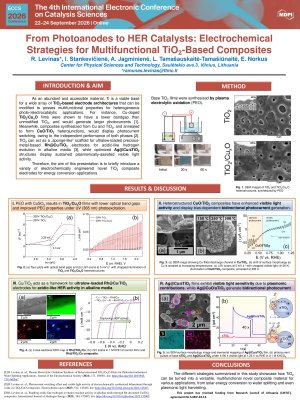
Titanium dioxide (TiO2) remains one of the most attractive semiconductor platforms for water splitting due to its abundance, chemical stability, low cost, and compatibility with electrochemical modification strategies. However, its wide band gap and limited visible light activity require modification to improve charge carrier separation, extend optical response, and introduce additional catalytic functionality. This study summarizes a series of electrochemical approaches for engineering TiO2-based hybrid composite films for photoelectrochemical (PEC) water splitting and alkaline hydrogen evolution reaction (HER).
TiO2 films were primarily synthesized by plasma electrolytic oxidation (PEO), enabling the formation of porous oxide frameworks with tunable morphology and structure. Incorporation of copper species during synthesis produced TiO2/CuxO heterostructures with modified optical properties and lower band gap values, resulting in enhanced PEC performance. Further development involved electrodeposition of Cu into through-oxide TiO2 channels, followed by controlled annealing into Cu2O, CuO or mixed oxide phases. This architecture promoted TiO2-CuO interfacial contact and enabled unusual photocurrent switching behavior, where the photocurrent could be controlled by applied potential. Visible light sensitivity and improved charge transport highlighted the importance of conductive Cu pathways and oxide heterojunction formation. Beyond photoanode design, the same TiO2/Cu architecture was adapted for alkaline HER. Galvanic displacement of ultralow Rh loadings onto Cu/TiO2 produced Rh@Cu nanostructures embedded within the porous matrix. The optimized electrode, containing only 0.28 wt% Rh, achieved 10 mA cm-2 at 58 mV in 1 M KOH, with a Tafel slope of 40 mV dec-1, demonstrating acidic-like HER activity under alkaline conditions. Ongoing work with Ag@Cu/TiO2 further explores plasmonically assisted visible light activity and photocurrent switching.
Overall, this study demonstrates electrochemical synthesis as a versatile platform for designing multifunctional TiO2-based composites for PEC and electrocatalytic water splitting.
Keywords
titanium oxide
water splitting
electrochemistry
photoelectrochemicstry
heterostructures
Poster
Ramunas Levinas poster presentation.pdf
SUNLIGHT-DRIVEN PHOTOCATALYTIC DEGRADATION OF SULPIRIDE BY ZnO- AND CeO2-DOPED MgAl COATINGS
Electrochemical Degradation of Tetracycline Hydrochloride in Aqueous Solution at β-PbO2/α-PbO2/Ni Electrode