Event submissions
Published
This submission belongs to the session S3. Photocatalysis and Electrocatalysis of the event The 4th International Electronic Conference on Catalysis Sciences
Published date
16 Sep, 2026
Academic Editor
'%3e%3cpath%20d='M12.6657%2010.9104C12.4185%2010.325%2012.0599%209.79327%2011.6097%209.34482C11.1609%208.89508%2010.6293%208.5365%2010.0442%208.28888C10.0389%208.28626%2010.0337%208.28495%2010.0285%208.28233C10.8446%207.69279%2011.3752%206.73249%2011.3752%205.64904C11.3752%203.8542%209.92103%202.39999%208.1262%202.39999C6.33136%202.39999%204.87715%203.8542%204.87715%205.64904C4.87715%206.73249%205.40774%207.69279%206.22393%208.28364C6.21869%208.28626%206.21345%208.28757%206.20821%208.29019C5.62129%208.5378%205.09463%208.89284%204.64265%209.34613C4.1929%209.79493%203.83432%2010.3266%203.58671%2010.9117C3.34345%2011.4845%203.21226%2012.0987%203.20023%2012.7209C3.19988%2012.7349%203.20233%2012.7488%203.20744%2012.7619C3.21255%2012.7749%203.22022%2012.7867%203.22998%2012.7968C3.23975%2012.8068%203.25142%2012.8147%203.26431%2012.8202C3.2772%2012.8256%203.29105%2012.8284%203.30504%2012.8284H4.09109C4.14874%2012.8284%204.19459%2012.7825%204.1959%2012.7262C4.2221%2011.7148%204.62823%2010.7676%205.34617%2010.0497C6.08899%209.30683%207.0755%208.89808%208.1262%208.89808C9.17689%208.89808%2010.1634%209.30683%2010.9062%2010.0497C11.6242%2010.7676%2012.0303%2011.7148%2012.0565%2012.7262C12.0578%2012.7838%2012.1037%2012.8284%2012.1613%2012.8284H12.9474C12.9613%2012.8284%2012.9752%2012.8256%2012.9881%2012.8202C13.001%2012.8147%2013.0126%2012.8068%2013.0224%2012.7968C13.0322%2012.7867%2013.0398%2012.7749%2013.0449%2012.7619C13.0501%2012.7488%2013.0525%2012.7349%2013.0522%2012.7209C13.0391%2012.0947%2012.9094%2011.4855%2012.6657%2010.9104ZM8.1262%207.9024C7.52486%207.9024%206.9589%207.6679%206.53312%207.24211C6.10733%206.81633%205.87283%206.25037%205.87283%205.64904C5.87283%205.0477%206.10733%204.48174%206.53312%204.05596C6.9589%203.63018%207.52486%203.39567%208.1262%203.39567C8.72753%203.39567%209.29349%203.63018%209.71927%204.05596C10.1451%204.48174%2010.3796%205.0477%2010.3796%205.64904C10.3796%206.25037%2010.1451%206.81633%209.71927%207.24211C9.29349%207.6679%208.72753%207.9024%208.1262%207.9024Z'%20fill='%235D1EE1'/%3e%3c/g%3e%3c/svg%3e) Carmelo Vecchio
Carmelo VecchioCitation
Paulo Henrique Eleuterio Falsetti, Jéssica Cristina de Almeida, Douglas Mendes da Silva Del Duque, Caue Ribeiro de Oliveira, Guillermo Díaz-Sainz, Vagner Romito de Mendonça, Monoethanolamine-assisted Cu/Cu₂O composites for efficient CO₂ electroreduction to formate, in Proceedings of The 4th International Electronic Conference on Catalysis Sciences, 22 September–24 September 2026, MDPI: Basel, Switzerland
Share
Email
Facebook
Twitter
LinkedIn
Monoethanolamine-assisted Cu/Cu2O composites for efficient CO2 electroreduction to formate
'%3e%3cpath%20d='M12.6647%2010.9104C12.4176%2010.325%2012.0589%209.7933%2011.6088%209.34485C11.16%208.89511%2010.6283%208.53653%2010.0432%208.28891C10.038%208.28629%2010.0327%208.28498%2010.0275%208.28236C10.8437%207.69282%2011.3743%206.73252%2011.3743%205.64907C11.3743%203.85423%209.92005%202.40002%208.12522%202.40002C6.33038%202.40002%204.87618%203.85423%204.87618%205.64907C4.87618%206.73252%205.40677%207.69282%206.22296%208.28367C6.21772%208.28629%206.21248%208.2876%206.20724%208.29022C5.62031%208.53783%205.09365%208.89287%204.64167%209.34616C4.19192%209.79496%203.83334%2010.3266%203.58573%2010.9117C3.34247%2011.4846%203.21128%2012.0987%203.19925%2012.721C3.1989%2012.735%203.20135%2012.7489%203.20646%2012.7619C3.21157%2012.7749%203.21924%2012.7868%203.22901%2012.7968C3.23877%2012.8068%203.25045%2012.8148%203.26334%2012.8202C3.27623%2012.8256%203.29007%2012.8284%203.30406%2012.8284H4.09012C4.14776%2012.8284%204.19362%2012.7825%204.19493%2012.7262C4.22113%2011.7148%204.62726%2010.7676%205.34519%2010.0497C6.08802%209.30686%207.07452%208.89811%208.12522%208.89811C9.17592%208.89811%2010.1624%209.30686%2010.9052%2010.0497C11.6232%2010.7676%2012.0293%2011.7148%2012.0555%2012.7262C12.0568%2012.7839%2012.1027%2012.8284%2012.1603%2012.8284H12.9464C12.9604%2012.8284%2012.9742%2012.8256%2012.9871%2012.8202C13%2012.8148%2013.0117%2012.8068%2013.0214%2012.7968C13.0312%2012.7868%2013.0389%2012.7749%2013.044%2012.7619C13.0491%2012.7489%2013.0515%2012.735%2013.0512%2012.721C13.0381%2012.0947%2012.9084%2011.4856%2012.6647%2010.9104ZM8.12522%207.90243C7.52388%207.90243%206.95792%207.66793%206.53214%207.24215C6.10636%206.81636%205.87185%206.2504%205.87185%205.64907C5.87185%205.04773%206.10636%204.48177%206.53214%204.05599C6.95792%203.63021%207.52388%203.3957%208.12522%203.3957C8.72655%203.3957%209.29252%203.63021%209.7183%204.05599C10.1441%204.48177%2010.3786%205.04773%2010.3786%205.64907C10.3786%206.2504%2010.1441%206.81636%209.7183%207.24215C9.29252%207.66793%208.72655%207.90243%208.12522%207.90243Z'%20fill='%235D1EE1'/%3e%3c/g%3e%3c/svg%3e)
Paulo Henrique Eleuterio Falsetti 1,2
Jéssica Cristina de Almeida 3
Douglas Mendes da Silva Del Duque 4

Caue Ribeiro de Oliveira 3

Guillermo Díaz-Sainz 1
Vagner Romito de Mendonça 2,4
1. Chemical and Biomolecular Engineering Department, University of Cantabria, Santander, Cantabria, Spain
2. Center for Science and Technologies for Sustainability, Federal University of São Carlos, Sorocaba, SP 18052-780, Brazil
3. Embrapa Instrumentation (Brazilian Agricultural Research Corporation), São Carlos, SP 13561-206, Brazil
4. Federal Institute of Education, Science and Technology of São Paulo, Itapetininga, São Paulo, Brazil
Abstract
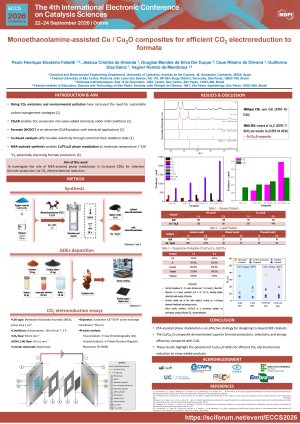
In recent periods, the increase in energy demand accompanied by population growth has intensified CO2 emissions into the atmosphere, disrupting the carbon cycle and enhancing the greenhouse effect. In this context, CO2 capture and conversion have emerged as promising strategies. Among them, CO2 electrochemical reduction (CO2ER) has gained particular attention. Accordingly, the present work aimed to develop gas diffusion electrodes (GDEs) with layers of CuO or Cu/Cu2O composites for CO2ER. The catalyst were synthesized by preparing an ethanolic solution of copper acetate (0.05 M), either with or without addition of monoethanolamine (Cu:ETA = 2:3). The solution was then subjected to 20 h in solvothermal reactor, resulting in CuO (JCPDS 48-1548) or Cu/Cu2O composite (JCPDS 04-0836 and 71-3645), as confirmed by X-ray diffraction analysis. The samples were deposited onto carbon paper via spray coating to produce GDEs. CO2ER tests were performed in membrane electrode assembly (MEA) cell (2 cm2) under galvanostatic conditions (150 mA·cm-2, 2 h) with CO2 flow of 30 mL·min-1, using nickel foam as counter electrode and an anion exchange membrane. Gas and liquid products were quantified by gas chromatography (GC) and proton nuclear magnetic resonance (1H NMR). After 2 h, formate (HCOO‒) was the predominant liquid-phase product, reaching 1051 μmol in CuO and 2274 μmol in Cu/Cu2O. The faradaic efficiency (FE) for formate formation was 14.1% for CuO and 30.5% for Cu/Cu2O, indicating that the Cu/Cu2O composite synthesized with ETA exhibited higher selectivity toward formate and greater energy efficiency, operating at 2.5 V compared to 2.9 V for CuO. Formate formation is particularly relevant, as it represents a selective two-electron reduction pathway and serves as a valuable chemical feedstock and energy carrier in sustainable technologies. ETA plays a key role in stabilizing Cu/Cu2O phase, enhancing both selectivity and efficiency for formate production.
Keywords
Formate
CO2 electroreduction
Gas diffusion electrode
Cu/Cu2O composite
Electrocatalysis
Poster
Presentation_Eletrorreduction.pdf
Electrochemical Degradation of Tetracycline Hydrochloride in Aqueous Solution at β-PbO2/α-PbO2/Ni Electrode
Visible-Light-Driven Photocatalytic H2 Production over an EDTA-TiO2/DHBA Hybrid Photocatalyst