Event submissions
Published
This submission belongs to the session S3. Photocatalysis and Electrocatalysis of the event The 4th International Electronic Conference on Catalysis Sciences
Published date
16 Sep, 2026
Academic Editor
'%3e%3cpath%20d='M12.6657%2010.9104C12.4185%2010.325%2012.0599%209.79327%2011.6097%209.34482C11.1609%208.89508%2010.6293%208.5365%2010.0442%208.28888C10.0389%208.28626%2010.0337%208.28495%2010.0285%208.28233C10.8446%207.69279%2011.3752%206.73249%2011.3752%205.64904C11.3752%203.8542%209.92103%202.39999%208.1262%202.39999C6.33136%202.39999%204.87715%203.8542%204.87715%205.64904C4.87715%206.73249%205.40774%207.69279%206.22393%208.28364C6.21869%208.28626%206.21345%208.28757%206.20821%208.29019C5.62129%208.5378%205.09463%208.89284%204.64265%209.34613C4.1929%209.79493%203.83432%2010.3266%203.58671%2010.9117C3.34345%2011.4845%203.21226%2012.0987%203.20023%2012.7209C3.19988%2012.7349%203.20233%2012.7488%203.20744%2012.7619C3.21255%2012.7749%203.22022%2012.7867%203.22998%2012.7968C3.23975%2012.8068%203.25142%2012.8147%203.26431%2012.8202C3.2772%2012.8256%203.29105%2012.8284%203.30504%2012.8284H4.09109C4.14874%2012.8284%204.19459%2012.7825%204.1959%2012.7262C4.2221%2011.7148%204.62823%2010.7676%205.34617%2010.0497C6.08899%209.30683%207.0755%208.89808%208.1262%208.89808C9.17689%208.89808%2010.1634%209.30683%2010.9062%2010.0497C11.6242%2010.7676%2012.0303%2011.7148%2012.0565%2012.7262C12.0578%2012.7838%2012.1037%2012.8284%2012.1613%2012.8284H12.9474C12.9613%2012.8284%2012.9752%2012.8256%2012.9881%2012.8202C13.001%2012.8147%2013.0126%2012.8068%2013.0224%2012.7968C13.0322%2012.7867%2013.0398%2012.7749%2013.0449%2012.7619C13.0501%2012.7488%2013.0525%2012.7349%2013.0522%2012.7209C13.0391%2012.0947%2012.9094%2011.4855%2012.6657%2010.9104ZM8.1262%207.9024C7.52486%207.9024%206.9589%207.6679%206.53312%207.24211C6.10733%206.81633%205.87283%206.25037%205.87283%205.64904C5.87283%205.0477%206.10733%204.48174%206.53312%204.05596C6.9589%203.63018%207.52486%203.39567%208.1262%203.39567C8.72753%203.39567%209.29349%203.63018%209.71927%204.05596C10.1451%204.48174%2010.3796%205.0477%2010.3796%205.64904C10.3796%206.25037%2010.1451%206.81633%209.71927%207.24211C9.29349%207.6679%208.72753%207.9024%208.1262%207.9024Z'%20fill='%235D1EE1'/%3e%3c/g%3e%3c/svg%3e) Carmelo Vecchio
Carmelo VecchioCitation
Mst. Kaniz Subarna, Abdul Awal, Md. Delwar Hossain, A. J. Saleh Ahammad, Reduce Graphene Oxide–Rice Husk Activated Carbon Composite Based Glassy Carbon Electrode for Sensitive Electrochemical Detection of Paracetamol, in Proceedings of The 4th International Electronic Conference on Catalysis Sciences, 22 September–24 September 2026, MDPI: Basel, Switzerland
Share
Email
Facebook
Twitter
LinkedIn
Reduce Graphene Oxide–Rice Husk Activated Carbon Composite Based Glassy Carbon Electrode for Sensitive Electrochemical Detection of Paracetamol
'%3e%3cpath%20d='M12.6647%2010.9104C12.4176%2010.325%2012.0589%209.7933%2011.6088%209.34485C11.16%208.89511%2010.6283%208.53653%2010.0432%208.28891C10.038%208.28629%2010.0327%208.28498%2010.0275%208.28236C10.8437%207.69282%2011.3743%206.73252%2011.3743%205.64907C11.3743%203.85423%209.92005%202.40002%208.12522%202.40002C6.33038%202.40002%204.87618%203.85423%204.87618%205.64907C4.87618%206.73252%205.40677%207.69282%206.22296%208.28367C6.21772%208.28629%206.21248%208.2876%206.20724%208.29022C5.62031%208.53783%205.09365%208.89287%204.64167%209.34616C4.19192%209.79496%203.83334%2010.3266%203.58573%2010.9117C3.34247%2011.4846%203.21128%2012.0987%203.19925%2012.721C3.1989%2012.735%203.20135%2012.7489%203.20646%2012.7619C3.21157%2012.7749%203.21924%2012.7868%203.22901%2012.7968C3.23877%2012.8068%203.25045%2012.8148%203.26334%2012.8202C3.27623%2012.8256%203.29007%2012.8284%203.30406%2012.8284H4.09012C4.14776%2012.8284%204.19362%2012.7825%204.19493%2012.7262C4.22113%2011.7148%204.62726%2010.7676%205.34519%2010.0497C6.08802%209.30686%207.07452%208.89811%208.12522%208.89811C9.17592%208.89811%2010.1624%209.30686%2010.9052%2010.0497C11.6232%2010.7676%2012.0293%2011.7148%2012.0555%2012.7262C12.0568%2012.7839%2012.1027%2012.8284%2012.1603%2012.8284H12.9464C12.9604%2012.8284%2012.9742%2012.8256%2012.9871%2012.8202C13%2012.8148%2013.0117%2012.8068%2013.0214%2012.7968C13.0312%2012.7868%2013.0389%2012.7749%2013.044%2012.7619C13.0491%2012.7489%2013.0515%2012.735%2013.0512%2012.721C13.0381%2012.0947%2012.9084%2011.4856%2012.6647%2010.9104ZM8.12522%207.90243C7.52388%207.90243%206.95792%207.66793%206.53214%207.24215C6.10636%206.81636%205.87185%206.2504%205.87185%205.64907C5.87185%205.04773%206.10636%204.48177%206.53214%204.05599C6.95792%203.63021%207.52388%203.3957%208.12522%203.3957C8.72655%203.3957%209.29252%203.63021%209.7183%204.05599C10.1441%204.48177%2010.3786%205.04773%2010.3786%205.64907C10.3786%206.2504%2010.1441%206.81636%209.7183%207.24215C9.29252%207.66793%208.72655%207.90243%208.12522%207.90243Z'%20fill='%235D1EE1'/%3e%3c/g%3e%3c/svg%3e)
Mst. Kaniz Subarna 1
Abdul Awal 1
Md. Delwar Hossain 1
A. J. Saleh Ahammad 1
1. Department of Chemistry, Jagannath University, Dhaka-1100, Bangladesh
Abstract
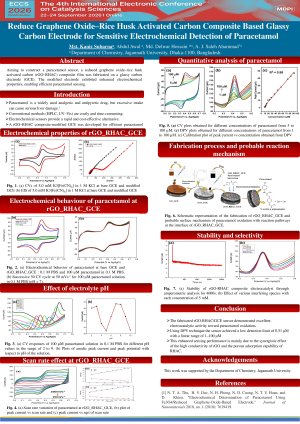
Introduction: Paracetamol is a common painkiller and fever reducer, but taking too much of this drug can cause serious damage to your liver. Hence, the sensitive detection of paracetamol is very important. Conventional techniques such as UV-Vis and HPLC are effective but involve expensive equipment and time-consuming sample preparation. In order to overcome these limitations, a great deal of attention has been paid to the development of sensitive and inexpensive electrochemical sensors. In this work, a glassy carbon electrode (GCE) was modified with an efficient electrocatalytic composite of reduced graphene oxide and rice husk activated carbon (rGO–RHAC) for the electrochemical detection of paracetamol.
Methods: In this study, rGO-RHAC film was fabricated on a glassy carbon electrode using an electrochemical method. Graphene oxide (GO) was first deposited on GCE and then reduced to rGO, followed by dropcasting RHAC to form the rGO-RHAC film. The resulting rGO_RHAC/GCE sensor was evaluated for paracetamol detection by cyclic voltammetry (CV) in 0.1 M PBS. The sensor’s selectivity was tested against common interfering agents, and its applicability was assessed using real water samples.
Results: CV and EIS techniques in 5mM K3[Fe(CN)6] solution confirm the formation of rGO_RHAC composite. The modified sensor exhibited excellent electrocatalytic activity towards paracetamol oxidation, with a detection limit of only 0.51μM with a linear range 1μM to 100μM. The enhanced performance is attributed to the synergistic effect between the high conductivity of rGO and the porous adsorption capability of RHAC.
Conclusions: The rGO-RHAC/GCE sensor provides a low cost, simple and stable platform for the detection of paracetamol. Because of its high sensitivity, selectivity and applicability in real sample analysis, it is a promising candidate for monitoring of paracetamol. Its application in portable paracetamol sensors may be further optimised.
Keywords
Electrochemical sensor
rGO_RHAC
paracetamol.
Poster
MK SUBARNA POSTER11.pdf
Exfoliated 2D Carbon Nitride Enables Efficient Visible-Light-Driven Nitrogen Reduction to Ammonium under Mild Conditions.
Synthesis of Biopolymer-Metal Oxide Nanomaterials for Efficient Photocatalysis