Event submissions
Published
This submission belongs to the session S3. Photocatalysis and Electrocatalysis of the event The 4th International Electronic Conference on Catalysis Sciences
Published date
16 Sep, 2026
Academic Editor
'%3e%3cpath%20d='M12.6657%2010.9104C12.4185%2010.325%2012.0599%209.79327%2011.6097%209.34482C11.1609%208.89508%2010.6293%208.5365%2010.0442%208.28888C10.0389%208.28626%2010.0337%208.28495%2010.0285%208.28233C10.8446%207.69279%2011.3752%206.73249%2011.3752%205.64904C11.3752%203.8542%209.92103%202.39999%208.1262%202.39999C6.33136%202.39999%204.87715%203.8542%204.87715%205.64904C4.87715%206.73249%205.40774%207.69279%206.22393%208.28364C6.21869%208.28626%206.21345%208.28757%206.20821%208.29019C5.62129%208.5378%205.09463%208.89284%204.64265%209.34613C4.1929%209.79493%203.83432%2010.3266%203.58671%2010.9117C3.34345%2011.4845%203.21226%2012.0987%203.20023%2012.7209C3.19988%2012.7349%203.20233%2012.7488%203.20744%2012.7619C3.21255%2012.7749%203.22022%2012.7867%203.22998%2012.7968C3.23975%2012.8068%203.25142%2012.8147%203.26431%2012.8202C3.2772%2012.8256%203.29105%2012.8284%203.30504%2012.8284H4.09109C4.14874%2012.8284%204.19459%2012.7825%204.1959%2012.7262C4.2221%2011.7148%204.62823%2010.7676%205.34617%2010.0497C6.08899%209.30683%207.0755%208.89808%208.1262%208.89808C9.17689%208.89808%2010.1634%209.30683%2010.9062%2010.0497C11.6242%2010.7676%2012.0303%2011.7148%2012.0565%2012.7262C12.0578%2012.7838%2012.1037%2012.8284%2012.1613%2012.8284H12.9474C12.9613%2012.8284%2012.9752%2012.8256%2012.9881%2012.8202C13.001%2012.8147%2013.0126%2012.8068%2013.0224%2012.7968C13.0322%2012.7867%2013.0398%2012.7749%2013.0449%2012.7619C13.0501%2012.7488%2013.0525%2012.7349%2013.0522%2012.7209C13.0391%2012.0947%2012.9094%2011.4855%2012.6657%2010.9104ZM8.1262%207.9024C7.52486%207.9024%206.9589%207.6679%206.53312%207.24211C6.10733%206.81633%205.87283%206.25037%205.87283%205.64904C5.87283%205.0477%206.10733%204.48174%206.53312%204.05596C6.9589%203.63018%207.52486%203.39567%208.1262%203.39567C8.72753%203.39567%209.29349%203.63018%209.71927%204.05596C10.1451%204.48174%2010.3796%205.0477%2010.3796%205.64904C10.3796%206.25037%2010.1451%206.81633%209.71927%207.24211C9.29349%207.6679%208.72753%207.9024%208.1262%207.9024Z'%20fill='%235D1EE1'/%3e%3c/g%3e%3c/svg%3e) Carmelo Vecchio
Carmelo VecchioCitation
Dorota Stanek, Sebastian Jarczewski, Krzysztof Mech, Effect of SO₂ Impurities on Cu-Based Catalysts Prepared by Thermal Evaporation and Magnetron Sputtering for Electrochemical CO₂ Reduction, in Proceedings of The 4th International Electronic Conference on Catalysis Sciences, 22 September–24 September 2026, MDPI: Basel, Switzerland
Share
Email
Facebook
Twitter
LinkedIn
Effect of SO₂ Impurities on Cu-Based Catalysts Prepared by Thermal Evaporation and Magnetron Sputtering for Electrochemical CO₂ Reduction
'%3e%3cpath%20d='M12.6647%2010.9104C12.4176%2010.325%2012.0589%209.7933%2011.6088%209.34485C11.16%208.89511%2010.6283%208.53653%2010.0432%208.28891C10.038%208.28629%2010.0327%208.28498%2010.0275%208.28236C10.8437%207.69282%2011.3743%206.73252%2011.3743%205.64907C11.3743%203.85423%209.92005%202.40002%208.12522%202.40002C6.33038%202.40002%204.87618%203.85423%204.87618%205.64907C4.87618%206.73252%205.40677%207.69282%206.22296%208.28367C6.21772%208.28629%206.21248%208.2876%206.20724%208.29022C5.62031%208.53783%205.09365%208.89287%204.64167%209.34616C4.19192%209.79496%203.83334%2010.3266%203.58573%2010.9117C3.34247%2011.4846%203.21128%2012.0987%203.19925%2012.721C3.1989%2012.735%203.20135%2012.7489%203.20646%2012.7619C3.21157%2012.7749%203.21924%2012.7868%203.22901%2012.7968C3.23877%2012.8068%203.25045%2012.8148%203.26334%2012.8202C3.27623%2012.8256%203.29007%2012.8284%203.30406%2012.8284H4.09012C4.14776%2012.8284%204.19362%2012.7825%204.19493%2012.7262C4.22113%2011.7148%204.62726%2010.7676%205.34519%2010.0497C6.08802%209.30686%207.07452%208.89811%208.12522%208.89811C9.17592%208.89811%2010.1624%209.30686%2010.9052%2010.0497C11.6232%2010.7676%2012.0293%2011.7148%2012.0555%2012.7262C12.0568%2012.7839%2012.1027%2012.8284%2012.1603%2012.8284H12.9464C12.9604%2012.8284%2012.9742%2012.8256%2012.9871%2012.8202C13%2012.8148%2013.0117%2012.8068%2013.0214%2012.7968C13.0312%2012.7868%2013.0389%2012.7749%2013.044%2012.7619C13.0491%2012.7489%2013.0515%2012.735%2013.0512%2012.721C13.0381%2012.0947%2012.9084%2011.4856%2012.6647%2010.9104ZM8.12522%207.90243C7.52388%207.90243%206.95792%207.66793%206.53214%207.24215C6.10636%206.81636%205.87185%206.2504%205.87185%205.64907C5.87185%205.04773%206.10636%204.48177%206.53214%204.05599C6.95792%203.63021%207.52388%203.3957%208.12522%203.3957C8.72655%203.3957%209.29252%203.63021%209.7183%204.05599C10.1441%204.48177%2010.3786%205.04773%2010.3786%205.64907C10.3786%206.2504%2010.1441%206.81636%209.7183%207.24215C9.29252%207.66793%208.72655%207.90243%208.12522%207.90243Z'%20fill='%235D1EE1'/%3e%3c/g%3e%3c/svg%3e)
Dorota Stanek 1
Sebastian Jarczewski 1
Krzysztof Mech 1
1. Academic Centre for Materials and Nanotechnology, AGH University of Krakow, Krakow, Poland
Abstract
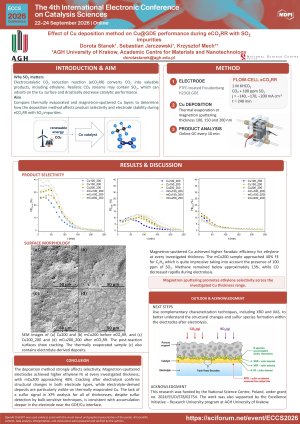
Introduction:Electrochemical CO2 reduction reaction (CO2RR) is a promising route for converting carbon dioxide into value-added products. Copper-based catalysts are particularly important materials for CO2RR due to their ability to promote C-C coupling and produce multi-carbon products such as ethylen. Real CO2 feed streams may contain impurities, including SO2, which can affect catalytic activity, selectivity and long-term stability. Understanding how SO2 interacts with different Cu surfaces is therefore essential for designing catalysts resistant to poisoning.
Methods:Cu-based catalytic layers were prepared by thermal evaporation and magnetron sputtering. Layers thickness were determined to compare the structural parameters resulting from both sputtering techniques. Their performance was evaluated during CO2RR under a CO2 stream containing 100 ppm SO2. Product distribution and Faradaic efficiency was monitored during electrolysis with particular focus on ethylene formation. The catalysts were characterized before and after testing using XRD, SEM, AFM, ATR-FTIR, XPS and XRF. Post-reaction analysis was used to identify sulfur-containing species formed after SO₂ exposure.
Results:All investigated Cu-based catalysts showed comparable activity levels, with maximum FE toward C2H4 reaching approximately 25-40%. Although SEM revealed cracks after electrolysis, XPS did not detect sulfur species on the outer Cu surface, while XRF confirmed sulfur accumulation within the electrode structure. This suggests that sulfur-containing species accumulated mainly at the GDE/Cu interface rather than penetrating through the Cu layer to the exposed catalyst surface.
Conclusions:The obtained results will provide insight into the relationship between Cu preparation method, surface structure and susceptibility to SO2 induced deactivation. This knowledge may support the development of Cu-based catalysts with improved stability for CO2 conversion using impurity containing feed streams.
Keywords
CO2 conversion
Electrocatalysis
Cu catalysts
SO₂ impurities
Catalyst deactivation
Poster
ECCS2026_Stanek_Poster.pdf
Synthesis of Biopolymer-Metal Oxide Nanomaterials for Efficient Photocatalysis
Selective Photocatalytic Reduction of 4-Nitrophenol to 4-Aminophenol over Ru-Doped TiO₂: Effect of Ru Loading and Reaction Parameters