Event submissions
Published
This submission belongs to the session S3. Photocatalysis and Electrocatalysis of the event The 4th International Electronic Conference on Catalysis Sciences
Published date
16 Sep, 2026
Academic Editor
'%3e%3cpath%20d='M12.6657%2010.9104C12.4185%2010.325%2012.0599%209.79327%2011.6097%209.34482C11.1609%208.89508%2010.6293%208.5365%2010.0442%208.28888C10.0389%208.28626%2010.0337%208.28495%2010.0285%208.28233C10.8446%207.69279%2011.3752%206.73249%2011.3752%205.64904C11.3752%203.8542%209.92103%202.39999%208.1262%202.39999C6.33136%202.39999%204.87715%203.8542%204.87715%205.64904C4.87715%206.73249%205.40774%207.69279%206.22393%208.28364C6.21869%208.28626%206.21345%208.28757%206.20821%208.29019C5.62129%208.5378%205.09463%208.89284%204.64265%209.34613C4.1929%209.79493%203.83432%2010.3266%203.58671%2010.9117C3.34345%2011.4845%203.21226%2012.0987%203.20023%2012.7209C3.19988%2012.7349%203.20233%2012.7488%203.20744%2012.7619C3.21255%2012.7749%203.22022%2012.7867%203.22998%2012.7968C3.23975%2012.8068%203.25142%2012.8147%203.26431%2012.8202C3.2772%2012.8256%203.29105%2012.8284%203.30504%2012.8284H4.09109C4.14874%2012.8284%204.19459%2012.7825%204.1959%2012.7262C4.2221%2011.7148%204.62823%2010.7676%205.34617%2010.0497C6.08899%209.30683%207.0755%208.89808%208.1262%208.89808C9.17689%208.89808%2010.1634%209.30683%2010.9062%2010.0497C11.6242%2010.7676%2012.0303%2011.7148%2012.0565%2012.7262C12.0578%2012.7838%2012.1037%2012.8284%2012.1613%2012.8284H12.9474C12.9613%2012.8284%2012.9752%2012.8256%2012.9881%2012.8202C13.001%2012.8147%2013.0126%2012.8068%2013.0224%2012.7968C13.0322%2012.7867%2013.0398%2012.7749%2013.0449%2012.7619C13.0501%2012.7488%2013.0525%2012.7349%2013.0522%2012.7209C13.0391%2012.0947%2012.9094%2011.4855%2012.6657%2010.9104ZM8.1262%207.9024C7.52486%207.9024%206.9589%207.6679%206.53312%207.24211C6.10733%206.81633%205.87283%206.25037%205.87283%205.64904C5.87283%205.0477%206.10733%204.48174%206.53312%204.05596C6.9589%203.63018%207.52486%203.39567%208.1262%203.39567C8.72753%203.39567%209.29349%203.63018%209.71927%204.05596C10.1451%204.48174%2010.3796%205.0477%2010.3796%205.64904C10.3796%206.25037%2010.1451%206.81633%209.71927%207.24211C9.29349%207.6679%208.72753%207.9024%208.1262%207.9024Z'%20fill='%235D1EE1'/%3e%3c/g%3e%3c/svg%3e) Ioannis Konstantinou
Ioannis KonstantinouCitation
Dušica Jovanović, Daniela Šojić Merkulov, Vesna Despotović, Sabolč Bognar, Nina Finčur, From Thyme to Treatment: Green‑Engineered ZnO Photocatalyst for Light‑Driven Removal of Sulpiride, in Proceedings of The 4th International Electronic Conference on Catalysis Sciences, 22 September–24 September 2026, MDPI: Basel, Switzerland
Share
Email
Facebook
Twitter
LinkedIn
From Thyme to Treatment: Green‑Engineered ZnO Photocatalyst for Light‑Driven Removal of Sulpiride
'%3e%3cpath%20d='M12.6647%2010.9104C12.4176%2010.325%2012.0589%209.7933%2011.6088%209.34485C11.16%208.89511%2010.6283%208.53653%2010.0432%208.28891C10.038%208.28629%2010.0327%208.28498%2010.0275%208.28236C10.8437%207.69282%2011.3743%206.73252%2011.3743%205.64907C11.3743%203.85423%209.92005%202.40002%208.12522%202.40002C6.33038%202.40002%204.87618%203.85423%204.87618%205.64907C4.87618%206.73252%205.40677%207.69282%206.22296%208.28367C6.21772%208.28629%206.21248%208.2876%206.20724%208.29022C5.62031%208.53783%205.09365%208.89287%204.64167%209.34616C4.19192%209.79496%203.83334%2010.3266%203.58573%2010.9117C3.34247%2011.4846%203.21128%2012.0987%203.19925%2012.721C3.1989%2012.735%203.20135%2012.7489%203.20646%2012.7619C3.21157%2012.7749%203.21924%2012.7868%203.22901%2012.7968C3.23877%2012.8068%203.25045%2012.8148%203.26334%2012.8202C3.27623%2012.8256%203.29007%2012.8284%203.30406%2012.8284H4.09012C4.14776%2012.8284%204.19362%2012.7825%204.19493%2012.7262C4.22113%2011.7148%204.62726%2010.7676%205.34519%2010.0497C6.08802%209.30686%207.07452%208.89811%208.12522%208.89811C9.17592%208.89811%2010.1624%209.30686%2010.9052%2010.0497C11.6232%2010.7676%2012.0293%2011.7148%2012.0555%2012.7262C12.0568%2012.7839%2012.1027%2012.8284%2012.1603%2012.8284H12.9464C12.9604%2012.8284%2012.9742%2012.8256%2012.9871%2012.8202C13%2012.8148%2013.0117%2012.8068%2013.0214%2012.7968C13.0312%2012.7868%2013.0389%2012.7749%2013.044%2012.7619C13.0491%2012.7489%2013.0515%2012.735%2013.0512%2012.721C13.0381%2012.0947%2012.9084%2011.4856%2012.6647%2010.9104ZM8.12522%207.90243C7.52388%207.90243%206.95792%207.66793%206.53214%207.24215C6.10636%206.81636%205.87185%206.2504%205.87185%205.64907C5.87185%205.04773%206.10636%204.48177%206.53214%204.05599C6.95792%203.63021%207.52388%203.3957%208.12522%203.3957C8.72655%203.3957%209.29252%203.63021%209.7183%204.05599C10.1441%204.48177%2010.3786%205.04773%2010.3786%205.64907C10.3786%206.2504%2010.1441%206.81636%209.7183%207.24215C9.29252%207.66793%208.72655%207.90243%208.12522%207.90243Z'%20fill='%235D1EE1'/%3e%3c/g%3e%3c/svg%3e)
Dušica Jovanović 1

Daniela Šojić Merkulov 1
Vesna Despotović 1
Sabolč Bognar 1

Nina Finčur 1
1. Department of Chemistry, Biochemistry and Environmental Protection, University of Novi Sad Faculty of Sciences, Trg D. Obradovića 3, 21000 Novi Sad, Serbia
Abstract
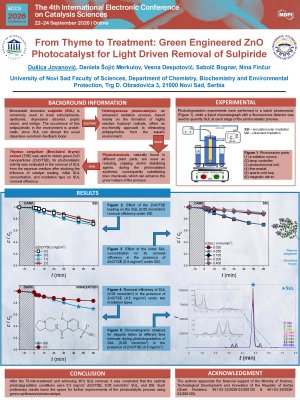
Benzamide derivative sulpiride (SUL) is commonly used to treat schizophrenia, dysthymia, depressive disorder, peptic ulcers, and vertigo. The occurrence of this antipsychotic in the environment is problematic, since SUL can disrupt the usual dopamine–serotonin feedback loops in non-patients. Therefore, finding green and sustainable water remediation technologies is of vital importance.
Heterogeneous photocatalysis, an advanced oxidation process, based mainly on the formation of highly reactive hydroxyl radicals, offers an eco-friendly approach to eliminating antipsychotics from the aquatic environment. This process can become even more green with the assistance of diverse plant extracts during the photocatalyst synthesis. Various phytochemicals, naturally found in different parts of plants, are used as reducing, capping and/or stabilizing agents, consequently substituting toxic chemicals.
Thus, for this research, Thymus serpyllum (Breckland thyme) extract (TSE) was used to obtain ZnO nanoparticles (ZnO/TSE). Its photocatalytic activity was evaluated in the removal of SUL from the aqueous medium after studying the influence of catalyst loading, initial SUL concentration, and irradiation type on SUL removal efficiency. Ultrafast liquid chromatograph with a fluorescence detector was used to quantify SUL at each stage of the photocatalytic process.
After the 75-min-treatment and achieving 30% SUL removal, it was concluded that the optimal photodegradation conditions were 0.5 mg/cm3 ZnO/TSE, 0.05 mmol/dm3 SUL, and simulated solar irradiation. Such preliminary results leave the space for further improvements of the photocatalytic process.
Acknowledgements: The authors acknowledge the financial support of the Ministry of Science, Technological Development and Innovation of the Republic of Serbia (Grant Numbers: 451-03-33/2026-03/200125 & 451-03-34/2026-03/200125).
Keywords
Sulpiride
Heterogeneous photocatalysis
ZnO
Green synthesis
Thymus serpyllum
Poster
ECCS_Poster_Dušica Jovanović PDF.pdf
Selective Photocatalytic Reduction of 4-Nitrophenol to 4-Aminophenol over Ru-Doped TiO₂: Effect of Ru Loading and Reaction Parameters
Effects of Metal Centers and meso-substituents on Electronic and Catalytic Properties of Porphyrins: A Quantum Chemical Approach