Event submissions
Published
This submission belongs to the session S1. Catalytic Materials of the event The 4th International Electronic Conference on Catalysis Sciences
Published date
16 Sep, 2026
Academic Editor
'%3e%3cpath%20d='M12.6657%2010.9104C12.4185%2010.325%2012.0599%209.79327%2011.6097%209.34482C11.1609%208.89508%2010.6293%208.5365%2010.0442%208.28888C10.0389%208.28626%2010.0337%208.28495%2010.0285%208.28233C10.8446%207.69279%2011.3752%206.73249%2011.3752%205.64904C11.3752%203.8542%209.92103%202.39999%208.1262%202.39999C6.33136%202.39999%204.87715%203.8542%204.87715%205.64904C4.87715%206.73249%205.40774%207.69279%206.22393%208.28364C6.21869%208.28626%206.21345%208.28757%206.20821%208.29019C5.62129%208.5378%205.09463%208.89284%204.64265%209.34613C4.1929%209.79493%203.83432%2010.3266%203.58671%2010.9117C3.34345%2011.4845%203.21226%2012.0987%203.20023%2012.7209C3.19988%2012.7349%203.20233%2012.7488%203.20744%2012.7619C3.21255%2012.7749%203.22022%2012.7867%203.22998%2012.7968C3.23975%2012.8068%203.25142%2012.8147%203.26431%2012.8202C3.2772%2012.8256%203.29105%2012.8284%203.30504%2012.8284H4.09109C4.14874%2012.8284%204.19459%2012.7825%204.1959%2012.7262C4.2221%2011.7148%204.62823%2010.7676%205.34617%2010.0497C6.08899%209.30683%207.0755%208.89808%208.1262%208.89808C9.17689%208.89808%2010.1634%209.30683%2010.9062%2010.0497C11.6242%2010.7676%2012.0303%2011.7148%2012.0565%2012.7262C12.0578%2012.7838%2012.1037%2012.8284%2012.1613%2012.8284H12.9474C12.9613%2012.8284%2012.9752%2012.8256%2012.9881%2012.8202C13.001%2012.8147%2013.0126%2012.8068%2013.0224%2012.7968C13.0322%2012.7867%2013.0398%2012.7749%2013.0449%2012.7619C13.0501%2012.7488%2013.0525%2012.7349%2013.0522%2012.7209C13.0391%2012.0947%2012.9094%2011.4855%2012.6657%2010.9104ZM8.1262%207.9024C7.52486%207.9024%206.9589%207.6679%206.53312%207.24211C6.10733%206.81633%205.87283%206.25037%205.87283%205.64904C5.87283%205.0477%206.10733%204.48174%206.53312%204.05596C6.9589%203.63018%207.52486%203.39567%208.1262%203.39567C8.72753%203.39567%209.29349%203.63018%209.71927%204.05596C10.1451%204.48174%2010.3796%205.0477%2010.3796%205.64904C10.3796%206.25037%2010.1451%206.81633%209.71927%207.24211C9.29349%207.6679%208.72753%207.9024%208.1262%207.9024Z'%20fill='%235D1EE1'/%3e%3c/g%3e%3c/svg%3e) Narendra Kumar
Narendra KumarCitation
Md. Ruhul Amin Niloy, S.M. Mehedi Afnan Rejve, Md. Atiqur Rahman, Md Anamul Hoque, Aniruddha Saha, Amitav Sen, Monir Uzzaman, Effects of Metal Centers and meso-substituents on Electronic and Catalytic Properties of Porphyrins: A Quantum Chemical Approach, in Proceedings of The 4th International Electronic Conference on Catalysis Sciences, 22 September–24 September 2026, MDPI: Basel, Switzerland
Share
Email
Facebook
Twitter
LinkedIn
Effects of Metal Centers and meso-substituents on Electronic and Catalytic Properties of Porphyrins: A Quantum Chemical Approach
'%3e%3cpath%20d='M12.6647%2010.9104C12.4176%2010.325%2012.0589%209.7933%2011.6088%209.34485C11.16%208.89511%2010.6283%208.53653%2010.0432%208.28891C10.038%208.28629%2010.0327%208.28498%2010.0275%208.28236C10.8437%207.69282%2011.3743%206.73252%2011.3743%205.64907C11.3743%203.85423%209.92005%202.40002%208.12522%202.40002C6.33038%202.40002%204.87618%203.85423%204.87618%205.64907C4.87618%206.73252%205.40677%207.69282%206.22296%208.28367C6.21772%208.28629%206.21248%208.2876%206.20724%208.29022C5.62031%208.53783%205.09365%208.89287%204.64167%209.34616C4.19192%209.79496%203.83334%2010.3266%203.58573%2010.9117C3.34247%2011.4846%203.21128%2012.0987%203.19925%2012.721C3.1989%2012.735%203.20135%2012.7489%203.20646%2012.7619C3.21157%2012.7749%203.21924%2012.7868%203.22901%2012.7968C3.23877%2012.8068%203.25045%2012.8148%203.26334%2012.8202C3.27623%2012.8256%203.29007%2012.8284%203.30406%2012.8284H4.09012C4.14776%2012.8284%204.19362%2012.7825%204.19493%2012.7262C4.22113%2011.7148%204.62726%2010.7676%205.34519%2010.0497C6.08802%209.30686%207.07452%208.89811%208.12522%208.89811C9.17592%208.89811%2010.1624%209.30686%2010.9052%2010.0497C11.6232%2010.7676%2012.0293%2011.7148%2012.0555%2012.7262C12.0568%2012.7839%2012.1027%2012.8284%2012.1603%2012.8284H12.9464C12.9604%2012.8284%2012.9742%2012.8256%2012.9871%2012.8202C13%2012.8148%2013.0117%2012.8068%2013.0214%2012.7968C13.0312%2012.7868%2013.0389%2012.7749%2013.044%2012.7619C13.0491%2012.7489%2013.0515%2012.735%2013.0512%2012.721C13.0381%2012.0947%2012.9084%2011.4856%2012.6647%2010.9104ZM8.12522%207.90243C7.52388%207.90243%206.95792%207.66793%206.53214%207.24215C6.10636%206.81636%205.87185%206.2504%205.87185%205.64907C5.87185%205.04773%206.10636%204.48177%206.53214%204.05599C6.95792%203.63021%207.52388%203.3957%208.12522%203.3957C8.72655%203.3957%209.29252%203.63021%209.7183%204.05599C10.1441%204.48177%2010.3786%205.04773%2010.3786%205.64907C10.3786%206.2504%2010.1441%206.81636%209.7183%207.24215C9.29252%207.66793%208.72655%207.90243%208.12522%207.90243Z'%20fill='%235D1EE1'/%3e%3c/g%3e%3c/svg%3e)
Md. Ruhul Amin Niloy 1
S.M. Mehedi Afnan Rejve 1
Md. Atiqur Rahman 2
Md Anamul Hoque 3
Aniruddha Saha 1
Amitav Sen 4

Monir Uzzaman 5
1. Faculty of Science, Department of Applied Chemistry and Chemical Engineering, University of Chittagong, Chittagong, Bangladesh
2. Faculty of Science, Department of Chemistry, University of Chittagong, Chittagong, Bangladesh
3. Faculty of Science, Department of Physics, University of Dhaka, Dhaka, Bangladesh
4. Department of Chemistry, Missouri University of Science and Technology, Rolla, Missouri- 65409, USA
5. Graduate School of Engineering, Department of Applied Chemistry, Mie University, Tsu, Mie 514-8507, Japan
Abstract
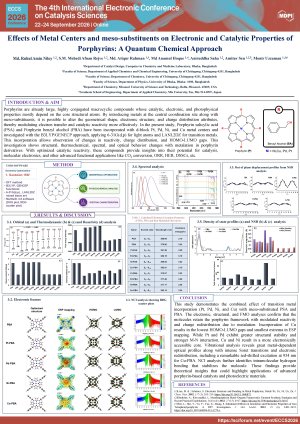
Porphyrins constitute a versatile class of π-conjugated macrocycles with high structural stability and broad applicability in catalysis. However, the catalytic activity of free-base porphyrins is limited by the absence of metal-centers and limited electronic tunability. Metalation with meso-substitution introduces d-orbital interactions that regulate electronic structure, charge distribution, and geometry, enhancing electron-transfer and catalytic performance. In the present study, meso-substituted porphyrins, namely porphyrin salicylic acid (PSA) and porphyrin benzyl alcohol (PBA) were systematically investigated upon incorporation of Pt, Pd, Ni, and Cu centers using B3LYP/GENECP approach, employing 6-31G(d,p) for light atoms and LANL2DZ for transition metals. Metal incorporation produced HOMO–LUMO gaps between 2.76 (Cu-PBA) and 2.97 (Pt-PSA) compared with 2.58-2.60 eV for free ligands. Dipole moments increased from 4.19 D (PSA) and 2.00 D (PBA) to as high as 4.41 D (Pt-PSA) and 2.06 D (Pt-PBA, Ni-PBA) respectively. ESP maps revealed pronounced electron-rich regions around the oxygen-containing meso substituents and electron-deficient metal coordination centers. NSD analysis revealed reduced out-of-plane distortions for Pt-PSA (0.23 Å) and Pd-PSA (0.20 Å) relative to PSA (0.33 Å), whereas Ni-PBA exhibited pronounced ruffling with a distortion amplitude of 0.69 Å (pyrrole tilt = 7.6°). TD-DFT calculations revealed strong metal-dependent optical responses, with intense Soret transitions appearing at 372–388 nm (f = 0.856–0.973) for Pt and Pd derivatives, while Cu-PBA displayed a remarkable red-shifted excitation at 934 nm. Vibrational analysis further confirmed electronic redistribution, with the C=C stretching mode at 1531cm-1 (PSA) shifts distinctively to 1515 cm-1 in Pt-PSA and 1506 cm-1 in Cu-PSA. NCI analysis confirms meso-salicylate groups engage in extensive intramolecular hydrogen bonding. These findings identify metal and meso-substituent character function as orthogonal handles for tuning macrocycle planarity, frontier orbital energetics, and optical response, offering a complete framework for the rational design of meso-substituted metallo-porphyrins with target electronic and photophysical profiles.
Keywords
Metalloporphyrins
Meso-substitution
TD-DFT
Catalysis
Optical properties
Poster
poster for MDPI conference.pdf
From Thyme to Treatment: Green‑Engineered ZnO Photocatalyst for Light‑Driven Removal of Sulpiride
Euphorbia geroldii Silver Nanoparticles: Evaluation of Photocatalytic and Catalytic Applications