Event submissions
Published
This submission belongs to the session S1. Catalytic Materials of the event The 4th International Electronic Conference on Catalysis Sciences
Published date
16 Sep, 2026
Academic Editor
'%3e%3cpath%20d='M12.6657%2010.9104C12.4185%2010.325%2012.0599%209.79327%2011.6097%209.34482C11.1609%208.89508%2010.6293%208.5365%2010.0442%208.28888C10.0389%208.28626%2010.0337%208.28495%2010.0285%208.28233C10.8446%207.69279%2011.3752%206.73249%2011.3752%205.64904C11.3752%203.8542%209.92103%202.39999%208.1262%202.39999C6.33136%202.39999%204.87715%203.8542%204.87715%205.64904C4.87715%206.73249%205.40774%207.69279%206.22393%208.28364C6.21869%208.28626%206.21345%208.28757%206.20821%208.29019C5.62129%208.5378%205.09463%208.89284%204.64265%209.34613C4.1929%209.79493%203.83432%2010.3266%203.58671%2010.9117C3.34345%2011.4845%203.21226%2012.0987%203.20023%2012.7209C3.19988%2012.7349%203.20233%2012.7488%203.20744%2012.7619C3.21255%2012.7749%203.22022%2012.7867%203.22998%2012.7968C3.23975%2012.8068%203.25142%2012.8147%203.26431%2012.8202C3.2772%2012.8256%203.29105%2012.8284%203.30504%2012.8284H4.09109C4.14874%2012.8284%204.19459%2012.7825%204.1959%2012.7262C4.2221%2011.7148%204.62823%2010.7676%205.34617%2010.0497C6.08899%209.30683%207.0755%208.89808%208.1262%208.89808C9.17689%208.89808%2010.1634%209.30683%2010.9062%2010.0497C11.6242%2010.7676%2012.0303%2011.7148%2012.0565%2012.7262C12.0578%2012.7838%2012.1037%2012.8284%2012.1613%2012.8284H12.9474C12.9613%2012.8284%2012.9752%2012.8256%2012.9881%2012.8202C13.001%2012.8147%2013.0126%2012.8068%2013.0224%2012.7968C13.0322%2012.7867%2013.0398%2012.7749%2013.0449%2012.7619C13.0501%2012.7488%2013.0525%2012.7349%2013.0522%2012.7209C13.0391%2012.0947%2012.9094%2011.4855%2012.6657%2010.9104ZM8.1262%207.9024C7.52486%207.9024%206.9589%207.6679%206.53312%207.24211C6.10733%206.81633%205.87283%206.25037%205.87283%205.64904C5.87283%205.0477%206.10733%204.48174%206.53312%204.05596C6.9589%203.63018%207.52486%203.39567%208.1262%203.39567C8.72753%203.39567%209.29349%203.63018%209.71927%204.05596C10.1451%204.48174%2010.3796%205.0477%2010.3796%205.64904C10.3796%206.25037%2010.1451%206.81633%209.71927%207.24211C9.29349%207.6679%208.72753%207.9024%208.1262%207.9024Z'%20fill='%235D1EE1'/%3e%3c/g%3e%3c/svg%3e) Narendra Kumar
Narendra KumarCitation
Jorge Aguilera Moreno, Carlos Tardío Rubio, Nuria García-Mancha Delgado-Ureña, Cristina Montes Correal, Roberto Campana Prada, Promoting Pt/Al₂O₃ Catalysts with Fe, Mn, and Co for Enhanced LOHC Dehydrogenation., in Proceedings of The 4th International Electronic Conference on Catalysis Sciences, 22 September–24 September 2026, MDPI: Basel, Switzerland
Share
Email
Facebook
Twitter
LinkedIn
Promoting Pt/Al₂O₃ Catalysts with Fe, Mn, and Co for Enhanced LOHC Dehydrogenation.
'%3e%3cpath%20d='M12.6647%2010.9104C12.4176%2010.325%2012.0589%209.7933%2011.6088%209.34485C11.16%208.89511%2010.6283%208.53653%2010.0432%208.28891C10.038%208.28629%2010.0327%208.28498%2010.0275%208.28236C10.8437%207.69282%2011.3743%206.73252%2011.3743%205.64907C11.3743%203.85423%209.92005%202.40002%208.12522%202.40002C6.33038%202.40002%204.87618%203.85423%204.87618%205.64907C4.87618%206.73252%205.40677%207.69282%206.22296%208.28367C6.21772%208.28629%206.21248%208.2876%206.20724%208.29022C5.62031%208.53783%205.09365%208.89287%204.64167%209.34616C4.19192%209.79496%203.83334%2010.3266%203.58573%2010.9117C3.34247%2011.4846%203.21128%2012.0987%203.19925%2012.721C3.1989%2012.735%203.20135%2012.7489%203.20646%2012.7619C3.21157%2012.7749%203.21924%2012.7868%203.22901%2012.7968C3.23877%2012.8068%203.25045%2012.8148%203.26334%2012.8202C3.27623%2012.8256%203.29007%2012.8284%203.30406%2012.8284H4.09012C4.14776%2012.8284%204.19362%2012.7825%204.19493%2012.7262C4.22113%2011.7148%204.62726%2010.7676%205.34519%2010.0497C6.08802%209.30686%207.07452%208.89811%208.12522%208.89811C9.17592%208.89811%2010.1624%209.30686%2010.9052%2010.0497C11.6232%2010.7676%2012.0293%2011.7148%2012.0555%2012.7262C12.0568%2012.7839%2012.1027%2012.8284%2012.1603%2012.8284H12.9464C12.9604%2012.8284%2012.9742%2012.8256%2012.9871%2012.8202C13%2012.8148%2013.0117%2012.8068%2013.0214%2012.7968C13.0312%2012.7868%2013.0389%2012.7749%2013.044%2012.7619C13.0491%2012.7489%2013.0515%2012.735%2013.0512%2012.721C13.0381%2012.0947%2012.9084%2011.4856%2012.6647%2010.9104ZM8.12522%207.90243C7.52388%207.90243%206.95792%207.66793%206.53214%207.24215C6.10636%206.81636%205.87185%206.2504%205.87185%205.64907C5.87185%205.04773%206.10636%204.48177%206.53214%204.05599C6.95792%203.63021%207.52388%203.3957%208.12522%203.3957C8.72655%203.3957%209.29252%203.63021%209.7183%204.05599C10.1441%204.48177%2010.3786%205.04773%2010.3786%205.64907C10.3786%206.2504%2010.1441%206.81636%209.7183%207.24215C9.29252%207.66793%208.72655%207.90243%208.12522%207.90243Z'%20fill='%235D1EE1'/%3e%3c/g%3e%3c/svg%3e)
Jorge Aguilera Moreno 1
Carlos Tardío Rubio 1
Nuria García-Mancha Delgado-Ureña 1
Cristina Montes Correal 1
Roberto Campana Prada 1
1. UTAPE (Scientific Development Unit for Advanced Technologies in the Production of Eco-Fuels), Centro Nacional del Hidrógeno (CNH2), Puertollano, 13500, Spain
Abstract
Introduction
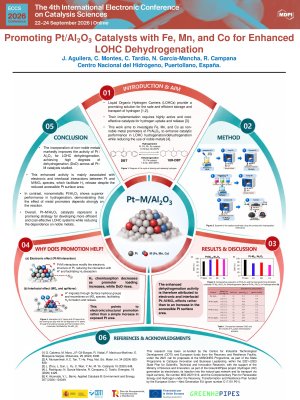
Hydrogen is a key energy carrier, but storage challenges persist. LOHCs like DBT offer a viable solution, though reliance on noble metals limits scalability. This work explores Fe, Mn, and Co as promoters to enable more sustainable LOHC catalysis.
Methods
The catalysts were prepared by wet impregnation and characterised by nitrogen adsorption-desorption and hydrogen pulse chemisorption. Catalytic performance was evaluated in hydrogenation using a 600 mL autoclave-type reactor (Parr, Type 4568) at 50 bar and 290 °C, while dehydrogenation was carried out in a spherical flask, at atmospheric pressure and the same temperature.
Results
This study evaluates Pt-based bimetallic catalysts containing non-precious metals (Fe, Mn, and Co). The Pt loading was kept constant at 0.25 wt%, while Fe, Mn, and Co loadings were varied at 0.1, 0.25, and 0.5 wt%. The catalysts were tested in both hydrogenation and dehydrogenation reactions and compared with a monometallic Pt catalyst. In dehydrogenation, all bimetallic catalysts achieved higher degrees of dehydrogenation, representing 10% enhancement over the monometallic catalyst, with performance improving as the secondary metal loading increased. This enhancement is attributed to electronic modifications of Pt induced by alloy formation, which facilitate H* desorption, as well as to the presence of Fe, Mn, and Co oxides that act as hydrogen acceptors, promoting H* spillover and H₂ release while preserving active Pt sites. In contrast, hydrogenation activity decreased with increasing Fe, Mn, or Co loading due to weakened Pt–H₂ interactions caused by alloying and to the partial coverage of Pt active sites by metal oxides, which hinder H₂ dissociation and reduce Pt affinity for H0-DBT.
Conclusion
Additives are a promising strategy for catalytic systems in organic liquids.
Keywords
LOHC
catalyst
iron
manganese and cobalt
Poster
Poster_ECCS2026.pdf
In-situ construction of Bi₃O₄Br onto Ni-MOF-74 heterojunction with interfacial charge separation for photocatalytic degradation of organic pollutants
Microwave-Assisted Liquid Exfoliation of Bulk g-C3N4 Synthesized under Nitrogen Atmosphere Derived from Thiourea towards Ciprofloxacin degradation in aqueous matrices