Event submissions
Published
This submission belongs to the session S3. Photocatalysis and Electrocatalysis of the event The 4th International Electronic Conference on Catalysis Sciences
Published date
16 Sep, 2026
Academic Editor
'%3e%3cpath%20d='M12.6657%2010.9104C12.4185%2010.325%2012.0599%209.79327%2011.6097%209.34482C11.1609%208.89508%2010.6293%208.5365%2010.0442%208.28888C10.0389%208.28626%2010.0337%208.28495%2010.0285%208.28233C10.8446%207.69279%2011.3752%206.73249%2011.3752%205.64904C11.3752%203.8542%209.92103%202.39999%208.1262%202.39999C6.33136%202.39999%204.87715%203.8542%204.87715%205.64904C4.87715%206.73249%205.40774%207.69279%206.22393%208.28364C6.21869%208.28626%206.21345%208.28757%206.20821%208.29019C5.62129%208.5378%205.09463%208.89284%204.64265%209.34613C4.1929%209.79493%203.83432%2010.3266%203.58671%2010.9117C3.34345%2011.4845%203.21226%2012.0987%203.20023%2012.7209C3.19988%2012.7349%203.20233%2012.7488%203.20744%2012.7619C3.21255%2012.7749%203.22022%2012.7867%203.22998%2012.7968C3.23975%2012.8068%203.25142%2012.8147%203.26431%2012.8202C3.2772%2012.8256%203.29105%2012.8284%203.30504%2012.8284H4.09109C4.14874%2012.8284%204.19459%2012.7825%204.1959%2012.7262C4.2221%2011.7148%204.62823%2010.7676%205.34617%2010.0497C6.08899%209.30683%207.0755%208.89808%208.1262%208.89808C9.17689%208.89808%2010.1634%209.30683%2010.9062%2010.0497C11.6242%2010.7676%2012.0303%2011.7148%2012.0565%2012.7262C12.0578%2012.7838%2012.1037%2012.8284%2012.1613%2012.8284H12.9474C12.9613%2012.8284%2012.9752%2012.8256%2012.9881%2012.8202C13.001%2012.8147%2013.0126%2012.8068%2013.0224%2012.7968C13.0322%2012.7867%2013.0398%2012.7749%2013.0449%2012.7619C13.0501%2012.7488%2013.0525%2012.7349%2013.0522%2012.7209C13.0391%2012.0947%2012.9094%2011.4855%2012.6657%2010.9104ZM8.1262%207.9024C7.52486%207.9024%206.9589%207.6679%206.53312%207.24211C6.10733%206.81633%205.87283%206.25037%205.87283%205.64904C5.87283%205.0477%206.10733%204.48174%206.53312%204.05596C6.9589%203.63018%207.52486%203.39567%208.1262%203.39567C8.72753%203.39567%209.29349%203.63018%209.71927%204.05596C10.1451%204.48174%2010.3796%205.0477%2010.3796%205.64904C10.3796%206.25037%2010.1451%206.81633%209.71927%207.24211C9.29349%207.6679%208.72753%207.9024%208.1262%207.9024Z'%20fill='%235D1EE1'/%3e%3c/g%3e%3c/svg%3e) Carmelo Vecchio
Carmelo VecchioCitation
Eleni Sdoukou, Ioanna Makrelli, Ioannis Konstantinou, Microwave-Assisted Liquid Exfoliation of Bulk g-C₃N₄ Synthesized under Nitrogen Atmosphere Derived from Thiourea towards Ciprofloxacin degradation in aqueous matrices, in Proceedings of The 4th International Electronic Conference on Catalysis Sciences, 22 September–24 September 2026, MDPI: Basel, Switzerland
Share
Email
Facebook
Twitter
LinkedIn
Microwave-Assisted Liquid Exfoliation of Bulk g-C3N4 Synthesized under Nitrogen Atmosphere Derived from Thiourea towards Ciprofloxacin degradation in aqueous matrices
'%3e%3cpath%20d='M12.6647%2010.9104C12.4176%2010.325%2012.0589%209.7933%2011.6088%209.34485C11.16%208.89511%2010.6283%208.53653%2010.0432%208.28891C10.038%208.28629%2010.0327%208.28498%2010.0275%208.28236C10.8437%207.69282%2011.3743%206.73252%2011.3743%205.64907C11.3743%203.85423%209.92005%202.40002%208.12522%202.40002C6.33038%202.40002%204.87618%203.85423%204.87618%205.64907C4.87618%206.73252%205.40677%207.69282%206.22296%208.28367C6.21772%208.28629%206.21248%208.2876%206.20724%208.29022C5.62031%208.53783%205.09365%208.89287%204.64167%209.34616C4.19192%209.79496%203.83334%2010.3266%203.58573%2010.9117C3.34247%2011.4846%203.21128%2012.0987%203.19925%2012.721C3.1989%2012.735%203.20135%2012.7489%203.20646%2012.7619C3.21157%2012.7749%203.21924%2012.7868%203.22901%2012.7968C3.23877%2012.8068%203.25045%2012.8148%203.26334%2012.8202C3.27623%2012.8256%203.29007%2012.8284%203.30406%2012.8284H4.09012C4.14776%2012.8284%204.19362%2012.7825%204.19493%2012.7262C4.22113%2011.7148%204.62726%2010.7676%205.34519%2010.0497C6.08802%209.30686%207.07452%208.89811%208.12522%208.89811C9.17592%208.89811%2010.1624%209.30686%2010.9052%2010.0497C11.6232%2010.7676%2012.0293%2011.7148%2012.0555%2012.7262C12.0568%2012.7839%2012.1027%2012.8284%2012.1603%2012.8284H12.9464C12.9604%2012.8284%2012.9742%2012.8256%2012.9871%2012.8202C13%2012.8148%2013.0117%2012.8068%2013.0214%2012.7968C13.0312%2012.7868%2013.0389%2012.7749%2013.044%2012.7619C13.0491%2012.7489%2013.0515%2012.735%2013.0512%2012.721C13.0381%2012.0947%2012.9084%2011.4856%2012.6647%2010.9104ZM8.12522%207.90243C7.52388%207.90243%206.95792%207.66793%206.53214%207.24215C6.10636%206.81636%205.87185%206.2504%205.87185%205.64907C5.87185%205.04773%206.10636%204.48177%206.53214%204.05599C6.95792%203.63021%207.52388%203.3957%208.12522%203.3957C8.72655%203.3957%209.29252%203.63021%209.7183%204.05599C10.1441%204.48177%2010.3786%205.04773%2010.3786%205.64907C10.3786%206.2504%2010.1441%206.81636%209.7183%207.24215C9.29252%207.66793%208.72655%207.90243%208.12522%207.90243Z'%20fill='%235D1EE1'/%3e%3c/g%3e%3c/svg%3e)
Eleni Sdoukou 1
Ioanna Makrelli 1

Ioannis Konstantinou 1
1. Department of Chemistry, University of Ioannina, Ioannina, Greece
Abstract
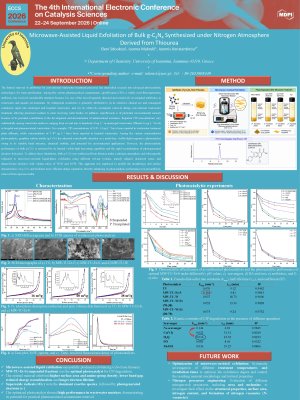
The insufficient elimination of antibiotics by conventional wastewater treatment methods has increased interest in photocatalytic technologies. Among various photocatalysts, graphitic carbon nitride (g-C3N4) has emerged as a promising visible-light-driven photocatalyst for water purification applications. Herein, we developed bulk g-C3N4 synthesized from thiourea (CNT) under a nitrogen atmosphere, which was subsequently subjected to microwave-assisted liquid exfoliation treatment (MWT) using various solvent systems, including ethanol, water, and their mixtures (70/30 and 30/70 v/v). In a typical procedure, 0.2 g of CNT was dispersed in 6 mL of solvent in a microwave vessel and treated at 150 °C for 1 h. After MWT, two distinct fractions were formed in ethanol and ethanol/water solvent systems. Less-exfoliated particles sedimented, forming two distinct phases of g-C3N4, whereas thinner, exfoliated nanosheets remained suspended in the upper phase only in H2O and H2O/ethanol (70/30) mixture due to enhanced colloidal stabilization. Briefly, we thoroughly analyzed the structural and physicochemical properties through XRD, SEM–EDS mapping, porosimetry, elemental analysis, ATR-FTIR, Raman, UV–Vis DRS, and PL/TRF. Notably, the mesoporous microwave-treated photocatalysts exhibited a high oxygen content (~17%), according to elemental analysis. The Tauc plot analysis of the optimal photocatalytic system, MWT/EtOH derived from CNT and collected from the lower sedimented fraction, revealed dual band gap energies of 2.07 and 2.46 eV. Photocatalytic efficiency was evaluated towards ciprofloxacin (CIP) degradation using simulated solar light (SSL). The MWT/EtOH sample collected from the lower sedimented phase presented the best photocatalytic activity in ultrapure water under SSL conditions, with a kinetic rate constant of k = 0.116 min⁻¹, whereas the upper sedimented phase exhibited lower degradation performance, with a kinetic rate constant of k = 0.059 min⁻¹. However, the suspended upper phase obtained from the CNT/H2O MWT system showed the highest photocatalytic efficiency overall, with a kinetic rate constant of k = 0.213 min⁻¹.
Keywords
g-C3N4
exfoliation
microwave
photocatalysis
pollutant degradation
Poster
Poster _ Sdoukou_Konstantinou, et al_4th International Electronic Conference on Catalysis.pdf
Promoting Pt/Al₂O₃ Catalysts with Fe, Mn, and Co for Enhanced LOHC Dehydrogenation.
Etna ash-derived photocatalysts for the solar H2 production