Event submissions
Published
This submission belongs to the session S3. Photocatalysis and Electrocatalysis of the event The 4th International Electronic Conference on Catalysis Sciences
Published date
16 Sep, 2026
Academic Editor
'%3e%3cpath%20d='M12.6657%2010.9104C12.4185%2010.325%2012.0599%209.79327%2011.6097%209.34482C11.1609%208.89508%2010.6293%208.5365%2010.0442%208.28888C10.0389%208.28626%2010.0337%208.28495%2010.0285%208.28233C10.8446%207.69279%2011.3752%206.73249%2011.3752%205.64904C11.3752%203.8542%209.92103%202.39999%208.1262%202.39999C6.33136%202.39999%204.87715%203.8542%204.87715%205.64904C4.87715%206.73249%205.40774%207.69279%206.22393%208.28364C6.21869%208.28626%206.21345%208.28757%206.20821%208.29019C5.62129%208.5378%205.09463%208.89284%204.64265%209.34613C4.1929%209.79493%203.83432%2010.3266%203.58671%2010.9117C3.34345%2011.4845%203.21226%2012.0987%203.20023%2012.7209C3.19988%2012.7349%203.20233%2012.7488%203.20744%2012.7619C3.21255%2012.7749%203.22022%2012.7867%203.22998%2012.7968C3.23975%2012.8068%203.25142%2012.8147%203.26431%2012.8202C3.2772%2012.8256%203.29105%2012.8284%203.30504%2012.8284H4.09109C4.14874%2012.8284%204.19459%2012.7825%204.1959%2012.7262C4.2221%2011.7148%204.62823%2010.7676%205.34617%2010.0497C6.08899%209.30683%207.0755%208.89808%208.1262%208.89808C9.17689%208.89808%2010.1634%209.30683%2010.9062%2010.0497C11.6242%2010.7676%2012.0303%2011.7148%2012.0565%2012.7262C12.0578%2012.7838%2012.1037%2012.8284%2012.1613%2012.8284H12.9474C12.9613%2012.8284%2012.9752%2012.8256%2012.9881%2012.8202C13.001%2012.8147%2013.0126%2012.8068%2013.0224%2012.7968C13.0322%2012.7867%2013.0398%2012.7749%2013.0449%2012.7619C13.0501%2012.7488%2013.0525%2012.7349%2013.0522%2012.7209C13.0391%2012.0947%2012.9094%2011.4855%2012.6657%2010.9104ZM8.1262%207.9024C7.52486%207.9024%206.9589%207.6679%206.53312%207.24211C6.10733%206.81633%205.87283%206.25037%205.87283%205.64904C5.87283%205.0477%206.10733%204.48174%206.53312%204.05596C6.9589%203.63018%207.52486%203.39567%208.1262%203.39567C8.72753%203.39567%209.29349%203.63018%209.71927%204.05596C10.1451%204.48174%2010.3796%205.0477%2010.3796%205.64904C10.3796%206.25037%2010.1451%206.81633%209.71927%207.24211C9.29349%207.6679%208.72753%207.9024%208.1262%207.9024Z'%20fill='%235D1EE1'/%3e%3c/g%3e%3c/svg%3e) Ioannis Konstantinou
Ioannis KonstantinouCitation
Gregor Žerjav, Albin Pintar, Platinum Is Not a Universal Electron Sink: Support-Dependent Charge Transfer and Reactive Oxygen Species Pathways in Photocatalysis, in Proceedings of The 4th International Electronic Conference on Catalysis Sciences, 22 September–24 September 2026, MDPI: Basel, Switzerland
Share
Email
Facebook
Twitter
LinkedIn
Platinum Is Not a Universal Electron Sink: Support-Dependent Charge Transfer and Reactive Oxygen Species Pathways in Photocatalysis

Gregor Žerjav 1

Albin Pintar 1
1. Department of Inorganic Chemistry and Technology, National Institute of Chemistry, Hajdrihova 19, SI-1001 Ljubljana, Slovenia
Abstract
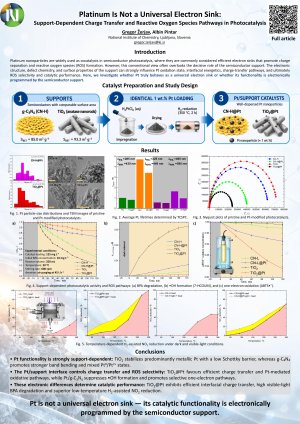
The performance of noble-metal photocatalysts is commonly attributed to the intrinsic properties of the deposited metal, while the role of the semiconductor support is often considered secondary. In this work, we show that platinum (Pt) functionality is electronically programmed by the support, resulting in fundamentally different charge-transfer pathways, reactive oxygen species (ROS) generation, and environmental catalytic performance. To isolate support-dependent effects, TiO2 nanorods and graphitic carbon nitride (g-C3N4) materials with comparable surface areas were modified with identical Pt loading (1 wt%) using the same impregnation–reduction protocol. Structural characterisation confirmed similar Pt contents and homogeneous nanoparticle dispersion, enabling direct comparison of metal–support interactions. The resulting photocatalysts were evaluated in visible-light-driven bisphenol A (BPA) degradation and H2-assisted NO2 reduction, while interfacial charge-transfer properties were investigated using XPS, electrochemical impedance spectroscopy, time-correlated single-photon counting, and ROS probing experiments. The results revealed pronounced support-controlled electronic behaviour. Pt/TiO2 formed highly metallic Pt nanoparticles and a low Schottky barrier, promoting rapid electron extraction, efficient charge separation, and enhanced hydroxyl radical generation. Consequently, Pt/TiO2 exhibited the highest BPA degradation rates and the lowest activation temperatures for NO2 reduction. In contrast, Pt/g-C3N4 generated stronger interfacial band bending and mixed Pt0/Pt2+ surface states, suppressing hydroxyl radical formation while favouring selective one-electron oxidation pathways. These differences produced distinct ROS landscapes and catalytic responses despite identical Pt loading. Furthermore, improved textural properties of high-surface-area g-C3N4 enhanced interfacial charge transfer and catalytic performance, highlighting the importance of coupling structural optimisation with electronic engineering. Overall, this study shows that platinum cannot be regarded as a universal electron sink. Instead, its catalytic behaviour is defined by support-dependent electronic interactions that determine charge-transfer kinetics, ROS selectivity, and photocatalytic performance. These findings provide important design principles for the development of next-generation photocatalytic and photothermal systems for sustainable environmental remediation.
Keywords
Platinum cocatalysts
Electronic metal-support interactions
Schottky barriers
Reactive oxygen species
Visible-light photocatalysis
Environmental catalysis
Poster
poster ECCS 2026 Zerjav.pdf
Tuning the electronic structure of graphene oxide through functionalization and doping: A physicochemical, spectral, and catalytic study
Sulfanilamide Oxidative Degradation Over M(II)/Ce(III) Type Layered Double Hydroxide Catalysts