Event submissions
Published
This submission belongs to the session S2. Environmental Catalysis of the event The 4th International Electronic Conference on Catalysis Sciences
Published date
16 Sep, 2026
Academic Editor
'%3e%3cpath%20d='M12.6657%2010.9104C12.4185%2010.325%2012.0599%209.79327%2011.6097%209.34482C11.1609%208.89508%2010.6293%208.5365%2010.0442%208.28888C10.0389%208.28626%2010.0337%208.28495%2010.0285%208.28233C10.8446%207.69279%2011.3752%206.73249%2011.3752%205.64904C11.3752%203.8542%209.92103%202.39999%208.1262%202.39999C6.33136%202.39999%204.87715%203.8542%204.87715%205.64904C4.87715%206.73249%205.40774%207.69279%206.22393%208.28364C6.21869%208.28626%206.21345%208.28757%206.20821%208.29019C5.62129%208.5378%205.09463%208.89284%204.64265%209.34613C4.1929%209.79493%203.83432%2010.3266%203.58671%2010.9117C3.34345%2011.4845%203.21226%2012.0987%203.20023%2012.7209C3.19988%2012.7349%203.20233%2012.7488%203.20744%2012.7619C3.21255%2012.7749%203.22022%2012.7867%203.22998%2012.7968C3.23975%2012.8068%203.25142%2012.8147%203.26431%2012.8202C3.2772%2012.8256%203.29105%2012.8284%203.30504%2012.8284H4.09109C4.14874%2012.8284%204.19459%2012.7825%204.1959%2012.7262C4.2221%2011.7148%204.62823%2010.7676%205.34617%2010.0497C6.08899%209.30683%207.0755%208.89808%208.1262%208.89808C9.17689%208.89808%2010.1634%209.30683%2010.9062%2010.0497C11.6242%2010.7676%2012.0303%2011.7148%2012.0565%2012.7262C12.0578%2012.7838%2012.1037%2012.8284%2012.1613%2012.8284H12.9474C12.9613%2012.8284%2012.9752%2012.8256%2012.9881%2012.8202C13.001%2012.8147%2013.0126%2012.8068%2013.0224%2012.7968C13.0322%2012.7867%2013.0398%2012.7749%2013.0449%2012.7619C13.0501%2012.7488%2013.0525%2012.7349%2013.0522%2012.7209C13.0391%2012.0947%2012.9094%2011.4855%2012.6657%2010.9104ZM8.1262%207.9024C7.52486%207.9024%206.9589%207.6679%206.53312%207.24211C6.10733%206.81633%205.87283%206.25037%205.87283%205.64904C5.87283%205.0477%206.10733%204.48174%206.53312%204.05596C6.9589%203.63018%207.52486%203.39567%208.1262%203.39567C8.72753%203.39567%209.29349%203.63018%209.71927%204.05596C10.1451%204.48174%2010.3796%205.0477%2010.3796%205.64904C10.3796%206.25037%2010.1451%206.81633%209.71927%207.24211C9.29349%207.6679%208.72753%207.9024%208.1262%207.9024Z'%20fill='%235D1EE1'/%3e%3c/g%3e%3c/svg%3e) Albin Pintar
Albin PintarCitation
Mohd Shkir, Ashwani Kumar, Sustainable Green Synthesis of Zirconia Nanoparticles and Their Multifunctional Applications in Environmental Remediation, in Proceedings of The 4th International Electronic Conference on Catalysis Sciences, 22 September–24 September 2026, MDPI: Basel, Switzerland
Share
Email
Facebook
Twitter
LinkedIn
Sustainable Green Synthesis of Zirconia Nanoparticles and Their Multifunctional Applications in Environmental Remediation

Mohd Shkir 1
'%3e%3cpath%20d='M12.6647%2010.9104C12.4176%2010.325%2012.0589%209.7933%2011.6088%209.34485C11.16%208.89511%2010.6283%208.53653%2010.0432%208.28891C10.038%208.28629%2010.0327%208.28498%2010.0275%208.28236C10.8437%207.69282%2011.3743%206.73252%2011.3743%205.64907C11.3743%203.85423%209.92005%202.40002%208.12522%202.40002C6.33038%202.40002%204.87618%203.85423%204.87618%205.64907C4.87618%206.73252%205.40677%207.69282%206.22296%208.28367C6.21772%208.28629%206.21248%208.2876%206.20724%208.29022C5.62031%208.53783%205.09365%208.89287%204.64167%209.34616C4.19192%209.79496%203.83334%2010.3266%203.58573%2010.9117C3.34247%2011.4846%203.21128%2012.0987%203.19925%2012.721C3.1989%2012.735%203.20135%2012.7489%203.20646%2012.7619C3.21157%2012.7749%203.21924%2012.7868%203.22901%2012.7968C3.23877%2012.8068%203.25045%2012.8148%203.26334%2012.8202C3.27623%2012.8256%203.29007%2012.8284%203.30406%2012.8284H4.09012C4.14776%2012.8284%204.19362%2012.7825%204.19493%2012.7262C4.22113%2011.7148%204.62726%2010.7676%205.34519%2010.0497C6.08802%209.30686%207.07452%208.89811%208.12522%208.89811C9.17592%208.89811%2010.1624%209.30686%2010.9052%2010.0497C11.6232%2010.7676%2012.0293%2011.7148%2012.0555%2012.7262C12.0568%2012.7839%2012.1027%2012.8284%2012.1603%2012.8284H12.9464C12.9604%2012.8284%2012.9742%2012.8256%2012.9871%2012.8202C13%2012.8148%2013.0117%2012.8068%2013.0214%2012.7968C13.0312%2012.7868%2013.0389%2012.7749%2013.044%2012.7619C13.0491%2012.7489%2013.0515%2012.735%2013.0512%2012.721C13.0381%2012.0947%2012.9084%2011.4856%2012.6647%2010.9104ZM8.12522%207.90243C7.52388%207.90243%206.95792%207.66793%206.53214%207.24215C6.10636%206.81636%205.87185%206.2504%205.87185%205.64907C5.87185%205.04773%206.10636%204.48177%206.53214%204.05599C6.95792%203.63021%207.52388%203.3957%208.12522%203.3957C8.72655%203.3957%209.29252%203.63021%209.7183%204.05599C10.1441%204.48177%2010.3786%205.04773%2010.3786%205.64907C10.3786%206.2504%2010.1441%206.81636%209.7183%207.24215C9.29252%207.66793%208.72655%207.90243%208.12522%207.90243Z'%20fill='%235D1EE1'/%3e%3c/g%3e%3c/svg%3e)
Ashwani Kumar 2
1. Department of Physics, College of Science, King Khalid University, PO Box 960, AlQura’a, Abha 61421, Saudi Arabia
2. University Center for Research & Development, Chandigarh University, Gharuan, Mohali 140413, Punjab, India
Abstract
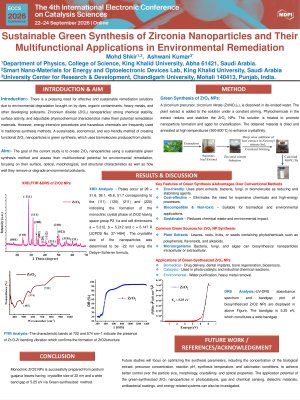
The present study reports the sustainable green synthesis of zirconium oxide (ZrO₂) nanoparticles using a plant-mediated eco-friendly approach and explores their multifunctional applications in environmental. Nanoparticles of zirconia are considered to be among the most important metal oxide nanoparticles because of the numerous applications they have in the field of biomedical science. These applications include dentistry, medication transport, and catalytic science, which include environmental cleanup and chemical synthesis. In the current research work the nanoparticles of crystalline ZrO2 were produced through the utilization of an optimized concentration of zirconyl nitrate ZrN2O7·xH2O through the approach of green synthesis. This approach of green synthesis provides an environmentally sustainable alternative to traditional synthesis processes by minimizing hazardous waste and employing renewable resources. XRD analysis confirmed the crystalline nature of the synthesized ZrO₂ nanoparticles. Peaks occur at 2θ = 31.6, 38.1, 45.6, 51.7 corresponding to the (111), (120), (211) and (220) indicating the formation of the monoclinic crystal phase of ZrO2 having space group P2 1/a and cell dimensions a = 5.312, b = 5.212 and c = 5.147 Å [JCPDS No. 37-1484] The photocatalytic degradation of methylene blue utilizing ZrO2 nanoparticles was investigated under UV light irradiation. FTIR spectra analysis shows the characteristic bands at 722 and 574 cm−1 indicate the presence of Zr-O-Zr bending vibration which confirms the formation of ZrO2structure. The UV-Vis absorption spectra reveal a significant quantization with a band gap of 5.25 eV. FESEM observations revealed nearly spherical (~136 nm) and uniformly distributed nanostructures with reduced agglomeration. Optical investigations demonstrated favorable band gap characteristics and defect-mediated charge transfer behavior, indicating their suitability for photocatalytic applications.
Keywords
Green synthesis
Zirconia nanoparticles
Sustainable nanotechnology
Environmental remediation
Optical properties
Poster
Poster presentation Catalysis.pdf
Sulfanilamide Oxidative Degradation Over M(II)/Ce(III) Type Layered Double Hydroxide Catalysts
Porous Carbon-Coupled Co-ZnO Heterojunction with Synergistic Photocatalytic Activity for Visible-Light-Driven Bisphenol A Degradation