Event submissions
Published
This submission belongs to the session S2. Environmental Catalysis of the event The 4th International Electronic Conference on Catalysis Sciences
Published date
16 Sep, 2026
Academic Editor
'%3e%3cpath%20d='M12.6657%2010.9104C12.4185%2010.325%2012.0599%209.79327%2011.6097%209.34482C11.1609%208.89508%2010.6293%208.5365%2010.0442%208.28888C10.0389%208.28626%2010.0337%208.28495%2010.0285%208.28233C10.8446%207.69279%2011.3752%206.73249%2011.3752%205.64904C11.3752%203.8542%209.92103%202.39999%208.1262%202.39999C6.33136%202.39999%204.87715%203.8542%204.87715%205.64904C4.87715%206.73249%205.40774%207.69279%206.22393%208.28364C6.21869%208.28626%206.21345%208.28757%206.20821%208.29019C5.62129%208.5378%205.09463%208.89284%204.64265%209.34613C4.1929%209.79493%203.83432%2010.3266%203.58671%2010.9117C3.34345%2011.4845%203.21226%2012.0987%203.20023%2012.7209C3.19988%2012.7349%203.20233%2012.7488%203.20744%2012.7619C3.21255%2012.7749%203.22022%2012.7867%203.22998%2012.7968C3.23975%2012.8068%203.25142%2012.8147%203.26431%2012.8202C3.2772%2012.8256%203.29105%2012.8284%203.30504%2012.8284H4.09109C4.14874%2012.8284%204.19459%2012.7825%204.1959%2012.7262C4.2221%2011.7148%204.62823%2010.7676%205.34617%2010.0497C6.08899%209.30683%207.0755%208.89808%208.1262%208.89808C9.17689%208.89808%2010.1634%209.30683%2010.9062%2010.0497C11.6242%2010.7676%2012.0303%2011.7148%2012.0565%2012.7262C12.0578%2012.7838%2012.1037%2012.8284%2012.1613%2012.8284H12.9474C12.9613%2012.8284%2012.9752%2012.8256%2012.9881%2012.8202C13.001%2012.8147%2013.0126%2012.8068%2013.0224%2012.7968C13.0322%2012.7867%2013.0398%2012.7749%2013.0449%2012.7619C13.0501%2012.7488%2013.0525%2012.7349%2013.0522%2012.7209C13.0391%2012.0947%2012.9094%2011.4855%2012.6657%2010.9104ZM8.1262%207.9024C7.52486%207.9024%206.9589%207.6679%206.53312%207.24211C6.10733%206.81633%205.87283%206.25037%205.87283%205.64904C5.87283%205.0477%206.10733%204.48174%206.53312%204.05596C6.9589%203.63018%207.52486%203.39567%208.1262%203.39567C8.72753%203.39567%209.29349%203.63018%209.71927%204.05596C10.1451%204.48174%2010.3796%205.0477%2010.3796%205.64904C10.3796%206.25037%2010.1451%206.81633%209.71927%207.24211C9.29349%207.6679%208.72753%207.9024%208.1262%207.9024Z'%20fill='%235D1EE1'/%3e%3c/g%3e%3c/svg%3e) Albin Pintar
Albin PintarCitation
Gayathri Jeevanandham, Dan Meyerstein, Mg(H₂O)₆²⁺ as an Activator of PMS: A Transition-Metal-Free Advanced Oxidation Process in Neutral Solutions, in Proceedings of The 4th International Electronic Conference on Catalysis Sciences, 22 September–24 September 2026, MDPI: Basel, Switzerland
Share
Email
Facebook
Twitter
LinkedIn
Mg(H2O)6²⁺ as an Activator of PMS: A Transition-Metal-Free Advanced Oxidation Process in Neutral Solutions
'%3e%3cpath%20d='M12.6647%2010.9104C12.4176%2010.325%2012.0589%209.7933%2011.6088%209.34485C11.16%208.89511%2010.6283%208.53653%2010.0432%208.28891C10.038%208.28629%2010.0327%208.28498%2010.0275%208.28236C10.8437%207.69282%2011.3743%206.73252%2011.3743%205.64907C11.3743%203.85423%209.92005%202.40002%208.12522%202.40002C6.33038%202.40002%204.87618%203.85423%204.87618%205.64907C4.87618%206.73252%205.40677%207.69282%206.22296%208.28367C6.21772%208.28629%206.21248%208.2876%206.20724%208.29022C5.62031%208.53783%205.09365%208.89287%204.64167%209.34616C4.19192%209.79496%203.83334%2010.3266%203.58573%2010.9117C3.34247%2011.4846%203.21128%2012.0987%203.19925%2012.721C3.1989%2012.735%203.20135%2012.7489%203.20646%2012.7619C3.21157%2012.7749%203.21924%2012.7868%203.22901%2012.7968C3.23877%2012.8068%203.25045%2012.8148%203.26334%2012.8202C3.27623%2012.8256%203.29007%2012.8284%203.30406%2012.8284H4.09012C4.14776%2012.8284%204.19362%2012.7825%204.19493%2012.7262C4.22113%2011.7148%204.62726%2010.7676%205.34519%2010.0497C6.08802%209.30686%207.07452%208.89811%208.12522%208.89811C9.17592%208.89811%2010.1624%209.30686%2010.9052%2010.0497C11.6232%2010.7676%2012.0293%2011.7148%2012.0555%2012.7262C12.0568%2012.7839%2012.1027%2012.8284%2012.1603%2012.8284H12.9464C12.9604%2012.8284%2012.9742%2012.8256%2012.9871%2012.8202C13%2012.8148%2013.0117%2012.8068%2013.0214%2012.7968C13.0312%2012.7868%2013.0389%2012.7749%2013.044%2012.7619C13.0491%2012.7489%2013.0515%2012.735%2013.0512%2012.721C13.0381%2012.0947%2012.9084%2011.4856%2012.6647%2010.9104ZM8.12522%207.90243C7.52388%207.90243%206.95792%207.66793%206.53214%207.24215C6.10636%206.81636%205.87185%206.2504%205.87185%205.64907C5.87185%205.04773%206.10636%204.48177%206.53214%204.05599C6.95792%203.63021%207.52388%203.3957%208.12522%203.3957C8.72655%203.3957%209.29252%203.63021%209.7183%204.05599C10.1441%204.48177%2010.3786%205.04773%2010.3786%205.64907C10.3786%206.2504%2010.1441%206.81636%209.7183%207.24215C9.29252%207.66793%208.72655%207.90243%208.12522%207.90243Z'%20fill='%235D1EE1'/%3e%3c/g%3e%3c/svg%3e)
Gayathri Jeevanandham 1

Dan Meyerstein 1,2
1. Chemical Sciences Department and The Radical Research Center, Ariel University, Ariel, Israel
2. Chemistry Department, Ben-Gurion University, Beer-Sheva, Israel
Abstract
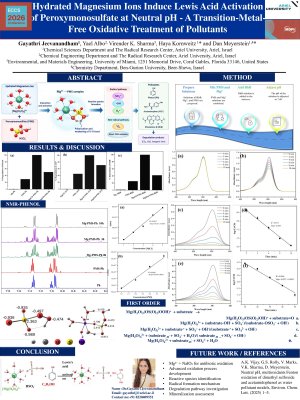
The development of sustainable and energy-efficient advanced oxidation processes (AOPs) is significant for the effective removal of persistent organic contaminants from aquatic environments, particularly under neutral pH conditions where many conventional catalytic systems exhibit poor performance. Traditional Fenton and Fenton-like AOPs generally rely on transition-metal ions or metal complexes and require strongly acidic conditions for efficient activation of oxidants. These limitations often lead to secondary pollution through metal sludge formation, catalyst instability, and increased operational costs, thereby restricting their large-scale environmental applications. In this study, we report for the first time that Mg(H₂O)₆²⁺, a non-redox-active, earth-abundant, low-toxicity, and environmentally benign cation, can effectively activate peroxymonosulfate (PMS) to establish a truly transition-metal-free oxidation system. The Mg²⁺/PMS process demonstrates remarkable catalytic activity under near-neutral pH conditions and follows first-order reaction kinetics with respect to both Mg(H₂O)₆²⁺ and PMS concentrations. Rapid and efficient degradation was achieved for a wide range of organic pollutants, including rhodamine B (RhB), acetaminophen (ACP), and phenol (Ph), highlighting the broad applicability of the system. Detailed mechanistic investigations, supported by density functional theory (DFT) calculations, reveal that Mg(H₂O)₆²⁺ acts as a strong Lewis acid that facilitates PMS activation through both radical and non-radical pathways, despite the absence of conventional redox-active transition metals. The generated reactive oxygen species significantly enhance pollutant oxidation and mineralization efficiency. This unprecedented demonstration of Mg²⁺-activated PMS introduces a green, scalable, and sustainable oxidation strategy with substantial potential for future wastewater treatment, environmental remediation, and the development of next-generation metal-free catalytic AOP technologies.
Keywords
Acetaminophen
phenol
Magnesium catalysis
Peroxy-mono-sulfate
Fenton-like reaction
Rhodamine B
Advanced oxidation processes
Poster
catalyst ppt.pdf
Porous Carbon-Coupled Co-ZnO Heterojunction with Synergistic Photocatalytic Activity for Visible-Light-Driven Bisphenol A Degradation
Synthesis, characterization, and optimization of visible-light active nitrogen-doped titania nanophotocatalyst for organic-dye degradation