Event submissions
Published
This submission belongs to the session S3. Photocatalysis and Electrocatalysis of the event The 4th International Electronic Conference on Catalysis Sciences
Published date
16 Sep, 2026
Academic Editor
'%3e%3cpath%20d='M12.6657%2010.9104C12.4185%2010.325%2012.0599%209.79327%2011.6097%209.34482C11.1609%208.89508%2010.6293%208.5365%2010.0442%208.28888C10.0389%208.28626%2010.0337%208.28495%2010.0285%208.28233C10.8446%207.69279%2011.3752%206.73249%2011.3752%205.64904C11.3752%203.8542%209.92103%202.39999%208.1262%202.39999C6.33136%202.39999%204.87715%203.8542%204.87715%205.64904C4.87715%206.73249%205.40774%207.69279%206.22393%208.28364C6.21869%208.28626%206.21345%208.28757%206.20821%208.29019C5.62129%208.5378%205.09463%208.89284%204.64265%209.34613C4.1929%209.79493%203.83432%2010.3266%203.58671%2010.9117C3.34345%2011.4845%203.21226%2012.0987%203.20023%2012.7209C3.19988%2012.7349%203.20233%2012.7488%203.20744%2012.7619C3.21255%2012.7749%203.22022%2012.7867%203.22998%2012.7968C3.23975%2012.8068%203.25142%2012.8147%203.26431%2012.8202C3.2772%2012.8256%203.29105%2012.8284%203.30504%2012.8284H4.09109C4.14874%2012.8284%204.19459%2012.7825%204.1959%2012.7262C4.2221%2011.7148%204.62823%2010.7676%205.34617%2010.0497C6.08899%209.30683%207.0755%208.89808%208.1262%208.89808C9.17689%208.89808%2010.1634%209.30683%2010.9062%2010.0497C11.6242%2010.7676%2012.0303%2011.7148%2012.0565%2012.7262C12.0578%2012.7838%2012.1037%2012.8284%2012.1613%2012.8284H12.9474C12.9613%2012.8284%2012.9752%2012.8256%2012.9881%2012.8202C13.001%2012.8147%2013.0126%2012.8068%2013.0224%2012.7968C13.0322%2012.7867%2013.0398%2012.7749%2013.0449%2012.7619C13.0501%2012.7488%2013.0525%2012.7349%2013.0522%2012.7209C13.0391%2012.0947%2012.9094%2011.4855%2012.6657%2010.9104ZM8.1262%207.9024C7.52486%207.9024%206.9589%207.6679%206.53312%207.24211C6.10733%206.81633%205.87283%206.25037%205.87283%205.64904C5.87283%205.0477%206.10733%204.48174%206.53312%204.05596C6.9589%203.63018%207.52486%203.39567%208.1262%203.39567C8.72753%203.39567%209.29349%203.63018%209.71927%204.05596C10.1451%204.48174%2010.3796%205.0477%2010.3796%205.64904C10.3796%206.25037%2010.1451%206.81633%209.71927%207.24211C9.29349%207.6679%208.72753%207.9024%208.1262%207.9024Z'%20fill='%235D1EE1'/%3e%3c/g%3e%3c/svg%3e) Ioannis Konstantinou
Ioannis KonstantinouCitation
Dragoș S. Baltag, Petruța Oancea, Bogdan Cojocaru, Rodica Zăvoianu, Vasile I Pârvulescu, Adina Răducan, Octavian D. Pavel, Sustainable LDH-based Zn–Fe and Co–Fe systems and derived oxides for photocatalytic removal of wastewater pollutants, in Proceedings of The 4th International Electronic Conference on Catalysis Sciences, 22 September–24 September 2026, MDPI: Basel, Switzerland
Share
Email
Facebook
Twitter
LinkedIn
Sustainable LDH-based Zn–Fe and Co–Fe systems and derived oxides for photocatalytic removal of wastewater pollutants
'%3e%3cpath%20d='M12.6647%2010.9104C12.4176%2010.325%2012.0589%209.7933%2011.6088%209.34485C11.16%208.89511%2010.6283%208.53653%2010.0432%208.28891C10.038%208.28629%2010.0327%208.28498%2010.0275%208.28236C10.8437%207.69282%2011.3743%206.73252%2011.3743%205.64907C11.3743%203.85423%209.92005%202.40002%208.12522%202.40002C6.33038%202.40002%204.87618%203.85423%204.87618%205.64907C4.87618%206.73252%205.40677%207.69282%206.22296%208.28367C6.21772%208.28629%206.21248%208.2876%206.20724%208.29022C5.62031%208.53783%205.09365%208.89287%204.64167%209.34616C4.19192%209.79496%203.83334%2010.3266%203.58573%2010.9117C3.34247%2011.4846%203.21128%2012.0987%203.19925%2012.721C3.1989%2012.735%203.20135%2012.7489%203.20646%2012.7619C3.21157%2012.7749%203.21924%2012.7868%203.22901%2012.7968C3.23877%2012.8068%203.25045%2012.8148%203.26334%2012.8202C3.27623%2012.8256%203.29007%2012.8284%203.30406%2012.8284H4.09012C4.14776%2012.8284%204.19362%2012.7825%204.19493%2012.7262C4.22113%2011.7148%204.62726%2010.7676%205.34519%2010.0497C6.08802%209.30686%207.07452%208.89811%208.12522%208.89811C9.17592%208.89811%2010.1624%209.30686%2010.9052%2010.0497C11.6232%2010.7676%2012.0293%2011.7148%2012.0555%2012.7262C12.0568%2012.7839%2012.1027%2012.8284%2012.1603%2012.8284H12.9464C12.9604%2012.8284%2012.9742%2012.8256%2012.9871%2012.8202C13%2012.8148%2013.0117%2012.8068%2013.0214%2012.7968C13.0312%2012.7868%2013.0389%2012.7749%2013.044%2012.7619C13.0491%2012.7489%2013.0515%2012.735%2013.0512%2012.721C13.0381%2012.0947%2012.9084%2011.4856%2012.6647%2010.9104ZM8.12522%207.90243C7.52388%207.90243%206.95792%207.66793%206.53214%207.24215C6.10636%206.81636%205.87185%206.2504%205.87185%205.64907C5.87185%205.04773%206.10636%204.48177%206.53214%204.05599C6.95792%203.63021%207.52388%203.3957%208.12522%203.3957C8.72655%203.3957%209.29252%203.63021%209.7183%204.05599C10.1441%204.48177%2010.3786%205.04773%2010.3786%205.64907C10.3786%206.2504%2010.1441%206.81636%209.7183%207.24215C9.29252%207.66793%208.72655%207.90243%208.12522%207.90243Z'%20fill='%235D1EE1'/%3e%3c/g%3e%3c/svg%3e)
Dragoș S. Baltag 1,2
Petruța Oancea 1

Bogdan Cojocaru 1,3

Rodica Zăvoianu 1,3

Vasile I Pârvulescu 1,3
Adina Răducan 1

Octavian D. Pavel 1,3
1. Faculty of Chemistry, University of Bucharest, 4-12 Regina Elisabeta Av., Bucharest, Romania
2. National Institute for Research and Development in Chemistry and Petrochemistry ICECHIM, Splaiul Independenței 202, 060021, Bucharest, Romania
3. Research Center for Catalysts & Catalytic Processes, University of Bucharest, Bucharest, Romania
Abstract
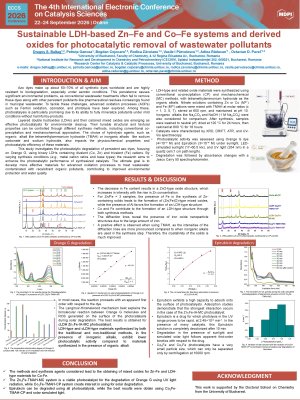
Significant global efforts are being made to enhance living standards and life expectancy; however, insufficient attention is directed towards the chemical waste generated by associated chemical processes. Municipal wastewater increasingly contains residues such as dyes and pharmaceuticals, many of which are resistant to conventional oxidation processes. Advanced oxidation processes (AOPs), including photocatalysis, can be a sustainable solution.
Our research focuses on developing photocatalytic systems using layered/oxide microscopic materials synthesized through conventional methods (co-precipitation, CP) or unconventional methods (mechanochemical, MC) and thermally induced in air. These systems are based on inexpensive transition elements M2+(Co or Zn) and M3+(Fe) and are synthetized in the presence of organic alkali (TMAH) or inorganic alkali (IA- NaOH and Na2CO3), maintaining the molar ratio M2+xM3+ (x=1;3;5;7). The physicochemical characterization of the materials (XRD, DRIFT, ATR, DR-UV-Vis, BET, TEM/SEM) confirms layered and oxide structures that are responsible for the catalytic performance.
To evaluate the photocatalytic properties (1 mg photocatalyst/mL pollutant solution), the azo dye Orange G (4×10⁻⁵ M) and the anti-cancer drug Epirubicin (3×10⁻⁴ M) were selected as target pollutants, utilizing sunlight, sunlight simulated by an LED lamp (17-60.5 klx), and UV light from a low-pressure mercury lamp (254 nm). The degree of discoloration of the solution was assessed by measuring the variation in absorbance of the pollutant solutions using a Jasco Carry 50 spectrophotometer.
The most effective results were η = 57.64% for solar Orange G degradation using LDH Zn7Fe TMAH MC in 180 minutes, η = 69.79% for simulated-solar (60.5 klx) Orange G degradation using LDH Co7Fe IA CP in 150 minutes, and η = 95.66% for simulated-solar (35 klx) Epirubicin degradation using LDH Co3Fe IA CP in 80 minutes. The Langmuir-Hinshelwood mechanism offers the most precise explanation for the bimolecular reaction between pollutant molecules and reactive oxygen species produced on the photocatalyst surface.
Keywords
photocatalyst
LDH
wastewater treatment
AOP
Poster
Baltag Dragos_Poster.pdf
Influence of Anaerobic Fermentation Parameters on In-Situ Hydrogen Production for Pressure Support in Mature Oil Wells
Enhancing the Hydrogen Evolution Activity of HOF Photocatalysts via Increased BET Specific Surface Area and Improved Crystallinity