Event submissions
Published
This submission belongs to the session S3. Photocatalysis and Electrocatalysis of the event The 4th International Electronic Conference on Catalysis Sciences
Published date
16 Sep, 2026
Academic Editor
'%3e%3cpath%20d='M12.6657%2010.9104C12.4185%2010.325%2012.0599%209.79327%2011.6097%209.34482C11.1609%208.89508%2010.6293%208.5365%2010.0442%208.28888C10.0389%208.28626%2010.0337%208.28495%2010.0285%208.28233C10.8446%207.69279%2011.3752%206.73249%2011.3752%205.64904C11.3752%203.8542%209.92103%202.39999%208.1262%202.39999C6.33136%202.39999%204.87715%203.8542%204.87715%205.64904C4.87715%206.73249%205.40774%207.69279%206.22393%208.28364C6.21869%208.28626%206.21345%208.28757%206.20821%208.29019C5.62129%208.5378%205.09463%208.89284%204.64265%209.34613C4.1929%209.79493%203.83432%2010.3266%203.58671%2010.9117C3.34345%2011.4845%203.21226%2012.0987%203.20023%2012.7209C3.19988%2012.7349%203.20233%2012.7488%203.20744%2012.7619C3.21255%2012.7749%203.22022%2012.7867%203.22998%2012.7968C3.23975%2012.8068%203.25142%2012.8147%203.26431%2012.8202C3.2772%2012.8256%203.29105%2012.8284%203.30504%2012.8284H4.09109C4.14874%2012.8284%204.19459%2012.7825%204.1959%2012.7262C4.2221%2011.7148%204.62823%2010.7676%205.34617%2010.0497C6.08899%209.30683%207.0755%208.89808%208.1262%208.89808C9.17689%208.89808%2010.1634%209.30683%2010.9062%2010.0497C11.6242%2010.7676%2012.0303%2011.7148%2012.0565%2012.7262C12.0578%2012.7838%2012.1037%2012.8284%2012.1613%2012.8284H12.9474C12.9613%2012.8284%2012.9752%2012.8256%2012.9881%2012.8202C13.001%2012.8147%2013.0126%2012.8068%2013.0224%2012.7968C13.0322%2012.7867%2013.0398%2012.7749%2013.0449%2012.7619C13.0501%2012.7488%2013.0525%2012.7349%2013.0522%2012.7209C13.0391%2012.0947%2012.9094%2011.4855%2012.6657%2010.9104ZM8.1262%207.9024C7.52486%207.9024%206.9589%207.6679%206.53312%207.24211C6.10733%206.81633%205.87283%206.25037%205.87283%205.64904C5.87283%205.0477%206.10733%204.48174%206.53312%204.05596C6.9589%203.63018%207.52486%203.39567%208.1262%203.39567C8.72753%203.39567%209.29349%203.63018%209.71927%204.05596C10.1451%204.48174%2010.3796%205.0477%2010.3796%205.64904C10.3796%206.25037%2010.1451%206.81633%209.71927%207.24211C9.29349%207.6679%208.72753%207.9024%208.1262%207.9024Z'%20fill='%235D1EE1'/%3e%3c/g%3e%3c/svg%3e) Carmelo Vecchio
Carmelo VecchioCitation
Jumpei Kawabata, Hideyuki Katsumata, Ikki Tateishi, Mai Furukawa, Satoshi Kaneco, Enhancing the Hydrogen Evolution Activity of HOF Photocatalysts via Increased BET Specific Surface Area and Improved Crystallinity, in Proceedings of The 4th International Electronic Conference on Catalysis Sciences, 22 September–24 September 2026, MDPI: Basel, Switzerland
Share
Email
Facebook
Twitter
LinkedIn
Enhancing the Hydrogen Evolution Activity of HOF Photocatalysts via Increased BET Specific Surface Area and Improved Crystallinity
'%3e%3cpath%20d='M12.6647%2010.9104C12.4176%2010.325%2012.0589%209.7933%2011.6088%209.34485C11.16%208.89511%2010.6283%208.53653%2010.0432%208.28891C10.038%208.28629%2010.0327%208.28498%2010.0275%208.28236C10.8437%207.69282%2011.3743%206.73252%2011.3743%205.64907C11.3743%203.85423%209.92005%202.40002%208.12522%202.40002C6.33038%202.40002%204.87618%203.85423%204.87618%205.64907C4.87618%206.73252%205.40677%207.69282%206.22296%208.28367C6.21772%208.28629%206.21248%208.2876%206.20724%208.29022C5.62031%208.53783%205.09365%208.89287%204.64167%209.34616C4.19192%209.79496%203.83334%2010.3266%203.58573%2010.9117C3.34247%2011.4846%203.21128%2012.0987%203.19925%2012.721C3.1989%2012.735%203.20135%2012.7489%203.20646%2012.7619C3.21157%2012.7749%203.21924%2012.7868%203.22901%2012.7968C3.23877%2012.8068%203.25045%2012.8148%203.26334%2012.8202C3.27623%2012.8256%203.29007%2012.8284%203.30406%2012.8284H4.09012C4.14776%2012.8284%204.19362%2012.7825%204.19493%2012.7262C4.22113%2011.7148%204.62726%2010.7676%205.34519%2010.0497C6.08802%209.30686%207.07452%208.89811%208.12522%208.89811C9.17592%208.89811%2010.1624%209.30686%2010.9052%2010.0497C11.6232%2010.7676%2012.0293%2011.7148%2012.0555%2012.7262C12.0568%2012.7839%2012.1027%2012.8284%2012.1603%2012.8284H12.9464C12.9604%2012.8284%2012.9742%2012.8256%2012.9871%2012.8202C13%2012.8148%2013.0117%2012.8068%2013.0214%2012.7968C13.0312%2012.7868%2013.0389%2012.7749%2013.044%2012.7619C13.0491%2012.7489%2013.0515%2012.735%2013.0512%2012.721C13.0381%2012.0947%2012.9084%2011.4856%2012.6647%2010.9104ZM8.12522%207.90243C7.52388%207.90243%206.95792%207.66793%206.53214%207.24215C6.10636%206.81636%205.87185%206.2504%205.87185%205.64907C5.87185%205.04773%206.10636%204.48177%206.53214%204.05599C6.95792%203.63021%207.52388%203.3957%208.12522%203.3957C8.72655%203.3957%209.29252%203.63021%209.7183%204.05599C10.1441%204.48177%2010.3786%205.04773%2010.3786%205.64907C10.3786%206.2504%2010.1441%206.81636%209.7183%207.24215C9.29252%207.66793%208.72655%207.90243%208.12522%207.90243Z'%20fill='%235D1EE1'/%3e%3c/g%3e%3c/svg%3e)
Jumpei Kawabata 1
Hideyuki Katsumata 1,2
Ikki Tateishi 2
Mai Furukawa 1
Satoshi Kaneco 1
1. Department of Applied Chemistry, Graduate School of Engineering, Mie University, Tsu, Mie, Japan
2. Center for Global Environment Education & Research, Mie University, Tsu, Mie, Japan
Abstract
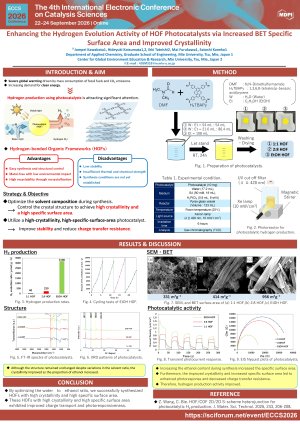
Photocatalytic hydrogen production has attracted considerable attention. Hydrogen-bonded organic frameworks (HOFs) are self-assembled photocatalysts. Although the HOF offers high structural designability and mild synthesis conditions, it is often susceptible to solvent effects, hindering stable reproduction. Here, we investigated a facile, highly reproducible synthesis method for the HOF, improving its crystallinity by varying the preparation solvent ratio.
1,3,6,8-tetrakis(p-benzoic acid)pyrene was dissolved in N,N-dimethylformamide and added dropwise into water/ethanol mixtures or pure ethanol. The mixture stood for 24 hours, followed by washing and drying. For activity evaluation, each catalyst (10 mg) was mixed with an aqueous sodium ascorbate solution (90 mM, 18 mL), a platinum standard solution (0.8 mL), and water (17.2 mL). After a 15-minute nitrogen purge, visible light (λ ≥ 420 nm) was irradiated for 6 hours.
The HOF prepared in pure ethanol (EtOH-HOF) exhibited the highest hydrogen production activity of 3190 µmol/g/h. Conversely, the 1:1 and 2:8 water/ethanol HOFs showed significantly lower activities of 40 µmol/g/h and 230 µmol/g/h, respectively. XRD analysis confirmed distinct AA stacking modes in EtOH-HOF. Furthermore, EtOH-HOF demonstrated a remarkably large specific surface area of 956 m²/g compared to the 1:1 HOF.
Highly crystalline HOF photocatalysts were successfully synthesized by reducing the water proportion in the solvent. The enhanced hydrogen evolution activity of EtOH-HOF is attributed to reduced charge transfer resistance from the improved AA stacking structure and increased reaction sites from the expanded specific surface area.
Keywords
Hydrogen-bonded organic frameworks
Hydrogen generation
Photocatalysts
Semiconductors
Pyrene derivatives
Poster
ECCS_poster_Jumpei_Kawabata.pdf
Sustainable LDH-based Zn–Fe and Co–Fe systems and derived oxides for photocatalytic removal of wastewater pollutants
Beyond a Single Model Pollutant: Dye-Dependent Photocatalytic Performance of Microwave-Synthesized ms-BiVO4