Event submissions
Published
This submission belongs to the session S3. Photocatalysis and Electrocatalysis of the event The 4th International Electronic Conference on Catalysis Sciences
Published date
16 Sep, 2026
Academic Editor
'%3e%3cpath%20d='M12.6657%2010.9104C12.4185%2010.325%2012.0599%209.79327%2011.6097%209.34482C11.1609%208.89508%2010.6293%208.5365%2010.0442%208.28888C10.0389%208.28626%2010.0337%208.28495%2010.0285%208.28233C10.8446%207.69279%2011.3752%206.73249%2011.3752%205.64904C11.3752%203.8542%209.92103%202.39999%208.1262%202.39999C6.33136%202.39999%204.87715%203.8542%204.87715%205.64904C4.87715%206.73249%205.40774%207.69279%206.22393%208.28364C6.21869%208.28626%206.21345%208.28757%206.20821%208.29019C5.62129%208.5378%205.09463%208.89284%204.64265%209.34613C4.1929%209.79493%203.83432%2010.3266%203.58671%2010.9117C3.34345%2011.4845%203.21226%2012.0987%203.20023%2012.7209C3.19988%2012.7349%203.20233%2012.7488%203.20744%2012.7619C3.21255%2012.7749%203.22022%2012.7867%203.22998%2012.7968C3.23975%2012.8068%203.25142%2012.8147%203.26431%2012.8202C3.2772%2012.8256%203.29105%2012.8284%203.30504%2012.8284H4.09109C4.14874%2012.8284%204.19459%2012.7825%204.1959%2012.7262C4.2221%2011.7148%204.62823%2010.7676%205.34617%2010.0497C6.08899%209.30683%207.0755%208.89808%208.1262%208.89808C9.17689%208.89808%2010.1634%209.30683%2010.9062%2010.0497C11.6242%2010.7676%2012.0303%2011.7148%2012.0565%2012.7262C12.0578%2012.7838%2012.1037%2012.8284%2012.1613%2012.8284H12.9474C12.9613%2012.8284%2012.9752%2012.8256%2012.9881%2012.8202C13.001%2012.8147%2013.0126%2012.8068%2013.0224%2012.7968C13.0322%2012.7867%2013.0398%2012.7749%2013.0449%2012.7619C13.0501%2012.7488%2013.0525%2012.7349%2013.0522%2012.7209C13.0391%2012.0947%2012.9094%2011.4855%2012.6657%2010.9104ZM8.1262%207.9024C7.52486%207.9024%206.9589%207.6679%206.53312%207.24211C6.10733%206.81633%205.87283%206.25037%205.87283%205.64904C5.87283%205.0477%206.10733%204.48174%206.53312%204.05596C6.9589%203.63018%207.52486%203.39567%208.1262%203.39567C8.72753%203.39567%209.29349%203.63018%209.71927%204.05596C10.1451%204.48174%2010.3796%205.0477%2010.3796%205.64904C10.3796%206.25037%2010.1451%206.81633%209.71927%207.24211C9.29349%207.6679%208.72753%207.9024%208.1262%207.9024Z'%20fill='%235D1EE1'/%3e%3c/g%3e%3c/svg%3e) Carmelo Vecchio
Carmelo VecchioCitation
Nataša Tot, Bojana Vasiljević, Dragana Marinković, Beyond a Single Model Pollutant: Dye-Dependent Photocatalytic Performance of Microwave-Synthesized ms-BiVO₄, in Proceedings of The 4th International Electronic Conference on Catalysis Sciences, 22 September–24 September 2026, MDPI: Basel, Switzerland
Share
Email
Facebook
Twitter
LinkedIn
Beyond a Single Model Pollutant: Dye-Dependent Photocatalytic Performance of Microwave-Synthesized ms-BiVO4

Nataša Tot 1

Bojana Vasiljević 1

Dragana Marinković 1
1. Vinča Institute of Nuclear Sciences, National Institute of the Republic of Serbia, University of Belgrade, P. O. Box 522, 11001 Belgrade, Serbia
Abstract
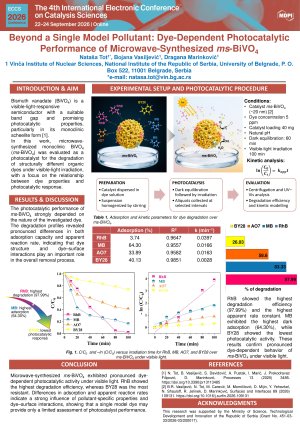
Introduction: Visible-light-active photocatalysts are of great interest for sustainable wastewater treatment, particularly for the degradation of organic pollutants under solar-relevant irradiation. Monoclinic bismuth vanadate (ms-BiVO4) has attracted attention due to its suitable band gap and promising photocatalytic behavior. However, photocatalytic performance is often evaluated using only one model pollutant, which may not fully reflect the response of the material toward structurally different organic compounds. Therefore, this study investigates the dye-dependent photocatalytic activity of microwave-synthesized ms-BiVO4.
Methods: ms-BiVO4 was prepared by a rapid aqueous microwave-assisted method and tested toward representative anionic and cationic dyes: Acid Orange 7 (AO7), Basic Yellow 28 (BY28), Methylene Blue (MB), and Rhodamine B (RhB). Experiments used 5 ppm dye solutions, natural pH, 40 mg catalyst (0.8 g L–1), and 100 min of visible-light irradiation. Before illumination, suspensions were kept in the dark to establish adsorption–desorption equilibrium. Degradation efficiency and kinetic parameters were evaluated using the pseudo-first-order model.
Results: The synthesized ms-BiVO4 showed a monoclinic scheelite structure, nanosized crystallites of approximately 19 nm, particle sizes around 20 nm, and a direct band gap of 2.55 eV. After 100 min of irradiation, degradation efficiencies followed the order RhB (97.99%) > MB (83.33%) > AO7 (58.60%) > BY28 (26.03%). Dark adsorption was highest for MB (64.30%) and lowest for RhB (3.74%). The apparent rate constants ranged from 0.0028 min–1 for BY28 to 0.0397 min–1 for RhB.
Conclusions: Microwave-synthesized ms-BiVO4 exhibited strong but dye-dependent visible-light photocatalytic activity. The highest degradation of cationic RhB, despite negligible adsorption, and poor degradation of cationic BY28, despite considerable adsorption, indicate that ionic character alone did not govern the response. Instead, dye-specific molecular structure and adsorption behavior jointly controlled degradation efficiency. Therefore, multi-dye testing provides a more realistic assessment of BiVO4 than evaluation based on a single model pollutant.
Keywords
bismuth vanadate
dye-dependent photocatalysis
visible light
microwave-assisted synthesis
organic dyes
Poster
ECCS 2026_NT Poster.pdf
Enhancing the Hydrogen Evolution Activity of HOF Photocatalysts via Increased BET Specific Surface Area and Improved Crystallinity
Wavelength-Dependent Photocatalytic Activity of a Perylene-Based Zirconium MOF: Accessing Distinct Excited States through Selective Visible-Light Excitation