Event submissions
Published
This submission belongs to the session S3. Photocatalysis and Electrocatalysis of the event The 4th International Electronic Conference on Catalysis Sciences
Published date
16 Sep, 2026
Academic Editor
'%3e%3cpath%20d='M12.6657%2010.9104C12.4185%2010.325%2012.0599%209.79327%2011.6097%209.34482C11.1609%208.89508%2010.6293%208.5365%2010.0442%208.28888C10.0389%208.28626%2010.0337%208.28495%2010.0285%208.28233C10.8446%207.69279%2011.3752%206.73249%2011.3752%205.64904C11.3752%203.8542%209.92103%202.39999%208.1262%202.39999C6.33136%202.39999%204.87715%203.8542%204.87715%205.64904C4.87715%206.73249%205.40774%207.69279%206.22393%208.28364C6.21869%208.28626%206.21345%208.28757%206.20821%208.29019C5.62129%208.5378%205.09463%208.89284%204.64265%209.34613C4.1929%209.79493%203.83432%2010.3266%203.58671%2010.9117C3.34345%2011.4845%203.21226%2012.0987%203.20023%2012.7209C3.19988%2012.7349%203.20233%2012.7488%203.20744%2012.7619C3.21255%2012.7749%203.22022%2012.7867%203.22998%2012.7968C3.23975%2012.8068%203.25142%2012.8147%203.26431%2012.8202C3.2772%2012.8256%203.29105%2012.8284%203.30504%2012.8284H4.09109C4.14874%2012.8284%204.19459%2012.7825%204.1959%2012.7262C4.2221%2011.7148%204.62823%2010.7676%205.34617%2010.0497C6.08899%209.30683%207.0755%208.89808%208.1262%208.89808C9.17689%208.89808%2010.1634%209.30683%2010.9062%2010.0497C11.6242%2010.7676%2012.0303%2011.7148%2012.0565%2012.7262C12.0578%2012.7838%2012.1037%2012.8284%2012.1613%2012.8284H12.9474C12.9613%2012.8284%2012.9752%2012.8256%2012.9881%2012.8202C13.001%2012.8147%2013.0126%2012.8068%2013.0224%2012.7968C13.0322%2012.7867%2013.0398%2012.7749%2013.0449%2012.7619C13.0501%2012.7488%2013.0525%2012.7349%2013.0522%2012.7209C13.0391%2012.0947%2012.9094%2011.4855%2012.6657%2010.9104ZM8.1262%207.9024C7.52486%207.9024%206.9589%207.6679%206.53312%207.24211C6.10733%206.81633%205.87283%206.25037%205.87283%205.64904C5.87283%205.0477%206.10733%204.48174%206.53312%204.05596C6.9589%203.63018%207.52486%203.39567%208.1262%203.39567C8.72753%203.39567%209.29349%203.63018%209.71927%204.05596C10.1451%204.48174%2010.3796%205.0477%2010.3796%205.64904C10.3796%206.25037%2010.1451%206.81633%209.71927%207.24211C9.29349%207.6679%208.72753%207.9024%208.1262%207.9024Z'%20fill='%235D1EE1'/%3e%3c/g%3e%3c/svg%3e) Ioannis Konstantinou
Ioannis KonstantinouCitation
Rodolfo Daniel Cacciari, Juan José Romero, Wavelength-Dependent Photocatalytic Activity of a Perylene-Based Zirconium MOF: Accessing Distinct Excited States through Selective Visible-Light Excitation, in Proceedings of The 4th International Electronic Conference on Catalysis Sciences, 22 September–24 September 2026, MDPI: Basel, Switzerland
Share
Email
Facebook
Twitter
LinkedIn
Wavelength-Dependent Photocatalytic Activity of a Perylene-Based Zirconium MOF: Accessing Distinct Excited States through Selective Visible-Light Excitation
'%3e%3cpath%20d='M12.6647%2010.9104C12.4176%2010.325%2012.0589%209.7933%2011.6088%209.34485C11.16%208.89511%2010.6283%208.53653%2010.0432%208.28891C10.038%208.28629%2010.0327%208.28498%2010.0275%208.28236C10.8437%207.69282%2011.3743%206.73252%2011.3743%205.64907C11.3743%203.85423%209.92005%202.40002%208.12522%202.40002C6.33038%202.40002%204.87618%203.85423%204.87618%205.64907C4.87618%206.73252%205.40677%207.69282%206.22296%208.28367C6.21772%208.28629%206.21248%208.2876%206.20724%208.29022C5.62031%208.53783%205.09365%208.89287%204.64167%209.34616C4.19192%209.79496%203.83334%2010.3266%203.58573%2010.9117C3.34247%2011.4846%203.21128%2012.0987%203.19925%2012.721C3.1989%2012.735%203.20135%2012.7489%203.20646%2012.7619C3.21157%2012.7749%203.21924%2012.7868%203.22901%2012.7968C3.23877%2012.8068%203.25045%2012.8148%203.26334%2012.8202C3.27623%2012.8256%203.29007%2012.8284%203.30406%2012.8284H4.09012C4.14776%2012.8284%204.19362%2012.7825%204.19493%2012.7262C4.22113%2011.7148%204.62726%2010.7676%205.34519%2010.0497C6.08802%209.30686%207.07452%208.89811%208.12522%208.89811C9.17592%208.89811%2010.1624%209.30686%2010.9052%2010.0497C11.6232%2010.7676%2012.0293%2011.7148%2012.0555%2012.7262C12.0568%2012.7839%2012.1027%2012.8284%2012.1603%2012.8284H12.9464C12.9604%2012.8284%2012.9742%2012.8256%2012.9871%2012.8202C13%2012.8148%2013.0117%2012.8068%2013.0214%2012.7968C13.0312%2012.7868%2013.0389%2012.7749%2013.044%2012.7619C13.0491%2012.7489%2013.0515%2012.735%2013.0512%2012.721C13.0381%2012.0947%2012.9084%2011.4856%2012.6647%2010.9104ZM8.12522%207.90243C7.52388%207.90243%206.95792%207.66793%206.53214%207.24215C6.10636%206.81636%205.87185%206.2504%205.87185%205.64907C5.87185%205.04773%206.10636%204.48177%206.53214%204.05599C6.95792%203.63021%207.52388%203.3957%208.12522%203.3957C8.72655%203.3957%209.29252%203.63021%209.7183%204.05599C10.1441%204.48177%2010.3786%205.04773%2010.3786%205.64907C10.3786%206.2504%2010.1441%206.81636%209.7183%207.24215C9.29252%207.66793%208.72655%207.90243%208.12522%207.90243Z'%20fill='%235D1EE1'/%3e%3c/g%3e%3c/svg%3e)
Rodolfo Daniel Cacciari 1
Juan José Romero 2
1. Research Institute of Theorical and Applied Physical chemistry (INIFTA), CONICET – University of La Plata, La Plata, Argentina
2. Institute for Integrative Biology of the Cell (CNRS), CEA – Université Paris Saclay, Gif sur Yvette Cedex, France
Abstract
Introduction
Perylene-based metal–organic frameworks (MOFs) have attracted considerable attention as visible-light photocatalysts due to their strong absorption and tunable excited-state properties. In this work, we investigate the wavelength-dependent photocatalytic behavior of ZIPER, a zirconium-based MOF incorporating perylene-derived organic linkers.
Methods
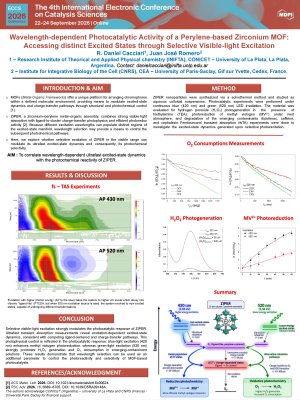
ZIPER nanoparticles were synthesized via a solvothermal method and studied as aqueous colloidal suspensions. Photocatalytic experiments were performed under continuous blue (420 nm) and green (520 nm) LED irradiation. The material was evaluated for hydrogen peroxide (H₂O₂) photogeneration in the presence of triethylamine (TEA), photoreduction of methyl viologen (MV²⁺) under inert atmosphere, and degradation of the emerging contaminants diclofenac, caffeine, and cephalexin. Femtosecond transient absorption spectroscopy (fs-TAS) studies are currently underway to investigate the excited-state dynamics generated upon selective photoexcitation.
Results
ZIPER exhibited a pronounced wavelength-dependent photocatalytic response. Under green-light irradiation, the material generated up to 420 μM H₂O₂ after 1 h in the presence of TEA, whereas only 50 μM was produced under blue-light irradiation. In contrast, the photoreduction of MV²⁺ was more efficient under blue-light excitation, indicating the formation of a more strongly reducing excited state. ZIPER also promoted the degradation of all contaminants under both irradiation wavelengths, with consistently higher degradation efficiencies observed under green light. These findings suggest that excitation at different wavelengths populates excited states with distinct redox properties and reactivity patterns.
Conclusions
The photocatalytic activity of ZIPER can be modulated through selective visible-light excitation. The distinct behaviors observed for H₂O₂ generation, MV²⁺ reduction, and pollutant degradation provide strong evidence for the involvement of different excited-state manifolds. Ongoing fs-TAS experiments will help elucidate the nature of these states and establish a mechanistic relationship between excitation wavelength and photocatalytic performance, providing valuable insights for the design of wavelength-selective photocatalysts.
Keywords
MOF
Photocatalysis
Wavelength dependence
Poster
Poster_CACCIARI.pdf
Beyond a Single Model Pollutant: Dye-Dependent Photocatalytic Performance of Microwave-Synthesized ms-BiVO4
Bi24O31Br10/Ni-MOF-74 heterojunction: construction and simultaneous photocatalytic degradation of ciprofloxacin and methyl orange