Event submissions
Published
This submission belongs to the session S3. Photocatalysis and Electrocatalysis of the event The 4th International Electronic Conference on Catalysis Sciences
Published date
16 Sep, 2026
Academic Editor
'%3e%3cpath%20d='M12.6657%2010.9104C12.4185%2010.325%2012.0599%209.79327%2011.6097%209.34482C11.1609%208.89508%2010.6293%208.5365%2010.0442%208.28888C10.0389%208.28626%2010.0337%208.28495%2010.0285%208.28233C10.8446%207.69279%2011.3752%206.73249%2011.3752%205.64904C11.3752%203.8542%209.92103%202.39999%208.1262%202.39999C6.33136%202.39999%204.87715%203.8542%204.87715%205.64904C4.87715%206.73249%205.40774%207.69279%206.22393%208.28364C6.21869%208.28626%206.21345%208.28757%206.20821%208.29019C5.62129%208.5378%205.09463%208.89284%204.64265%209.34613C4.1929%209.79493%203.83432%2010.3266%203.58671%2010.9117C3.34345%2011.4845%203.21226%2012.0987%203.20023%2012.7209C3.19988%2012.7349%203.20233%2012.7488%203.20744%2012.7619C3.21255%2012.7749%203.22022%2012.7867%203.22998%2012.7968C3.23975%2012.8068%203.25142%2012.8147%203.26431%2012.8202C3.2772%2012.8256%203.29105%2012.8284%203.30504%2012.8284H4.09109C4.14874%2012.8284%204.19459%2012.7825%204.1959%2012.7262C4.2221%2011.7148%204.62823%2010.7676%205.34617%2010.0497C6.08899%209.30683%207.0755%208.89808%208.1262%208.89808C9.17689%208.89808%2010.1634%209.30683%2010.9062%2010.0497C11.6242%2010.7676%2012.0303%2011.7148%2012.0565%2012.7262C12.0578%2012.7838%2012.1037%2012.8284%2012.1613%2012.8284H12.9474C12.9613%2012.8284%2012.9752%2012.8256%2012.9881%2012.8202C13.001%2012.8147%2013.0126%2012.8068%2013.0224%2012.7968C13.0322%2012.7867%2013.0398%2012.7749%2013.0449%2012.7619C13.0501%2012.7488%2013.0525%2012.7349%2013.0522%2012.7209C13.0391%2012.0947%2012.9094%2011.4855%2012.6657%2010.9104ZM8.1262%207.9024C7.52486%207.9024%206.9589%207.6679%206.53312%207.24211C6.10733%206.81633%205.87283%206.25037%205.87283%205.64904C5.87283%205.0477%206.10733%204.48174%206.53312%204.05596C6.9589%203.63018%207.52486%203.39567%208.1262%203.39567C8.72753%203.39567%209.29349%203.63018%209.71927%204.05596C10.1451%204.48174%2010.3796%205.0477%2010.3796%205.64904C10.3796%206.25037%2010.1451%206.81633%209.71927%207.24211C9.29349%207.6679%208.72753%207.9024%208.1262%207.9024Z'%20fill='%235D1EE1'/%3e%3c/g%3e%3c/svg%3e) Ioannis Konstantinou
Ioannis KonstantinouCitation
Momona Shimodaira, Hideyuki Katsumata, Ikki Tateishi, Mai Furukawa, Satoshi Kaneco, Enhanced Photocatalytic Hydrogen Production over Oxygen-Doped g-C₃N₄ via Molten Salt Treatment, in Proceedings of The 4th International Electronic Conference on Catalysis Sciences, 22 September–24 September 2026, MDPI: Basel, Switzerland
Share
Email
Facebook
Twitter
LinkedIn
Enhanced Photocatalytic Hydrogen Production over Oxygen-Doped g-C₃N₄ via Molten Salt Treatment
'%3e%3cpath%20d='M12.6647%2010.9104C12.4176%2010.325%2012.0589%209.7933%2011.6088%209.34485C11.16%208.89511%2010.6283%208.53653%2010.0432%208.28891C10.038%208.28629%2010.0327%208.28498%2010.0275%208.28236C10.8437%207.69282%2011.3743%206.73252%2011.3743%205.64907C11.3743%203.85423%209.92005%202.40002%208.12522%202.40002C6.33038%202.40002%204.87618%203.85423%204.87618%205.64907C4.87618%206.73252%205.40677%207.69282%206.22296%208.28367C6.21772%208.28629%206.21248%208.2876%206.20724%208.29022C5.62031%208.53783%205.09365%208.89287%204.64167%209.34616C4.19192%209.79496%203.83334%2010.3266%203.58573%2010.9117C3.34247%2011.4846%203.21128%2012.0987%203.19925%2012.721C3.1989%2012.735%203.20135%2012.7489%203.20646%2012.7619C3.21157%2012.7749%203.21924%2012.7868%203.22901%2012.7968C3.23877%2012.8068%203.25045%2012.8148%203.26334%2012.8202C3.27623%2012.8256%203.29007%2012.8284%203.30406%2012.8284H4.09012C4.14776%2012.8284%204.19362%2012.7825%204.19493%2012.7262C4.22113%2011.7148%204.62726%2010.7676%205.34519%2010.0497C6.08802%209.30686%207.07452%208.89811%208.12522%208.89811C9.17592%208.89811%2010.1624%209.30686%2010.9052%2010.0497C11.6232%2010.7676%2012.0293%2011.7148%2012.0555%2012.7262C12.0568%2012.7839%2012.1027%2012.8284%2012.1603%2012.8284H12.9464C12.9604%2012.8284%2012.9742%2012.8256%2012.9871%2012.8202C13%2012.8148%2013.0117%2012.8068%2013.0214%2012.7968C13.0312%2012.7868%2013.0389%2012.7749%2013.044%2012.7619C13.0491%2012.7489%2013.0515%2012.735%2013.0512%2012.721C13.0381%2012.0947%2012.9084%2011.4856%2012.6647%2010.9104ZM8.12522%207.90243C7.52388%207.90243%206.95792%207.66793%206.53214%207.24215C6.10636%206.81636%205.87185%206.2504%205.87185%205.64907C5.87185%205.04773%206.10636%204.48177%206.53214%204.05599C6.95792%203.63021%207.52388%203.3957%208.12522%203.3957C8.72655%203.3957%209.29252%203.63021%209.7183%204.05599C10.1441%204.48177%2010.3786%205.04773%2010.3786%205.64907C10.3786%206.2504%2010.1441%206.81636%209.7183%207.24215C9.29252%207.66793%208.72655%207.90243%208.12522%207.90243Z'%20fill='%235D1EE1'/%3e%3c/g%3e%3c/svg%3e)
Momona Shimodaira 1
Hideyuki Katsumata 1,2
Ikki Tateishi 2
Mai Furukawa 1
Satoshi Kaneco 1
1. Department of Applied Chemistry, Graduate School of Engineering, Mie University, Tsu, Mie, Japan
2. Center for Global Environment Education & Research, Mie University, Tsu, Mie, Japan
Abstract
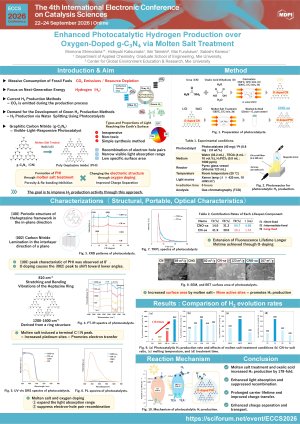
Photocatalytic water splitting using solar energy has attracted considerable attention as a CO₂-free hydrogen production method. Graphitic carbon nitride (g-C3N4), one of the representative photocatalysts, is non-toxic, inexpensive, and easy to synthesize. However, its photocatalytic hydrogen evolution activity is limited by insufficient visible-light absorption and the rapid recombination of photogenerated electron–hole pairs. In this study, molten salt treatment and oxygen incorporation were employed to improve the light absorption properties and charge transfer/separation properties of carbon nitride, thereby enhancing the photocatalytic hydrogen evolution activity.
The photocatalyst (CNO) was synthesized by the thermal polymerization of urea and oxalic acid dihydrate. The obtained CNO was subsequently subjected to molten salt processing using a NaCl/LiCl mixed salt. The resulting powder was named as CNO-sa (salt-assisted CNO). Photocatalytic hydrogen evolution was evaluated in an aqueous solution containing triethanolamine as a sacrificial agent and hexachloroplatinic acid as a Pt precursor under visible-light irradiation (λ ≥ 420 nm) for 6 h. The amount of evolved hydrogen was quantified by gas chromatography. Furthermore, various characterization techniques were employed to clarify the optical, electrochemical, and structural properties of the photocatalysts, and the factors contributing to the enhanced photocatalytic activity were discussed.
CNO-sa treated with molten salt treatment and oxygen incorporation exhibited a hydrogen evolution activity 178 times greater than that of pristine carbon nitride. SEM and DRS analyses revealed that the molten salt treatment induced the formation of a porous structure and enhanced visible-light absorption, which likely facilitated charge transfer. In addition, TRPL measurements confirmed that oxygen incorporation effectively prolonged the carrier lifetime. Furthermore, PL measurements demonstrated that the combined effects of molten salt treatment and oxygen incorporation suppressed the recombination of photogenerated electron–hole pairs, contributing to improved charge separation efficiency. These effects promoted efficient electron transfer and enhanced the photocatalytic hydrogen evolution activity.
Keywords
Hydrogen production
Photocatalysts
g-C₃N₄
Characterization
Poster
ECCS_Momona_Shimodaira_A0.pdf
Synthesis and Kinetics of Photocatalysis Mechanism of (La₀.₂₅Gd₀.₂₅Ca₀.₂₅Sr₀.₂₅)MnO3 for Wastewater Treatment
From Waste to Fuel: Integrated Conversion of Spent Coffee Grounds into Biochar-Supported Catalysts and Green Diesel