Event submissions
Published
This submission belongs to the session S2. Environmental Catalysis of the event The 4th International Electronic Conference on Catalysis Sciences
Published date
16 Sep, 2026
Academic Editor
'%3e%3cpath%20d='M12.6657%2010.9104C12.4185%2010.325%2012.0599%209.79327%2011.6097%209.34482C11.1609%208.89508%2010.6293%208.5365%2010.0442%208.28888C10.0389%208.28626%2010.0337%208.28495%2010.0285%208.28233C10.8446%207.69279%2011.3752%206.73249%2011.3752%205.64904C11.3752%203.8542%209.92103%202.39999%208.1262%202.39999C6.33136%202.39999%204.87715%203.8542%204.87715%205.64904C4.87715%206.73249%205.40774%207.69279%206.22393%208.28364C6.21869%208.28626%206.21345%208.28757%206.20821%208.29019C5.62129%208.5378%205.09463%208.89284%204.64265%209.34613C4.1929%209.79493%203.83432%2010.3266%203.58671%2010.9117C3.34345%2011.4845%203.21226%2012.0987%203.20023%2012.7209C3.19988%2012.7349%203.20233%2012.7488%203.20744%2012.7619C3.21255%2012.7749%203.22022%2012.7867%203.22998%2012.7968C3.23975%2012.8068%203.25142%2012.8147%203.26431%2012.8202C3.2772%2012.8256%203.29105%2012.8284%203.30504%2012.8284H4.09109C4.14874%2012.8284%204.19459%2012.7825%204.1959%2012.7262C4.2221%2011.7148%204.62823%2010.7676%205.34617%2010.0497C6.08899%209.30683%207.0755%208.89808%208.1262%208.89808C9.17689%208.89808%2010.1634%209.30683%2010.9062%2010.0497C11.6242%2010.7676%2012.0303%2011.7148%2012.0565%2012.7262C12.0578%2012.7838%2012.1037%2012.8284%2012.1613%2012.8284H12.9474C12.9613%2012.8284%2012.9752%2012.8256%2012.9881%2012.8202C13.001%2012.8147%2013.0126%2012.8068%2013.0224%2012.7968C13.0322%2012.7867%2013.0398%2012.7749%2013.0449%2012.7619C13.0501%2012.7488%2013.0525%2012.7349%2013.0522%2012.7209C13.0391%2012.0947%2012.9094%2011.4855%2012.6657%2010.9104ZM8.1262%207.9024C7.52486%207.9024%206.9589%207.6679%206.53312%207.24211C6.10733%206.81633%205.87283%206.25037%205.87283%205.64904C5.87283%205.0477%206.10733%204.48174%206.53312%204.05596C6.9589%203.63018%207.52486%203.39567%208.1262%203.39567C8.72753%203.39567%209.29349%203.63018%209.71927%204.05596C10.1451%204.48174%2010.3796%205.0477%2010.3796%205.64904C10.3796%206.25037%2010.1451%206.81633%209.71927%207.24211C9.29349%207.6679%208.72753%207.9024%208.1262%207.9024Z'%20fill='%235D1EE1'/%3e%3c/g%3e%3c/svg%3e) Albin Pintar
Albin PintarCitation
Antigone Tsatalpasidou, Sotiris Lycourghiotis, Konstantina Fani, John Zafeiropoulos, Kyriakos Bourikas, Eleana Kordouli, Christos Kordulis, From Waste to Fuel: Integrated Conversion of Spent Coffee Grounds into Biochar-Supported Catalysts and Green Diesel, in Proceedings of The 4th International Electronic Conference on Catalysis Sciences, 22 September–24 September 2026, MDPI: Basel, Switzerland
Share
Email
Facebook
Twitter
LinkedIn
From Waste to Fuel: Integrated Conversion of Spent Coffee Grounds into Biochar-Supported Catalysts and Green Diesel
'%3e%3cpath%20d='M12.6647%2010.9104C12.4176%2010.325%2012.0589%209.7933%2011.6088%209.34485C11.16%208.89511%2010.6283%208.53653%2010.0432%208.28891C10.038%208.28629%2010.0327%208.28498%2010.0275%208.28236C10.8437%207.69282%2011.3743%206.73252%2011.3743%205.64907C11.3743%203.85423%209.92005%202.40002%208.12522%202.40002C6.33038%202.40002%204.87618%203.85423%204.87618%205.64907C4.87618%206.73252%205.40677%207.69282%206.22296%208.28367C6.21772%208.28629%206.21248%208.2876%206.20724%208.29022C5.62031%208.53783%205.09365%208.89287%204.64167%209.34616C4.19192%209.79496%203.83334%2010.3266%203.58573%2010.9117C3.34247%2011.4846%203.21128%2012.0987%203.19925%2012.721C3.1989%2012.735%203.20135%2012.7489%203.20646%2012.7619C3.21157%2012.7749%203.21924%2012.7868%203.22901%2012.7968C3.23877%2012.8068%203.25045%2012.8148%203.26334%2012.8202C3.27623%2012.8256%203.29007%2012.8284%203.30406%2012.8284H4.09012C4.14776%2012.8284%204.19362%2012.7825%204.19493%2012.7262C4.22113%2011.7148%204.62726%2010.7676%205.34519%2010.0497C6.08802%209.30686%207.07452%208.89811%208.12522%208.89811C9.17592%208.89811%2010.1624%209.30686%2010.9052%2010.0497C11.6232%2010.7676%2012.0293%2011.7148%2012.0555%2012.7262C12.0568%2012.7839%2012.1027%2012.8284%2012.1603%2012.8284H12.9464C12.9604%2012.8284%2012.9742%2012.8256%2012.9871%2012.8202C13%2012.8148%2013.0117%2012.8068%2013.0214%2012.7968C13.0312%2012.7868%2013.0389%2012.7749%2013.044%2012.7619C13.0491%2012.7489%2013.0515%2012.735%2013.0512%2012.721C13.0381%2012.0947%2012.9084%2011.4856%2012.6647%2010.9104ZM8.12522%207.90243C7.52388%207.90243%206.95792%207.66793%206.53214%207.24215C6.10636%206.81636%205.87185%206.2504%205.87185%205.64907C5.87185%205.04773%206.10636%204.48177%206.53214%204.05599C6.95792%203.63021%207.52388%203.3957%208.12522%203.3957C8.72655%203.3957%209.29252%203.63021%209.7183%204.05599C10.1441%204.48177%2010.3786%205.04773%2010.3786%205.64907C10.3786%206.2504%2010.1441%206.81636%209.7183%207.24215C9.29252%207.66793%208.72655%207.90243%208.12522%207.90243Z'%20fill='%235D1EE1'/%3e%3c/g%3e%3c/svg%3e)
Antigone Tsatalpasidou 1

Sotiris Lycourghiotis 2
Konstantina Fani 2
John Zafeiropoulos 2

Kyriakos Bourikas 2
Eleana Kordouli 1

Christos Kordulis 1
1. Department of Chemistry, University of Patras, GR-26504, Patras, Greece
2. School of Science and Technology, Hellenic Open University, Tsamadou 13–15, GR-26222, Patras, Greece
Abstract
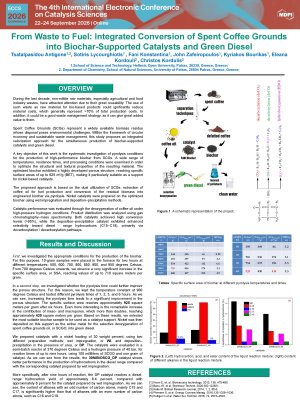
Spent Coffee Grounds (SCGs) represent a widely available biomass residue whose disposal poses environmental challenges. Within the framework of circular economy and sustainable waste management, this study proposes an integrated valorization approach for the simultaneous production of biochar-supported catalysts and green diesel.
A key objective of this work is the systematic investigation of pyrolysis conditions for the production of high-performance biochar from SCGs. A wide range of temperatures, residence times, and processing conditions were examined in order to optimize the structural and textural properties of the resulting material. The optimized biochar exhibited a highly developed porous structure, reaching specific surface areas of up to 925 m²/g (BET), making it particularly suitable as a support for nickel-based catalysts.
The proposed approach is based on the dual utilization of SCGs: extraction of coffee oil for fuel production and conversion of the residual biomass into engineered biochar via pyrolysis. Nickel catalysts were prepared on the optimized biochar using wet impregnation and deposition–precipitation methods.
Catalytic performance was evaluated through the deoxygenation of coffee oil under high-pressure hydrogen conditions. Product distribution was analyzed using gas chromatography–mass spectrometry. Both catalysts achieved high conversion levels (>95%), while the deposition–precipitation catalyst exhibited enhanced selectivity toward diesel-range hydrocarbons (C15–C18), primarily via decarbonylation/decarboxylation pathways.
The results demonstrate that SCG-derived biochar can be tailored through controlled pyrolysis to serve as an efficient catalyst support, enabling the transformation of waste into high-value fuel products. This approach demonstrates the tunability of SCG-derived biochar for catalytic applications, while integrating material optimization and fuel production into a single framework, highlighting the potential of SCGs as a multifunctional resource within circular economy systems.
Keywords
Spent coffee grounds
biochar
pyrolysis optimization
green diesel
nickel catalysts
Poster
Tsitalbasidou_et._al.pdf
Enhanced Photocatalytic Hydrogen Production over Oxygen-Doped g-C₃N₄ via Molten Salt Treatment
ZrC/BiOCl-mediated solar photocatalytic degradation of dexamethasone: transformation products and mechanistic insights