Event submissions
Published
This submission belongs to the session S3. Photocatalysis and Electrocatalysis of the event The 4th International Electronic Conference on Catalysis Sciences
Published date
16 Sep, 2026
Academic Editor
'%3e%3cpath%20d='M12.6657%2010.9104C12.4185%2010.325%2012.0599%209.79327%2011.6097%209.34482C11.1609%208.89508%2010.6293%208.5365%2010.0442%208.28888C10.0389%208.28626%2010.0337%208.28495%2010.0285%208.28233C10.8446%207.69279%2011.3752%206.73249%2011.3752%205.64904C11.3752%203.8542%209.92103%202.39999%208.1262%202.39999C6.33136%202.39999%204.87715%203.8542%204.87715%205.64904C4.87715%206.73249%205.40774%207.69279%206.22393%208.28364C6.21869%208.28626%206.21345%208.28757%206.20821%208.29019C5.62129%208.5378%205.09463%208.89284%204.64265%209.34613C4.1929%209.79493%203.83432%2010.3266%203.58671%2010.9117C3.34345%2011.4845%203.21226%2012.0987%203.20023%2012.7209C3.19988%2012.7349%203.20233%2012.7488%203.20744%2012.7619C3.21255%2012.7749%203.22022%2012.7867%203.22998%2012.7968C3.23975%2012.8068%203.25142%2012.8147%203.26431%2012.8202C3.2772%2012.8256%203.29105%2012.8284%203.30504%2012.8284H4.09109C4.14874%2012.8284%204.19459%2012.7825%204.1959%2012.7262C4.2221%2011.7148%204.62823%2010.7676%205.34617%2010.0497C6.08899%209.30683%207.0755%208.89808%208.1262%208.89808C9.17689%208.89808%2010.1634%209.30683%2010.9062%2010.0497C11.6242%2010.7676%2012.0303%2011.7148%2012.0565%2012.7262C12.0578%2012.7838%2012.1037%2012.8284%2012.1613%2012.8284H12.9474C12.9613%2012.8284%2012.9752%2012.8256%2012.9881%2012.8202C13.001%2012.8147%2013.0126%2012.8068%2013.0224%2012.7968C13.0322%2012.7867%2013.0398%2012.7749%2013.0449%2012.7619C13.0501%2012.7488%2013.0525%2012.7349%2013.0522%2012.7209C13.0391%2012.0947%2012.9094%2011.4855%2012.6657%2010.9104ZM8.1262%207.9024C7.52486%207.9024%206.9589%207.6679%206.53312%207.24211C6.10733%206.81633%205.87283%206.25037%205.87283%205.64904C5.87283%205.0477%206.10733%204.48174%206.53312%204.05596C6.9589%203.63018%207.52486%203.39567%208.1262%203.39567C8.72753%203.39567%209.29349%203.63018%209.71927%204.05596C10.1451%204.48174%2010.3796%205.0477%2010.3796%205.64904C10.3796%206.25037%2010.1451%206.81633%209.71927%207.24211C9.29349%207.6679%208.72753%207.9024%208.1262%207.9024Z'%20fill='%235D1EE1'/%3e%3c/g%3e%3c/svg%3e) Carmelo Vecchio
Carmelo VecchioCitation
Kosmas Lalas, Alexandra Ioannidi, Andreas Koullouris, Georgios Bampos, Maria Antonopoulou, Dionissios Mantzavinos, Zacharias Frontistis, ZrC/BiOCl-mediated solar photocatalytic degradation of dexamethasone: transformation products and mechanistic insights, in Proceedings of The 4th International Electronic Conference on Catalysis Sciences, 22 September–24 September 2026, MDPI: Basel, Switzerland
Share
Email
Facebook
Twitter
LinkedIn
ZrC/BiOCl-mediated solar photocatalytic degradation of dexamethasone: transformation products and mechanistic insights
'%3e%3cpath%20d='M12.6647%2010.9104C12.4176%2010.325%2012.0589%209.7933%2011.6088%209.34485C11.16%208.89511%2010.6283%208.53653%2010.0432%208.28891C10.038%208.28629%2010.0327%208.28498%2010.0275%208.28236C10.8437%207.69282%2011.3743%206.73252%2011.3743%205.64907C11.3743%203.85423%209.92005%202.40002%208.12522%202.40002C6.33038%202.40002%204.87618%203.85423%204.87618%205.64907C4.87618%206.73252%205.40677%207.69282%206.22296%208.28367C6.21772%208.28629%206.21248%208.2876%206.20724%208.29022C5.62031%208.53783%205.09365%208.89287%204.64167%209.34616C4.19192%209.79496%203.83334%2010.3266%203.58573%2010.9117C3.34247%2011.4846%203.21128%2012.0987%203.19925%2012.721C3.1989%2012.735%203.20135%2012.7489%203.20646%2012.7619C3.21157%2012.7749%203.21924%2012.7868%203.22901%2012.7968C3.23877%2012.8068%203.25045%2012.8148%203.26334%2012.8202C3.27623%2012.8256%203.29007%2012.8284%203.30406%2012.8284H4.09012C4.14776%2012.8284%204.19362%2012.7825%204.19493%2012.7262C4.22113%2011.7148%204.62726%2010.7676%205.34519%2010.0497C6.08802%209.30686%207.07452%208.89811%208.12522%208.89811C9.17592%208.89811%2010.1624%209.30686%2010.9052%2010.0497C11.6232%2010.7676%2012.0293%2011.7148%2012.0555%2012.7262C12.0568%2012.7839%2012.1027%2012.8284%2012.1603%2012.8284H12.9464C12.9604%2012.8284%2012.9742%2012.8256%2012.9871%2012.8202C13%2012.8148%2013.0117%2012.8068%2013.0214%2012.7968C13.0312%2012.7868%2013.0389%2012.7749%2013.044%2012.7619C13.0491%2012.7489%2013.0515%2012.735%2013.0512%2012.721C13.0381%2012.0947%2012.9084%2011.4856%2012.6647%2010.9104ZM8.12522%207.90243C7.52388%207.90243%206.95792%207.66793%206.53214%207.24215C6.10636%206.81636%205.87185%206.2504%205.87185%205.64907C5.87185%205.04773%206.10636%204.48177%206.53214%204.05599C6.95792%203.63021%207.52388%203.3957%208.12522%203.3957C8.72655%203.3957%209.29252%203.63021%209.7183%204.05599C10.1441%204.48177%2010.3786%205.04773%2010.3786%205.64907C10.3786%206.2504%2010.1441%206.81636%209.7183%207.24215C9.29252%207.66793%208.72655%207.90243%208.12522%207.90243Z'%20fill='%235D1EE1'/%3e%3c/g%3e%3c/svg%3e)
Kosmas Lalas 1

Alexandra Ioannidi 2,3
Andreas Koullouris 2

Georgios Bampos 2

Maria Antonopoulou 3

Dionissios Mantzavinos 2

Zacharias Frontistis 1
1. Department of Chemical Engineering, University of Western Macedonia, GR-50132 Kozani, Greece
2. Department of Chemical Engineering, University of Patras, Caratheodory 1, University Campus, GR-26504 Patras, Greece
3. Department of Sustainable Agriculture, University of Patras, 30131 Agrinio, Greece
Abstract
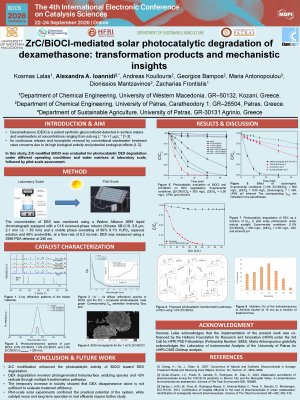
This work investigates the development of ZrC/BiOCl photocatalysts for the solar-driven degradation of dexamethasone (DEX), a recalcitrant corticosteroid frequently associated with aquatic contamination. The composites were prepared through an impregnation-based approach, aiming to improve the photocatalytic response of BiOCl under simulated solar irradiation. Characterization results from XRD, BET, SEM/EDS, and DRS analyses showed that the presence of ZrC did not cause significant changes in the crystalline phase, surface morphology, or textural properties of BiOCl. However, the modification significantly improved the degradation performance, suggesting that ZrC primarily contributed to more efficient charge transport and a reduction in electron-hole recombination; this was confirmed via photoluminescence spectroscopy.
Among the examined materials, the composite containing 1.0 wt% ZrC exhibited the highest activity. Under the optimized conditions, using 500 mg/L catalyst, complete removal of 500 μg/L DEX was achieved within 30 min, while the kapp was more than five times higher than that obtained with unmodified BiOCl. Mechanistic investigation using EPR spectroscopy and scavenging tests indicated that photogenerated holes/surface-bound oxidizing species and hydroxyl radicals played an important role in DEX transformation. The treatment efficiency was strongly dependent on the water matrix; the kapp was calculated to be 0.213, 0.017 and 0.008 min⁻¹ for UPW, BW, and WW, respectively.
UHPLC-HRMS analysis revealed the formation of sixteen transformation products. Acute toxicity tests with Aliivibrio fischeri showed a temporary toxicity increase during irradiation, most likely related to the formation of intermediate by-products. Nevertheless, prolonged treatment led to complete detoxification. Overall, results demonstrate ZrC modification is an effective strategy to enhance BiOCl photocatalysis and highlight the proposed solar process's potential for treating corticosteroid-contaminated water.
Keywords
Photocatalysis
solar light
Dexamethasone
degradation
ZrC/BiOCl
toxicity
transformation products.
Poster
POSTER ECCS ONLINE 12_9_2026.pdf
From Waste to Fuel: Integrated Conversion of Spent Coffee Grounds into Biochar-Supported Catalysts and Green Diesel
Hybrid Ir/TiO2 Catalysts for PEM Water Electrolysis: Influence of Composition and Preparation Strategy on OER Performance