Event submissions
Published
This submission belongs to the session S2. Environmental Catalysis of the event The 4th International Electronic Conference on Catalysis Sciences
Published date
16 Sep, 2026
Academic Editor
'%3e%3cpath%20d='M12.6657%2010.9104C12.4185%2010.325%2012.0599%209.79327%2011.6097%209.34482C11.1609%208.89508%2010.6293%208.5365%2010.0442%208.28888C10.0389%208.28626%2010.0337%208.28495%2010.0285%208.28233C10.8446%207.69279%2011.3752%206.73249%2011.3752%205.64904C11.3752%203.8542%209.92103%202.39999%208.1262%202.39999C6.33136%202.39999%204.87715%203.8542%204.87715%205.64904C4.87715%206.73249%205.40774%207.69279%206.22393%208.28364C6.21869%208.28626%206.21345%208.28757%206.20821%208.29019C5.62129%208.5378%205.09463%208.89284%204.64265%209.34613C4.1929%209.79493%203.83432%2010.3266%203.58671%2010.9117C3.34345%2011.4845%203.21226%2012.0987%203.20023%2012.7209C3.19988%2012.7349%203.20233%2012.7488%203.20744%2012.7619C3.21255%2012.7749%203.22022%2012.7867%203.22998%2012.7968C3.23975%2012.8068%203.25142%2012.8147%203.26431%2012.8202C3.2772%2012.8256%203.29105%2012.8284%203.30504%2012.8284H4.09109C4.14874%2012.8284%204.19459%2012.7825%204.1959%2012.7262C4.2221%2011.7148%204.62823%2010.7676%205.34617%2010.0497C6.08899%209.30683%207.0755%208.89808%208.1262%208.89808C9.17689%208.89808%2010.1634%209.30683%2010.9062%2010.0497C11.6242%2010.7676%2012.0303%2011.7148%2012.0565%2012.7262C12.0578%2012.7838%2012.1037%2012.8284%2012.1613%2012.8284H12.9474C12.9613%2012.8284%2012.9752%2012.8256%2012.9881%2012.8202C13.001%2012.8147%2013.0126%2012.8068%2013.0224%2012.7968C13.0322%2012.7867%2013.0398%2012.7749%2013.0449%2012.7619C13.0501%2012.7488%2013.0525%2012.7349%2013.0522%2012.7209C13.0391%2012.0947%2012.9094%2011.4855%2012.6657%2010.9104ZM8.1262%207.9024C7.52486%207.9024%206.9589%207.6679%206.53312%207.24211C6.10733%206.81633%205.87283%206.25037%205.87283%205.64904C5.87283%205.0477%206.10733%204.48174%206.53312%204.05596C6.9589%203.63018%207.52486%203.39567%208.1262%203.39567C8.72753%203.39567%209.29349%203.63018%209.71927%204.05596C10.1451%204.48174%2010.3796%205.0477%2010.3796%205.64904C10.3796%206.25037%2010.1451%206.81633%209.71927%207.24211C9.29349%207.6679%208.72753%207.9024%208.1262%207.9024Z'%20fill='%235D1EE1'/%3e%3c/g%3e%3c/svg%3e) Albin Pintar
Albin PintarCitation
ALEXIS MOUSTOS, SOTIRIS LYCOURGHIOTIS, JOHN ZAFEIROPOULOS, KONSTANTINA FANI, KYRIAKOS BOURIKAS, ELEANA KORDOULI, Holistic Valorization of Spent Coffee Grounds: Integrated Production of Biochar-Supported Catalysts and Green Diesel, in Proceedings of The 4th International Electronic Conference on Catalysis Sciences, 22 September–24 September 2026, MDPI: Basel, Switzerland
Share
Email
Facebook
Twitter
LinkedIn
Holistic Valorization of Spent Coffee Grounds: Integrated Production of Biochar-Supported Catalysts and Green Diesel
'%3e%3cpath%20d='M12.6647%2010.9104C12.4176%2010.325%2012.0589%209.7933%2011.6088%209.34485C11.16%208.89511%2010.6283%208.53653%2010.0432%208.28891C10.038%208.28629%2010.0327%208.28498%2010.0275%208.28236C10.8437%207.69282%2011.3743%206.73252%2011.3743%205.64907C11.3743%203.85423%209.92005%202.40002%208.12522%202.40002C6.33038%202.40002%204.87618%203.85423%204.87618%205.64907C4.87618%206.73252%205.40677%207.69282%206.22296%208.28367C6.21772%208.28629%206.21248%208.2876%206.20724%208.29022C5.62031%208.53783%205.09365%208.89287%204.64167%209.34616C4.19192%209.79496%203.83334%2010.3266%203.58573%2010.9117C3.34247%2011.4846%203.21128%2012.0987%203.19925%2012.721C3.1989%2012.735%203.20135%2012.7489%203.20646%2012.7619C3.21157%2012.7749%203.21924%2012.7868%203.22901%2012.7968C3.23877%2012.8068%203.25045%2012.8148%203.26334%2012.8202C3.27623%2012.8256%203.29007%2012.8284%203.30406%2012.8284H4.09012C4.14776%2012.8284%204.19362%2012.7825%204.19493%2012.7262C4.22113%2011.7148%204.62726%2010.7676%205.34519%2010.0497C6.08802%209.30686%207.07452%208.89811%208.12522%208.89811C9.17592%208.89811%2010.1624%209.30686%2010.9052%2010.0497C11.6232%2010.7676%2012.0293%2011.7148%2012.0555%2012.7262C12.0568%2012.7839%2012.1027%2012.8284%2012.1603%2012.8284H12.9464C12.9604%2012.8284%2012.9742%2012.8256%2012.9871%2012.8202C13%2012.8148%2013.0117%2012.8068%2013.0214%2012.7968C13.0312%2012.7868%2013.0389%2012.7749%2013.044%2012.7619C13.0491%2012.7489%2013.0515%2012.735%2013.0512%2012.721C13.0381%2012.0947%2012.9084%2011.4856%2012.6647%2010.9104ZM8.12522%207.90243C7.52388%207.90243%206.95792%207.66793%206.53214%207.24215C6.10636%206.81636%205.87185%206.2504%205.87185%205.64907C5.87185%205.04773%206.10636%204.48177%206.53214%204.05599C6.95792%203.63021%207.52388%203.3957%208.12522%203.3957C8.72655%203.3957%209.29252%203.63021%209.7183%204.05599C10.1441%204.48177%2010.3786%205.04773%2010.3786%205.64907C10.3786%206.2504%2010.1441%206.81636%209.7183%207.24215C9.29252%207.66793%208.72655%207.90243%208.12522%207.90243Z'%20fill='%235D1EE1'/%3e%3c/g%3e%3c/svg%3e)
ALEXIS MOUSTOS 1

SOTIRIS LYCOURGHIOTIS 2
JOHN ZAFEIROPOULOS 2
KONSTANTINA FANI 3

KYRIAKOS BOURIKAS 3
ELEANA KORDOULI 4
1. Department of Chemical Engineering, School of Engineering, Aristotle University of Thessaloniki, Thessaloniki, Greece.
2. School of Science and Technology, Hellenic Open University, Patras, 26335, Greece
3. Laboratory of Chemistry, School of Science and Technology, Hellenic Open University, Patras, Greece.
4. Department of Chemistry, School of Natural Sciences, University of Patras, 26504 Patras, Greece
Abstract
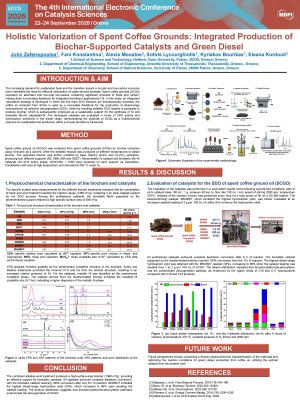
The increasing demand for sustainable fuels and the transition toward a circular economy have intensified interest in the valorization of agro-industrial residues as renewable feedstocks. In this study, an integrated approach is investigated for the utilization of spent coffee grounds (SCGs) for the production of green diesel via selective deoxygenation (SDO), combining oil extraction with the development of biochar-supported catalysts.
Coffee oil was initially extracted from SCGs, while the residual biomass was converted into biochar through pyrolysis and subsequently used as a support for catalyst preparation. Nickel-based and bimetallic Mo–Ni catalysts were synthesized using different preparation methods and evaluated for their catalytic performance.
The deoxygenation reactions were carried out under high-pressure hydrogen conditions, and the resulting liquid products were analyzed using gas chromatography–mass spectrometry. The results demonstrated that catalyst composition and support properties significantly influence both activity and selectivity. In particular, the bimetallic Mo–Ni catalyst supported on appropriately treated biochar exhibited enhanced performance, achieving up to 65% yield of hydrocarbons in the diesel range.
The improved catalytic behavior is attributed to the physicochemical properties of the biochar support, which affect metal dispersion and reaction pathways. These findings highlight the importance of catalyst design in optimizing SDO processes for renewable fuel production.
Overall, the study demonstrates the feasibility of converting SCGs into green diesel through an integrated process that combines waste valorization with catalytic upgrading, contributing to the development of sustainable fuel production systems within the framework of the circular economy.
Keywords
Spent coffee grounds
holistic valorization
biochar
selective deoxygenation
green diesel
Poster
Zafeiropoulos et al._ECCS_22-240926_final_version_070926.pdf
PHOTOCATALYRIC DEGRADATION OF RHODAMINE B BY CELLULOSE/ZnO COMPOSITE FILM
What really limits photocatalytic water treatment? Charge separation and ROS‑oxidation versus electron‑driven reduction on MoS₂, Fe₃O₄, TiO₂ and ZnO