Event submissions
Published
This submission belongs to the session S3. Photocatalysis and Electrocatalysis of the event The 4th International Electronic Conference on Catalysis Sciences
Published date
16 Sep, 2026
Academic Editor
'%3e%3cpath%20d='M12.6657%2010.9104C12.4185%2010.325%2012.0599%209.79327%2011.6097%209.34482C11.1609%208.89508%2010.6293%208.5365%2010.0442%208.28888C10.0389%208.28626%2010.0337%208.28495%2010.0285%208.28233C10.8446%207.69279%2011.3752%206.73249%2011.3752%205.64904C11.3752%203.8542%209.92103%202.39999%208.1262%202.39999C6.33136%202.39999%204.87715%203.8542%204.87715%205.64904C4.87715%206.73249%205.40774%207.69279%206.22393%208.28364C6.21869%208.28626%206.21345%208.28757%206.20821%208.29019C5.62129%208.5378%205.09463%208.89284%204.64265%209.34613C4.1929%209.79493%203.83432%2010.3266%203.58671%2010.9117C3.34345%2011.4845%203.21226%2012.0987%203.20023%2012.7209C3.19988%2012.7349%203.20233%2012.7488%203.20744%2012.7619C3.21255%2012.7749%203.22022%2012.7867%203.22998%2012.7968C3.23975%2012.8068%203.25142%2012.8147%203.26431%2012.8202C3.2772%2012.8256%203.29105%2012.8284%203.30504%2012.8284H4.09109C4.14874%2012.8284%204.19459%2012.7825%204.1959%2012.7262C4.2221%2011.7148%204.62823%2010.7676%205.34617%2010.0497C6.08899%209.30683%207.0755%208.89808%208.1262%208.89808C9.17689%208.89808%2010.1634%209.30683%2010.9062%2010.0497C11.6242%2010.7676%2012.0303%2011.7148%2012.0565%2012.7262C12.0578%2012.7838%2012.1037%2012.8284%2012.1613%2012.8284H12.9474C12.9613%2012.8284%2012.9752%2012.8256%2012.9881%2012.8202C13.001%2012.8147%2013.0126%2012.8068%2013.0224%2012.7968C13.0322%2012.7867%2013.0398%2012.7749%2013.0449%2012.7619C13.0501%2012.7488%2013.0525%2012.7349%2013.0522%2012.7209C13.0391%2012.0947%2012.9094%2011.4855%2012.6657%2010.9104ZM8.1262%207.9024C7.52486%207.9024%206.9589%207.6679%206.53312%207.24211C6.10733%206.81633%205.87283%206.25037%205.87283%205.64904C5.87283%205.0477%206.10733%204.48174%206.53312%204.05596C6.9589%203.63018%207.52486%203.39567%208.1262%203.39567C8.72753%203.39567%209.29349%203.63018%209.71927%204.05596C10.1451%204.48174%2010.3796%205.0477%2010.3796%205.64904C10.3796%206.25037%2010.1451%206.81633%209.71927%207.24211C9.29349%207.6679%208.72753%207.9024%208.1262%207.9024Z'%20fill='%235D1EE1'/%3e%3c/g%3e%3c/svg%3e) Ioannis Konstantinou
Ioannis KonstantinouCitation
Bojana Vasiljevic, Nataša Tot, Dragana Marinković, Impact of europium doping on bismuth vanadate nanopowder's morphological, optical, and photocatalytic characteristics, in Proceedings of The 4th International Electronic Conference on Catalysis Sciences, 22 September–24 September 2026, MDPI: Basel, Switzerland
Share
Email
Facebook
Twitter
LinkedIn
Impact of europium doping on bismuth vanadate nanopowder's morphological, optical, and photocatalytic characteristics

Bojana Vasiljevic 1

Nataša Tot 1

Dragana Marinković 1
1. Laboratory for Radiation Chemistry and Physics, Vinča Institute of Nuclear Sciences, University of Belgrade-National Institute of the Republic of Serbia, Belgrade, 11351 Vinča, Republic of Serbia
Abstract
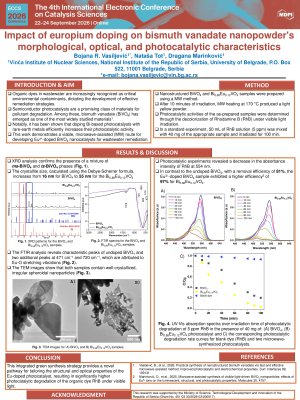
Introduction: Organic dyes in wastewater are recognized as critical environmental contaminants, dictating the development of effective remediation strategies. Semiconductor photocatalysts are a promising class of materials for pollutant degradation. Among these, BiVO4 has emerged as one of the most widely studied materials. However, the restricted separation of photogenerated electron-hole pairs significantly limits their application. Notably, doping Bi-based photocatalysts with rare-earth metals efficiently increases their photocatalytic activity. This work demonstrates a viable, microwave-assisted (MW) route for developing Eu³⁺-doped BiVO4 nanocatalysts for practical wastewater remediation.
Methods: Nanostructured BiVO4 and Bi0.88Eu0.12VO4 samples were prepared using a MW method. After 10 minutes of radiation, a yellow powder is produced by MW heating at 170 °C. Photocatalytic activities of the as-prepared samples were determined through the decolorization of Rhodamine B (RhB) under visible light irradiation. In a standard experiment, 50 mL of RhB solution with a 5 ppm concentration was mixed with 40 mg of the sample and subjected to 100 min of irradiation.
Results: The Eu³⁺-doped BiVO4 has been analyzed using XRD to confirm the presence of a mixture of ms-BiVO₄ and tz-BiVO₄ phases. The crystallite size, calculated using the Debye-Scherrer formula, increases from 16 for BiVO₄ to 55 nm for the Bi0.88Eu0.12VO4 sample. The TEM images show that both samples contain well-crystallized, irregular spheroidal nanoparticles. The FTIR analysis reveals characteristic peaks of undoped BiVO₄ and two additional peaks at 471 and 720 cm⁻¹, which are attributed to Eu-O stretching vibrations. Photocatalytic experiments revealed a decrease in absorbance intensities of RhB at 554 nm. In contrast to the undoped BiVO4, with a removal efficiency of 81%, the Eu3+-doped BiVO4 sample exhibited higher efficiencies of 97% for Bi0.88Eu0.12VO4.
Conclusions: This integrated green synthesis strategy provides a novel pathway for tailoring the structural and optical properties of Eu-doped photocatalyst, resulting in significantly higher photocatalytic degradation of organic dye RhB under visible light.
Keywords
Keywords: Eu3+-doping
BiVO4
microwave synthesis
photocatalysis
degradation of RhB
Poster
B.Vasiljevic_196075.pdf
Effect of thiourea addition on PMS activation by NiFe2O4 for dye degradation
Composition-Driven Synergistic Enhancement of NiCo Electrocatalysts for High-Efficiency Alkaline Overall Water Splitting