Event submissions
Published
This submission belongs to the session S3. Photocatalysis and Electrocatalysis of the event The 4th International Electronic Conference on Catalysis Sciences
Published date
16 Sep, 2026
Academic Editor
'%3e%3cpath%20d='M12.6657%2010.9104C12.4185%2010.325%2012.0599%209.79327%2011.6097%209.34482C11.1609%208.89508%2010.6293%208.5365%2010.0442%208.28888C10.0389%208.28626%2010.0337%208.28495%2010.0285%208.28233C10.8446%207.69279%2011.3752%206.73249%2011.3752%205.64904C11.3752%203.8542%209.92103%202.39999%208.1262%202.39999C6.33136%202.39999%204.87715%203.8542%204.87715%205.64904C4.87715%206.73249%205.40774%207.69279%206.22393%208.28364C6.21869%208.28626%206.21345%208.28757%206.20821%208.29019C5.62129%208.5378%205.09463%208.89284%204.64265%209.34613C4.1929%209.79493%203.83432%2010.3266%203.58671%2010.9117C3.34345%2011.4845%203.21226%2012.0987%203.20023%2012.7209C3.19988%2012.7349%203.20233%2012.7488%203.20744%2012.7619C3.21255%2012.7749%203.22022%2012.7867%203.22998%2012.7968C3.23975%2012.8068%203.25142%2012.8147%203.26431%2012.8202C3.2772%2012.8256%203.29105%2012.8284%203.30504%2012.8284H4.09109C4.14874%2012.8284%204.19459%2012.7825%204.1959%2012.7262C4.2221%2011.7148%204.62823%2010.7676%205.34617%2010.0497C6.08899%209.30683%207.0755%208.89808%208.1262%208.89808C9.17689%208.89808%2010.1634%209.30683%2010.9062%2010.0497C11.6242%2010.7676%2012.0303%2011.7148%2012.0565%2012.7262C12.0578%2012.7838%2012.1037%2012.8284%2012.1613%2012.8284H12.9474C12.9613%2012.8284%2012.9752%2012.8256%2012.9881%2012.8202C13.001%2012.8147%2013.0126%2012.8068%2013.0224%2012.7968C13.0322%2012.7867%2013.0398%2012.7749%2013.0449%2012.7619C13.0501%2012.7488%2013.0525%2012.7349%2013.0522%2012.7209C13.0391%2012.0947%2012.9094%2011.4855%2012.6657%2010.9104ZM8.1262%207.9024C7.52486%207.9024%206.9589%207.6679%206.53312%207.24211C6.10733%206.81633%205.87283%206.25037%205.87283%205.64904C5.87283%205.0477%206.10733%204.48174%206.53312%204.05596C6.9589%203.63018%207.52486%203.39567%208.1262%203.39567C8.72753%203.39567%209.29349%203.63018%209.71927%204.05596C10.1451%204.48174%2010.3796%205.0477%2010.3796%205.64904C10.3796%206.25037%2010.1451%206.81633%209.71927%207.24211C9.29349%207.6679%208.72753%207.9024%208.1262%207.9024Z'%20fill='%235D1EE1'/%3e%3c/g%3e%3c/svg%3e) Ioannis Konstantinou
Ioannis KonstantinouCitation
Huma Amber, Gitana Valeckytė, Zita Sukackienė, Loreta Tamašauskaitė-Tamašiūnaitė, Eugenijus Norkus, Composition-Driven Synergistic Enhancement of NiCo Electrocatalysts for High-Efficiency Alkaline Overall Water Splitting, in Proceedings of The 4th International Electronic Conference on Catalysis Sciences, 22 September–24 September 2026, MDPI: Basel, Switzerland
Share
Email
Facebook
Twitter
LinkedIn
Composition-Driven Synergistic Enhancement of NiCo Electrocatalysts for High-Efficiency Alkaline Overall Water Splitting
'%3e%3cpath%20d='M12.6647%2010.9104C12.4176%2010.325%2012.0589%209.7933%2011.6088%209.34485C11.16%208.89511%2010.6283%208.53653%2010.0432%208.28891C10.038%208.28629%2010.0327%208.28498%2010.0275%208.28236C10.8437%207.69282%2011.3743%206.73252%2011.3743%205.64907C11.3743%203.85423%209.92005%202.40002%208.12522%202.40002C6.33038%202.40002%204.87618%203.85423%204.87618%205.64907C4.87618%206.73252%205.40677%207.69282%206.22296%208.28367C6.21772%208.28629%206.21248%208.2876%206.20724%208.29022C5.62031%208.53783%205.09365%208.89287%204.64167%209.34616C4.19192%209.79496%203.83334%2010.3266%203.58573%2010.9117C3.34247%2011.4846%203.21128%2012.0987%203.19925%2012.721C3.1989%2012.735%203.20135%2012.7489%203.20646%2012.7619C3.21157%2012.7749%203.21924%2012.7868%203.22901%2012.7968C3.23877%2012.8068%203.25045%2012.8148%203.26334%2012.8202C3.27623%2012.8256%203.29007%2012.8284%203.30406%2012.8284H4.09012C4.14776%2012.8284%204.19362%2012.7825%204.19493%2012.7262C4.22113%2011.7148%204.62726%2010.7676%205.34519%2010.0497C6.08802%209.30686%207.07452%208.89811%208.12522%208.89811C9.17592%208.89811%2010.1624%209.30686%2010.9052%2010.0497C11.6232%2010.7676%2012.0293%2011.7148%2012.0555%2012.7262C12.0568%2012.7839%2012.1027%2012.8284%2012.1603%2012.8284H12.9464C12.9604%2012.8284%2012.9742%2012.8256%2012.9871%2012.8202C13%2012.8148%2013.0117%2012.8068%2013.0214%2012.7968C13.0312%2012.7868%2013.0389%2012.7749%2013.044%2012.7619C13.0491%2012.7489%2013.0515%2012.735%2013.0512%2012.721C13.0381%2012.0947%2012.9084%2011.4856%2012.6647%2010.9104ZM8.12522%207.90243C7.52388%207.90243%206.95792%207.66793%206.53214%207.24215C6.10636%206.81636%205.87185%206.2504%205.87185%205.64907C5.87185%205.04773%206.10636%204.48177%206.53214%204.05599C6.95792%203.63021%207.52388%203.3957%208.12522%203.3957C8.72655%203.3957%209.29252%203.63021%209.7183%204.05599C10.1441%204.48177%2010.3786%205.04773%2010.3786%205.64907C10.3786%206.2504%2010.1441%206.81636%209.7183%207.24215C9.29252%207.66793%208.72655%207.90243%208.12522%207.90243Z'%20fill='%235D1EE1'/%3e%3c/g%3e%3c/svg%3e)
Huma Amber 1
Gitana Valeckytė 1

Zita Sukackienė 1

Loreta Tamašauskaitė-Tamašiūnaitė 1
Eugenijus Norkus 1
1. Department of Catalysis, Center for Physical Sciences and Technology (FTMC), Vilnius 10257, Lithuania
Abstract
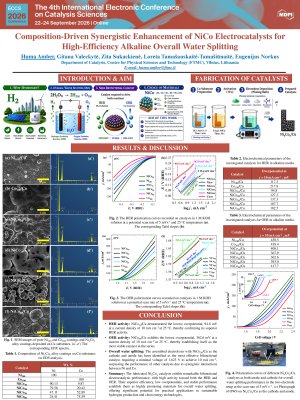
The development of inexpensive, highly efficient, and durable bifunctional electrocatalysts is crucial for large-scale hydrogen production through alkaline water splitting. NiCo-based catalysts have attracted significant interest due to their high catalytic activity and stability in alkaline solutions [1]. This study reports the fabrication of nickel-cobalt (NixCoy) bifunctional electrocatalysts with different compositions (Ni96Co4, Ni90Co10, Ni80Co20, Ni50Co50, and Ni20Co80) via electroless deposition on pretreated copper (Cu) substrates, where the Cu substrates were cleaned in HCl:H2O (1:1, v/v) and activated in a 0.5 g L-1 PdCl₂ solution before deposition. The morphology and composition of the catalysts were characterized using SEM, EDS, XRD, XPS, and ICP-OES. The electrocatalytic performance of the electrocatalysts toward HER and OER was evaluated in 1 M KOH using a three-electrode setup, while the OWS performance was assessed in a two-electrode system.
Among the catalysts, Ni90Co10/Cu exhibited the lowest overpotential of 94.8 mV at a current density of 10 mA cm-2 at 25 °C, confirming its superior HER activity. Ni50Co50/Cu showed the lowest overpotential of 362.6 mV at a current density of 10 mA cm-2 at 25 °C, indicating superior OER performance. An electrolyzer assembled with Ni50Co50/Cu as both the anode and cathode required a minimal voltage of 1.623 V to achieve a current density of 10 mA cm-2, outperforming all other compositions evaluated for OWS. Moreover, Ni50Co50 exhibited excellent HER durability in 1 M KOH, showing only a slight potential shift from -0.0554 to -0.0567 V vs. RHE over 15 h of chronopotentiometric testing at -10 mA cm-2. These results highlight the potential of NixCoy electrocatalysts for efficient overall water splitting and hydrogen production.
Reference:
Wang, X., Wang, T., Yu, Y., You, J., Hu, F., & Zhao, D. (2024). Enhancing the efficiency and stability of electrocatalysts for water splitting: NiCo-LDH nanosheet arrays at high current density. CrystEngComm, 26(37), 5144-5151.
Keywords
NiCo electrocatalyst
Alkaline overall water splitting
Hydrogen evolution reaction
Oxygen evolution reaction
Poster
Poster.pdf
Impact of europium doping on bismuth vanadate nanopowder's morphological, optical, and photocatalytic characteristics
Tailoring Structure–Activity Relationships in Ni and Ni₃Fe/Al₂O₃ Catalysts via Sol–Gel and Impregnation Routes for Enhanced Low-Temperature CO₂ Methanation