Event submissions
Published
This submission belongs to the session S3. Photocatalysis and Electrocatalysis of the event The 4th International Electronic Conference on Catalysis Sciences
Published date
16 Sep, 2026
Academic Editor
'%3e%3cpath%20d='M12.6657%2010.9104C12.4185%2010.325%2012.0599%209.79327%2011.6097%209.34482C11.1609%208.89508%2010.6293%208.5365%2010.0442%208.28888C10.0389%208.28626%2010.0337%208.28495%2010.0285%208.28233C10.8446%207.69279%2011.3752%206.73249%2011.3752%205.64904C11.3752%203.8542%209.92103%202.39999%208.1262%202.39999C6.33136%202.39999%204.87715%203.8542%204.87715%205.64904C4.87715%206.73249%205.40774%207.69279%206.22393%208.28364C6.21869%208.28626%206.21345%208.28757%206.20821%208.29019C5.62129%208.5378%205.09463%208.89284%204.64265%209.34613C4.1929%209.79493%203.83432%2010.3266%203.58671%2010.9117C3.34345%2011.4845%203.21226%2012.0987%203.20023%2012.7209C3.19988%2012.7349%203.20233%2012.7488%203.20744%2012.7619C3.21255%2012.7749%203.22022%2012.7867%203.22998%2012.7968C3.23975%2012.8068%203.25142%2012.8147%203.26431%2012.8202C3.2772%2012.8256%203.29105%2012.8284%203.30504%2012.8284H4.09109C4.14874%2012.8284%204.19459%2012.7825%204.1959%2012.7262C4.2221%2011.7148%204.62823%2010.7676%205.34617%2010.0497C6.08899%209.30683%207.0755%208.89808%208.1262%208.89808C9.17689%208.89808%2010.1634%209.30683%2010.9062%2010.0497C11.6242%2010.7676%2012.0303%2011.7148%2012.0565%2012.7262C12.0578%2012.7838%2012.1037%2012.8284%2012.1613%2012.8284H12.9474C12.9613%2012.8284%2012.9752%2012.8256%2012.9881%2012.8202C13.001%2012.8147%2013.0126%2012.8068%2013.0224%2012.7968C13.0322%2012.7867%2013.0398%2012.7749%2013.0449%2012.7619C13.0501%2012.7488%2013.0525%2012.7349%2013.0522%2012.7209C13.0391%2012.0947%2012.9094%2011.4855%2012.6657%2010.9104ZM8.1262%207.9024C7.52486%207.9024%206.9589%207.6679%206.53312%207.24211C6.10733%206.81633%205.87283%206.25037%205.87283%205.64904C5.87283%205.0477%206.10733%204.48174%206.53312%204.05596C6.9589%203.63018%207.52486%203.39567%208.1262%203.39567C8.72753%203.39567%209.29349%203.63018%209.71927%204.05596C10.1451%204.48174%2010.3796%205.0477%2010.3796%205.64904C10.3796%206.25037%2010.1451%206.81633%209.71927%207.24211C9.29349%207.6679%208.72753%207.9024%208.1262%207.9024Z'%20fill='%235D1EE1'/%3e%3c/g%3e%3c/svg%3e) Ioannis Konstantinou
Ioannis KonstantinouCitation
Irina Kuznetsova, Dmitry Kultin, Olga Lebedeva, Sergey Nesterenko, Leonid Kustov, NiCu bimetallic catalyst for improved electrochemical synthesis of ammonia from nitrates, in Proceedings of The 4th International Electronic Conference on Catalysis Sciences, 22 September–24 September 2026, MDPI: Basel, Switzerland
Share
Email
Facebook
Twitter
LinkedIn
NiCu bimetallic catalyst for improved electrochemical synthesis of ammonia from nitrates
'%3e%3cpath%20d='M12.6647%2010.9104C12.4176%2010.325%2012.0589%209.7933%2011.6088%209.34485C11.16%208.89511%2010.6283%208.53653%2010.0432%208.28891C10.038%208.28629%2010.0327%208.28498%2010.0275%208.28236C10.8437%207.69282%2011.3743%206.73252%2011.3743%205.64907C11.3743%203.85423%209.92005%202.40002%208.12522%202.40002C6.33038%202.40002%204.87618%203.85423%204.87618%205.64907C4.87618%206.73252%205.40677%207.69282%206.22296%208.28367C6.21772%208.28629%206.21248%208.2876%206.20724%208.29022C5.62031%208.53783%205.09365%208.89287%204.64167%209.34616C4.19192%209.79496%203.83334%2010.3266%203.58573%2010.9117C3.34247%2011.4846%203.21128%2012.0987%203.19925%2012.721C3.1989%2012.735%203.20135%2012.7489%203.20646%2012.7619C3.21157%2012.7749%203.21924%2012.7868%203.22901%2012.7968C3.23877%2012.8068%203.25045%2012.8148%203.26334%2012.8202C3.27623%2012.8256%203.29007%2012.8284%203.30406%2012.8284H4.09012C4.14776%2012.8284%204.19362%2012.7825%204.19493%2012.7262C4.22113%2011.7148%204.62726%2010.7676%205.34519%2010.0497C6.08802%209.30686%207.07452%208.89811%208.12522%208.89811C9.17592%208.89811%2010.1624%209.30686%2010.9052%2010.0497C11.6232%2010.7676%2012.0293%2011.7148%2012.0555%2012.7262C12.0568%2012.7839%2012.1027%2012.8284%2012.1603%2012.8284H12.9464C12.9604%2012.8284%2012.9742%2012.8256%2012.9871%2012.8202C13%2012.8148%2013.0117%2012.8068%2013.0214%2012.7968C13.0312%2012.7868%2013.0389%2012.7749%2013.044%2012.7619C13.0491%2012.7489%2013.0515%2012.735%2013.0512%2012.721C13.0381%2012.0947%2012.9084%2011.4856%2012.6647%2010.9104ZM8.12522%207.90243C7.52388%207.90243%206.95792%207.66793%206.53214%207.24215C6.10636%206.81636%205.87185%206.2504%205.87185%205.64907C5.87185%205.04773%206.10636%204.48177%206.53214%204.05599C6.95792%203.63021%207.52388%203.3957%208.12522%203.3957C8.72655%203.3957%209.29252%203.63021%209.7183%204.05599C10.1441%204.48177%2010.3786%205.04773%2010.3786%205.64907C10.3786%206.2504%2010.1441%206.81636%209.7183%207.24215C9.29252%207.66793%208.72655%207.90243%208.12522%207.90243Z'%20fill='%235D1EE1'/%3e%3c/g%3e%3c/svg%3e)
Irina Kuznetsova 1
Dmitry Kultin 1
Olga Lebedeva 1
Sergey Nesterenko 1

Leonid Kustov 1,2
1. Department of Chemistry, Lomonosov Moscow State University, Moscow, Russia
2. N.D. Zelinsky Institute of Organic Chemistry, Russian Academy of Sciences, Moscow, Russia
Abstract
Introduction
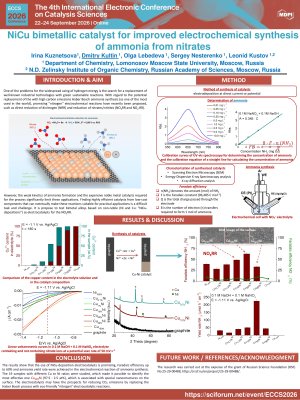
One of the problems for the widespread using of hydrogen energy is the search for a replacement of well-known industrial technologies with green sustainable reactions. With regard to the potential replacement of the with high carbon emissions Haber Bosch ammonia synthesis (as one of the most used in the world), promising "nitrogen" electrochemical reactions have recently been proposed, such as direct reduction of dinitrogen (NRR) and reduction of nitrates/nitrites (NO3RR and NO2-RR). However, the weak kinetics of ammonia formation and the expensive noble metal catalysts required for the process significantly limit these applications. Finding highly efficient catalysts from low-cost components that can eventually make these reactions suitable for practical applications is a difficult task and challenge. It is propose to test bimetal alloys based on non-noble (Ni and Cu: "NiCu-depositions") as electrocatalysts for the NO3RR.
Experimental
NiCu-deposition samples were produced by electrochemical co-deposition from aqueous solutions of the corresponding salts. The characterization of NiCu-deposition samples were used of SEM, EDX, XRD. The voltammetry and chronoamperometry were used to determine the conditions for the synthesis reactions of ammonia with use the Autolab PGSTAT302N and PS-20 potentiostats.
Results and Discussion
The results show that the use of NiCu-deposition electrocatalysts is promising, Faradaic efficiency up to 60% and ammonia yield rate were achieved in the electrochemical reaction of ammonia synthesis. The 19 samples with different Cu to Ni ratios were studied, which made it possible to identify the most effective one (97.5 : 2.5 at%), which is associated with special nanostructures on the surface. The electrocatalysts may have the prospects for reducing CO2 emissions by replacing the Haber Bosch process with eco-friendly "nitrogen" electrocatalytic reactions.
Acknowledgment.
The research was carried out at the expense of the grant of Russian Science Foundation (RSF) No 25-29-00488, https://rscf.ru/en/project/25-29-00488/.
Keywords
electrocatalysis
electrochemical ammonia synthesis
bimetallic catalyst
low-carbon technologies
sustainable chemistry
energy chemistry
Poster
Poster.pdf
Integrated Parametric, Kinetic, and In Situ DRIFTS Analysis of CO₂ Methanation over γ-Al₂O₃-Supported Ni–Fe and Rh Catalysts
Optimization of Combined Hydrothermal and Thermal Synthesis Conditions of g-C3N4 for Enhanced Photocatalytic Methane Production