Event submissions
Published
This submission belongs to the session S3. Photocatalysis and Electrocatalysis of the event The 4th International Electronic Conference on Catalysis Sciences
Published date
16 Sep, 2026
Academic Editor
'%3e%3cpath%20d='M12.6657%2010.9104C12.4185%2010.325%2012.0599%209.79327%2011.6097%209.34482C11.1609%208.89508%2010.6293%208.5365%2010.0442%208.28888C10.0389%208.28626%2010.0337%208.28495%2010.0285%208.28233C10.8446%207.69279%2011.3752%206.73249%2011.3752%205.64904C11.3752%203.8542%209.92103%202.39999%208.1262%202.39999C6.33136%202.39999%204.87715%203.8542%204.87715%205.64904C4.87715%206.73249%205.40774%207.69279%206.22393%208.28364C6.21869%208.28626%206.21345%208.28757%206.20821%208.29019C5.62129%208.5378%205.09463%208.89284%204.64265%209.34613C4.1929%209.79493%203.83432%2010.3266%203.58671%2010.9117C3.34345%2011.4845%203.21226%2012.0987%203.20023%2012.7209C3.19988%2012.7349%203.20233%2012.7488%203.20744%2012.7619C3.21255%2012.7749%203.22022%2012.7867%203.22998%2012.7968C3.23975%2012.8068%203.25142%2012.8147%203.26431%2012.8202C3.2772%2012.8256%203.29105%2012.8284%203.30504%2012.8284H4.09109C4.14874%2012.8284%204.19459%2012.7825%204.1959%2012.7262C4.2221%2011.7148%204.62823%2010.7676%205.34617%2010.0497C6.08899%209.30683%207.0755%208.89808%208.1262%208.89808C9.17689%208.89808%2010.1634%209.30683%2010.9062%2010.0497C11.6242%2010.7676%2012.0303%2011.7148%2012.0565%2012.7262C12.0578%2012.7838%2012.1037%2012.8284%2012.1613%2012.8284H12.9474C12.9613%2012.8284%2012.9752%2012.8256%2012.9881%2012.8202C13.001%2012.8147%2013.0126%2012.8068%2013.0224%2012.7968C13.0322%2012.7867%2013.0398%2012.7749%2013.0449%2012.7619C13.0501%2012.7488%2013.0525%2012.7349%2013.0522%2012.7209C13.0391%2012.0947%2012.9094%2011.4855%2012.6657%2010.9104ZM8.1262%207.9024C7.52486%207.9024%206.9589%207.6679%206.53312%207.24211C6.10733%206.81633%205.87283%206.25037%205.87283%205.64904C5.87283%205.0477%206.10733%204.48174%206.53312%204.05596C6.9589%203.63018%207.52486%203.39567%208.1262%203.39567C8.72753%203.39567%209.29349%203.63018%209.71927%204.05596C10.1451%204.48174%2010.3796%205.0477%2010.3796%205.64904C10.3796%206.25037%2010.1451%206.81633%209.71927%207.24211C9.29349%207.6679%208.72753%207.9024%208.1262%207.9024Z'%20fill='%235D1EE1'/%3e%3c/g%3e%3c/svg%3e) Carmelo Vecchio
Carmelo VecchioCitation
Hinata Suzuki, Hideyuki Katsumata, Ikki Tateishi, Mai Furukawa, Satoshi Kaneco, Efficient Visible-Light-Driven Dye Decolorization Using a Graphitic Carbon Nitride/Covalent Organic Framework Composite Photocatalyst., in Proceedings of The 4th International Electronic Conference on Catalysis Sciences, 22 September–24 September 2026, MDPI: Basel, Switzerland
Share
Email
Facebook
Twitter
LinkedIn
Efficient Visible-Light-Driven Dye Decolorization Using a Graphitic Carbon Nitride/Covalent Organic Framework Composite Photocatalyst.
'%3e%3cpath%20d='M12.6647%2010.9104C12.4176%2010.325%2012.0589%209.7933%2011.6088%209.34485C11.16%208.89511%2010.6283%208.53653%2010.0432%208.28891C10.038%208.28629%2010.0327%208.28498%2010.0275%208.28236C10.8437%207.69282%2011.3743%206.73252%2011.3743%205.64907C11.3743%203.85423%209.92005%202.40002%208.12522%202.40002C6.33038%202.40002%204.87618%203.85423%204.87618%205.64907C4.87618%206.73252%205.40677%207.69282%206.22296%208.28367C6.21772%208.28629%206.21248%208.2876%206.20724%208.29022C5.62031%208.53783%205.09365%208.89287%204.64167%209.34616C4.19192%209.79496%203.83334%2010.3266%203.58573%2010.9117C3.34247%2011.4846%203.21128%2012.0987%203.19925%2012.721C3.1989%2012.735%203.20135%2012.7489%203.20646%2012.7619C3.21157%2012.7749%203.21924%2012.7868%203.22901%2012.7968C3.23877%2012.8068%203.25045%2012.8148%203.26334%2012.8202C3.27623%2012.8256%203.29007%2012.8284%203.30406%2012.8284H4.09012C4.14776%2012.8284%204.19362%2012.7825%204.19493%2012.7262C4.22113%2011.7148%204.62726%2010.7676%205.34519%2010.0497C6.08802%209.30686%207.07452%208.89811%208.12522%208.89811C9.17592%208.89811%2010.1624%209.30686%2010.9052%2010.0497C11.6232%2010.7676%2012.0293%2011.7148%2012.0555%2012.7262C12.0568%2012.7839%2012.1027%2012.8284%2012.1603%2012.8284H12.9464C12.9604%2012.8284%2012.9742%2012.8256%2012.9871%2012.8202C13%2012.8148%2013.0117%2012.8068%2013.0214%2012.7968C13.0312%2012.7868%2013.0389%2012.7749%2013.044%2012.7619C13.0491%2012.7489%2013.0515%2012.735%2013.0512%2012.721C13.0381%2012.0947%2012.9084%2011.4856%2012.6647%2010.9104ZM8.12522%207.90243C7.52388%207.90243%206.95792%207.66793%206.53214%207.24215C6.10636%206.81636%205.87185%206.2504%205.87185%205.64907C5.87185%205.04773%206.10636%204.48177%206.53214%204.05599C6.95792%203.63021%207.52388%203.3957%208.12522%203.3957C8.72655%203.3957%209.29252%203.63021%209.7183%204.05599C10.1441%204.48177%2010.3786%205.04773%2010.3786%205.64907C10.3786%206.2504%2010.1441%206.81636%209.7183%207.24215C9.29252%207.66793%208.72655%207.90243%208.12522%207.90243Z'%20fill='%235D1EE1'/%3e%3c/g%3e%3c/svg%3e)
Hinata Suzuki 1
Hideyuki Katsumata 1,2
Ikki Tateishi 2
Mai Furukawa 1
Satoshi Kaneco 1
1. Department of Applied Chemistry, Graduate School of Engineering, Mie University, Tsu, Mie, Japan
2. Center for Global Environment Education & Research, Mie University, Tsu, Mie, Japan
Abstract
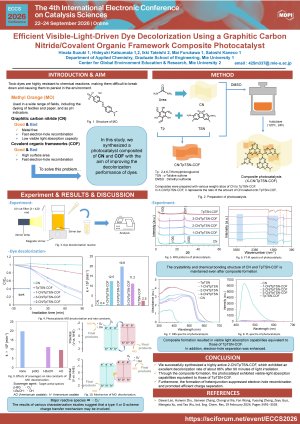
With recent industrial development, water pollution caused by industrial wastewater containing organic dyes has become a serious problem. For this reason, heterogeneous photocatalysis, which can degrade organic pollutants using sunlight, is attracting attention as a low-cost, environmentally friendly water treatment technology. Graphitic carbon nitride (CN) is a metal-free organic photocatalyst that is chemically and thermally stable and can be prepared simply. However, its limited visible light absorption capacity and rapid electron-hole pair recombination remain challenges. In this study, we aimed to achieve highly efficient decolorization of organic dyes by combining CN and covalent organic frameworks (COF) to improve charge separation efficiency and visible-light responsiveness.
The photocatalyst was prepared using the following procedure. Urea was placed in a crucible and fired in an electric furnace to obtain CN. CN and 3,7-diamino-2,8-dimethyldibenzothiophene sulfone (TSN) were added to dimethyl sulfoxide (DMSO) and processed by ultrasonication. 1,3,5-triformylphloroglucinol (Tp) was added, and a composite photocatalyst (CN/TpTSN-COF) was obtained using a hydrothermal synthesis method involving an autoclave. In the decolorization experiment, a xenon lamp was used as the light source, and light with a wavelength of 420 nm or longer was irradiated to the reaction solution. Samples of the reaction solution were taken at regular intervals, and the absorbance was measured using a UV-visible spectrophotometer.
Characterization using XRD and FT-IR confirmed the basic structures of CN and TpTSN-COF. Based on the DRS and PL measurement results, it was confirmed that the incorporation of TpTSN-COF led to a broadening of the light absorption range and a shift toward shorter wavelengths in the fluorescence spectrum. This indicates that charge separation between CN and TPTSN-COF was promoted, while recombination was suppressed. Furthermore, the results of the decolorization experiments showed that CN/TpTSN-COF exhibited a faster decolorization rate compared to the individual components.
Keywords
photocatalyst
dye decolorization
graphitic carbon nitride
covalent organic frameworks
Poster
4thECCS Poster Hinata Suzuki Mie university.pdf
Optimization of Combined Hydrothermal and Thermal Synthesis Conditions of g-C3N4 for Enhanced Photocatalytic Methane Production
Chitosan-based Cryogels Containing Copper Nanoparticles as Efficient Heterogeneous Catalysts for Hydrogenation of 4-Nitrophenol