Event submissions
Published
This submission belongs to the session S3. Photocatalysis and Electrocatalysis of the event The 4th International Electronic Conference on Catalysis Sciences
Published date
16 Sep, 2026
Academic Editor
'%3e%3cpath%20d='M12.6657%2010.9104C12.4185%2010.325%2012.0599%209.79327%2011.6097%209.34482C11.1609%208.89508%2010.6293%208.5365%2010.0442%208.28888C10.0389%208.28626%2010.0337%208.28495%2010.0285%208.28233C10.8446%207.69279%2011.3752%206.73249%2011.3752%205.64904C11.3752%203.8542%209.92103%202.39999%208.1262%202.39999C6.33136%202.39999%204.87715%203.8542%204.87715%205.64904C4.87715%206.73249%205.40774%207.69279%206.22393%208.28364C6.21869%208.28626%206.21345%208.28757%206.20821%208.29019C5.62129%208.5378%205.09463%208.89284%204.64265%209.34613C4.1929%209.79493%203.83432%2010.3266%203.58671%2010.9117C3.34345%2011.4845%203.21226%2012.0987%203.20023%2012.7209C3.19988%2012.7349%203.20233%2012.7488%203.20744%2012.7619C3.21255%2012.7749%203.22022%2012.7867%203.22998%2012.7968C3.23975%2012.8068%203.25142%2012.8147%203.26431%2012.8202C3.2772%2012.8256%203.29105%2012.8284%203.30504%2012.8284H4.09109C4.14874%2012.8284%204.19459%2012.7825%204.1959%2012.7262C4.2221%2011.7148%204.62823%2010.7676%205.34617%2010.0497C6.08899%209.30683%207.0755%208.89808%208.1262%208.89808C9.17689%208.89808%2010.1634%209.30683%2010.9062%2010.0497C11.6242%2010.7676%2012.0303%2011.7148%2012.0565%2012.7262C12.0578%2012.7838%2012.1037%2012.8284%2012.1613%2012.8284H12.9474C12.9613%2012.8284%2012.9752%2012.8256%2012.9881%2012.8202C13.001%2012.8147%2013.0126%2012.8068%2013.0224%2012.7968C13.0322%2012.7867%2013.0398%2012.7749%2013.0449%2012.7619C13.0501%2012.7488%2013.0525%2012.7349%2013.0522%2012.7209C13.0391%2012.0947%2012.9094%2011.4855%2012.6657%2010.9104ZM8.1262%207.9024C7.52486%207.9024%206.9589%207.6679%206.53312%207.24211C6.10733%206.81633%205.87283%206.25037%205.87283%205.64904C5.87283%205.0477%206.10733%204.48174%206.53312%204.05596C6.9589%203.63018%207.52486%203.39567%208.1262%203.39567C8.72753%203.39567%209.29349%203.63018%209.71927%204.05596C10.1451%204.48174%2010.3796%205.0477%2010.3796%205.64904C10.3796%206.25037%2010.1451%206.81633%209.71927%207.24211C9.29349%207.6679%208.72753%207.9024%208.1262%207.9024Z'%20fill='%235D1EE1'/%3e%3c/g%3e%3c/svg%3e) Ioannis Konstantinou
Ioannis KonstantinouCitation
Rin Shirafuji, Mai Furukawa, Ikki Tateishi, Hideyuki Katsumata, Satoshi Kaneco, Enhanced dye decolorization over metal-loaded Bi₂WO₆/g-C₃N₄ heterojunctions, in Proceedings of The 4th International Electronic Conference on Catalysis Sciences, 22 September–24 September 2026, MDPI: Basel, Switzerland
Share
Email
Facebook
Twitter
LinkedIn
Enhanced dye decolorization over metal-loaded Bi2WO6/g-C3N4 heterojunctions
'%3e%3cpath%20d='M12.6647%2010.9104C12.4176%2010.325%2012.0589%209.7933%2011.6088%209.34485C11.16%208.89511%2010.6283%208.53653%2010.0432%208.28891C10.038%208.28629%2010.0327%208.28498%2010.0275%208.28236C10.8437%207.69282%2011.3743%206.73252%2011.3743%205.64907C11.3743%203.85423%209.92005%202.40002%208.12522%202.40002C6.33038%202.40002%204.87618%203.85423%204.87618%205.64907C4.87618%206.73252%205.40677%207.69282%206.22296%208.28367C6.21772%208.28629%206.21248%208.2876%206.20724%208.29022C5.62031%208.53783%205.09365%208.89287%204.64167%209.34616C4.19192%209.79496%203.83334%2010.3266%203.58573%2010.9117C3.34247%2011.4846%203.21128%2012.0987%203.19925%2012.721C3.1989%2012.735%203.20135%2012.7489%203.20646%2012.7619C3.21157%2012.7749%203.21924%2012.7868%203.22901%2012.7968C3.23877%2012.8068%203.25045%2012.8148%203.26334%2012.8202C3.27623%2012.8256%203.29007%2012.8284%203.30406%2012.8284H4.09012C4.14776%2012.8284%204.19362%2012.7825%204.19493%2012.7262C4.22113%2011.7148%204.62726%2010.7676%205.34519%2010.0497C6.08802%209.30686%207.07452%208.89811%208.12522%208.89811C9.17592%208.89811%2010.1624%209.30686%2010.9052%2010.0497C11.6232%2010.7676%2012.0293%2011.7148%2012.0555%2012.7262C12.0568%2012.7839%2012.1027%2012.8284%2012.1603%2012.8284H12.9464C12.9604%2012.8284%2012.9742%2012.8256%2012.9871%2012.8202C13%2012.8148%2013.0117%2012.8068%2013.0214%2012.7968C13.0312%2012.7868%2013.0389%2012.7749%2013.044%2012.7619C13.0491%2012.7489%2013.0515%2012.735%2013.0512%2012.721C13.0381%2012.0947%2012.9084%2011.4856%2012.6647%2010.9104ZM8.12522%207.90243C7.52388%207.90243%206.95792%207.66793%206.53214%207.24215C6.10636%206.81636%205.87185%206.2504%205.87185%205.64907C5.87185%205.04773%206.10636%204.48177%206.53214%204.05599C6.95792%203.63021%207.52388%203.3957%208.12522%203.3957C8.72655%203.3957%209.29252%203.63021%209.7183%204.05599C10.1441%204.48177%2010.3786%205.04773%2010.3786%205.64907C10.3786%206.2504%2010.1441%206.81636%209.7183%207.24215C9.29252%207.66793%208.72655%207.90243%208.12522%207.90243Z'%20fill='%235D1EE1'/%3e%3c/g%3e%3c/svg%3e)
Rin Shirafuji 1
Mai Furukawa 1
Ikki Tateishi 2
Hideyuki Katsumata 1,2
Satoshi Kaneco 1
1. Department of Applied Chemistry, Graduate School of Engineering, Mie University, Tsu, Mie, Japan
2. Center for Global Environment Education & Research, Mie University, Tsu, Mie, Japan
Abstract
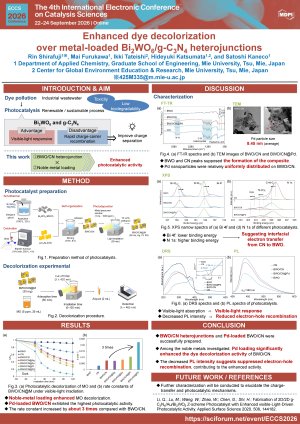
In recent years, the development of environmentally friendly visible-light-responsive photocatalysts has attracted significant attention for water purification applications. Among them, Bi2WO6 (BWO) and g-C3N4 (CN) are considered promising photocatalytic materials due to their visible-light response, suitable band structures, and high chemical stability. However, their photocatalytic activities of these single-component systems are limited by the rapid recombination of photogenerated charge carriers. Therefore, improving charge separation is essential for enhancing photocatalytic performance. In this study, a BWO/CN heterojunction was constructed, and metal species (1 wt%) were further loaded onto the photocatalyst surface to enhance photocatalytic activity through improved charge separation.
BWO was synthesized via a one-pot solvothermal method using ethylene glycol, while CN was prepared by calcination of urea. Subsequently, BWO/CN was fabricated through a self-assembly process, followed by metal loading via a photodeposition method to obtain BWO/CN@M (M = Pt, Au, Pd, and Ag). The photocatalytic performance was evaluated by the degradation of methyl orange (5 mg L-1, 35 mL) under a 500 W Xe lamp equipped with a cut-off filter (λ ≥ 420 nm).
The results showed that pristine BWO exhibited almost no decolorization, whereas CN achieved a decolorization efficiency of approximately 35 % after 120 min. The efficiency further increased to about 60 % for BWO/CN and reached approximately 90 % for BWO/CN@Pd. XRD and FT-IR analyses confirmed that the crystal structures and chemical bonding states of BWO and CN were maintained in BWO/CN@Pd. In addition, XPS and EDS analyses suggested the successful loading of Pd onto the photocatalyst surface. Furthermore, PL measurements revealed that BWO/CN@Pd exhibited the lowest emission intensity, indicating effective suppression of photogenerated charge carrier recombination. These results suggest that the enhanced photocatalytic activity mainly originates from the synergistic effects of heterojunction formation and improved charge separation induced by Pd loading.
Keywords
Bismuth tungstate
Graphitic carbon nitride
Photodeposition of metal
Dye decolorization
Poster
ECCS2026_shirafuji_Mie university.pdf
Green synthesis of bimetallic nanocomposite and its applications
Predicting Optimal Catalyst Design for Selective Catalytic Reduction