Event submissions
Published
This submission belongs to the session S2. Environmental Catalysis of the event The 4th International Electronic Conference on Catalysis Sciences
Published date
16 Sep, 2026
Academic Editor
'%3e%3cpath%20d='M12.6657%2010.9104C12.4185%2010.325%2012.0599%209.79327%2011.6097%209.34482C11.1609%208.89508%2010.6293%208.5365%2010.0442%208.28888C10.0389%208.28626%2010.0337%208.28495%2010.0285%208.28233C10.8446%207.69279%2011.3752%206.73249%2011.3752%205.64904C11.3752%203.8542%209.92103%202.39999%208.1262%202.39999C6.33136%202.39999%204.87715%203.8542%204.87715%205.64904C4.87715%206.73249%205.40774%207.69279%206.22393%208.28364C6.21869%208.28626%206.21345%208.28757%206.20821%208.29019C5.62129%208.5378%205.09463%208.89284%204.64265%209.34613C4.1929%209.79493%203.83432%2010.3266%203.58671%2010.9117C3.34345%2011.4845%203.21226%2012.0987%203.20023%2012.7209C3.19988%2012.7349%203.20233%2012.7488%203.20744%2012.7619C3.21255%2012.7749%203.22022%2012.7867%203.22998%2012.7968C3.23975%2012.8068%203.25142%2012.8147%203.26431%2012.8202C3.2772%2012.8256%203.29105%2012.8284%203.30504%2012.8284H4.09109C4.14874%2012.8284%204.19459%2012.7825%204.1959%2012.7262C4.2221%2011.7148%204.62823%2010.7676%205.34617%2010.0497C6.08899%209.30683%207.0755%208.89808%208.1262%208.89808C9.17689%208.89808%2010.1634%209.30683%2010.9062%2010.0497C11.6242%2010.7676%2012.0303%2011.7148%2012.0565%2012.7262C12.0578%2012.7838%2012.1037%2012.8284%2012.1613%2012.8284H12.9474C12.9613%2012.8284%2012.9752%2012.8256%2012.9881%2012.8202C13.001%2012.8147%2013.0126%2012.8068%2013.0224%2012.7968C13.0322%2012.7867%2013.0398%2012.7749%2013.0449%2012.7619C13.0501%2012.7488%2013.0525%2012.7349%2013.0522%2012.7209C13.0391%2012.0947%2012.9094%2011.4855%2012.6657%2010.9104ZM8.1262%207.9024C7.52486%207.9024%206.9589%207.6679%206.53312%207.24211C6.10733%206.81633%205.87283%206.25037%205.87283%205.64904C5.87283%205.0477%206.10733%204.48174%206.53312%204.05596C6.9589%203.63018%207.52486%203.39567%208.1262%203.39567C8.72753%203.39567%209.29349%203.63018%209.71927%204.05596C10.1451%204.48174%2010.3796%205.0477%2010.3796%205.64904C10.3796%206.25037%2010.1451%206.81633%209.71927%207.24211C9.29349%207.6679%208.72753%207.9024%208.1262%207.9024Z'%20fill='%235D1EE1'/%3e%3c/g%3e%3c/svg%3e) Albin Pintar
Albin PintarCitation
Hugo M Lapa, Elisabete Alegria, Luísa Martins, Selective Alcohol and Hydrocarbon oxidation using new C-Scorpionate Cu(II) and Fe(III) catalysts: Synthesis, activity, and Mechanistic Insights, in Proceedings of The 4th International Electronic Conference on Catalysis Sciences, 22 September–24 September 2026, MDPI: Basel, Switzerland
Share
Email
Facebook
Twitter
LinkedIn
Selective Alcohol and Hydrocarbon oxidation using new C-Scorpionate Cu(II) and Fe(III) catalysts: Synthesis, activity, and Mechanistic Insights

Hugo M Lapa 1,2,3

Elisabete Alegria 1,3

Luísa Martins 1,2
1. Centro de Química Estrutural, Institute of Molecular Sciences, Instituto Superior Técnico, University of Lisbon, Lisbon, Portugal
2. Chemical Engineering Department, Instituto Superior Técnico, University of Lisbon, Lisbon, Portugal
3. Chemical Engineering Department, Instituto Superior de Engenharia de Lisboa, Lisbon Polytechnic, Lisbon, Portugal
Abstract
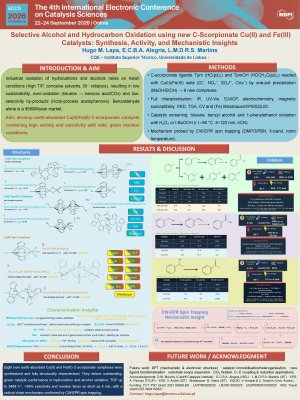
The selective oxidation of C–H bonds and alcohols remains one of the central challenges in sustainable synthetic chemistry, as it often requires harsh conditions, including high temperatures and elevated pressures. Developing earth-abundant metal catalysts capable of high activity under mild, environmentally benign conditions is a critical research priority. The C-scorpionate pro-ligands, when combined with first-row transition metals, can act as homogeneous catalysts for several reactions, including the oxidation of cycloalkanes under mild conditions, prompting us to investigate the pro-ligand's versatility. Herein, we report the synthesis and catalytic evaluation of a novel series of C-scorpionate Cu(II) and Fe(III) complexes for the oxidation of toluene, benzyl alcohol, and 1-phenylethanol. The new complexes were fully characterized using several techniques, including IR, XRD, cyclic voltammetry, TGA, magnetic susceptibility, UV-Vis, XPS, and Mössbauer spectroscopy. Under optimized, environmentally friendly conditions, these complexes deliver outstanding performance: TOFs of 5488 h⁻¹ (Cu) and 4925 h⁻¹ (Fe) for secondary alcohol oxidation, and selectivity exceeding 90% for benzaldehyde in primary alcohol transformations. These results were obtained under mild conditions, with a low catalytic load, and over short reaction times. Using CW-EPR spin-trap spectroscopy, we identify the key radical intermediates that intervene in the catalytic cycle, providing mechanistic insight into the reaction pathway for the oxidation of toluene and benzyl alcohol.
Keywords
Coordination Compounds
C-scorpionate complexes
Oxidation Reactions
Transition Metal complexes
Green Chemistry
Poster
Poster_hugoLapa.pdf
Predicting Optimal Catalyst Design for Selective Catalytic Reduction
Design and Construction of an Ag₃PO₄/Sepiolite/Fe-MOF Hybrid Photocatalyst for Efficient Removal of Ciprofloxacin from Aqueous Environments under Visible Light